Tag Archives: rifle scope

New iAiming iA-612 Thermal Scope

I have very little experience with thermal optics because they’re so damn expensive. But what I do know is that cheap thermal scopes are pretty much a waste of time. I stopped by the iAiming booth because it was literally across the isle after my visit to Athlon and it was well worth my effort.

iAiming is an Australian based company with US sales offices in Texas. The showed me their newest scope, the iA612 which MSRP’s for $5799 with a street price closer to $5500. One of the nice things about SHOT Show is getting hands on with products I in no way can hope to afford.

The ia-612 has a digital zoom from 2.4x-19.2x and a digital viewfinder with 1024×768 resolution. It offers the user the ability to range find and to choose one of 6 different reticle types. It has built-in WiFi which allows you to broadcast the scope’s view a phone App so your friends can see real time scope views and potentially spot for you.

The newest feature that iAming was showcasing with the ia-612 is an automatic 1-shot zero feature. When you set it up on the onboard menu, the self-zero feature detects the heat signature that a bullet leaves on a paper target. The scope will automatically re-zero the reticle to that hole and Bobs your uncle, you’re zero’d out. That’s something I’d like to test out myself.

Short Elon Musk randomly gifting 1000 shares of Tesla to Twitter users with “moon” and “dog”in their handle, it’s not likely I’ll get a chance to test one myself. There is hope that iAiming might send me an evaluation model but we’ll see.

This scope is available on Optic Planet using my Affiliate Link: https://shrsl.com/3yk3j

Xaegis Bore Sighter Kit

I’ve used various laser bore sighter devices to help me zero out a new scope but they can be a bit finicky and more than once, the battery died. Xaegis Tactical sent me a an traditional non-electronic bore sighter to test. These optical bore sighters sits on the end of your barrel and provide an alignment grid on visible when looking through your scope.

The kit comes with a 12 different caliber adapters, from .17 cal to .50 cal and a 20 ga-12ga shotgun bore adapter. These adapter arbor stems screw into the optical lens unit and are then fitted into your bore. Looking through your scope, you are presented with a 20×20 grid to help you align the reticle of your scope.

In my testing, using the kit on a Ruger 10/22 firing Aguila Super Extra High Velocity 40gr CPRN, was able to get on paper (30″x36″ paper target) at 100yrds. The impacts were low and to the left of bullseye by 15″-20″. This is not unexpected as target distance, barrel type, and bullet ballistics will alter the impact point from dead center of your bore. But being able to get on paper with my first shot meant I could easily make fine adjustments to zero out the scope.

Available on Amazon. Help support my videos buy using my a Affiliate link https://amzn.to/3XwKzA1

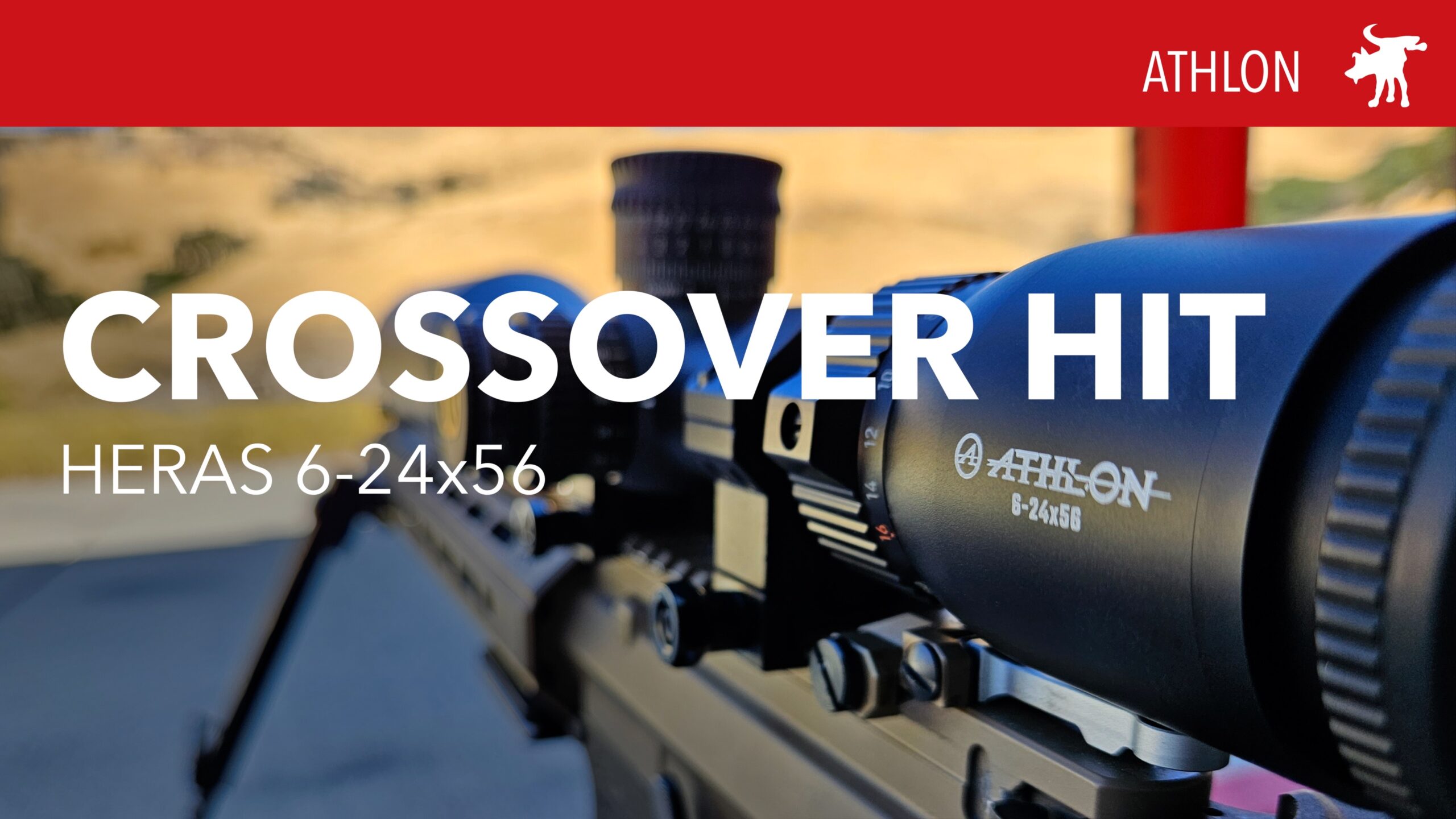
New Athlon Heras scopes

Athlon Optics already had a broad line of rifle scopes from budget (Talos) to high end PRS (Cronus) and Tactical scopes (Ares), and hunter (Midas). So it was surprising to find that they were coming out with a whole new line called Heras named for the Greek god and wife of Zeus.

The Heras are being called “crossover” scopes because these scopes combine the reticles and glass found in their PRS scopes, hunting features from their Midas, but with a minimum focus distance of 10yrds. This close range usability makes the Heras appealing to precision rimfire, airgun hunters or even airsoft players. The Heras will occupy a mid-tier price point of with an MSRP ranging from $500-$700.

New Arken EPL-4

The first thing most experienced shooters remark on the Arken EPL-5 and SH-4, apart from the low price, is the weight. For all the features you get in a sub $600 scope, the one thing you don’t want more of is weight. Compared to a similar magnification Vortex, Athlon, or higher end scope, Arkens are heavier. This isn’t much of an issue for benchrest or even NRL or PRS shooters but it certainly was a deal breaker for most hunters.

Arken listened to the feedback and came up with a new line of scopes with an “L” in their name for “light weight”. The new 6-24×50 EPL-4 shaves off 16oz of weight compared to a 5-25×56 ELP-5. That weight savings comes with a trade off a smaller range of adjustment due to its smaller objective lens and tube. But along with its capped windage turret, this 1-pound weight saving should make this new scope attractive to back-country hunters and most competition shooters alike.

I look forward to testing the EPL-4 later this year.

The Best Leupold Scope for NRL22?

While visiting the Leupold booth at Shot Show 2023, I asked John Snodgrass which scope he would recommend for NRL22 and without hesitation he said any of the Mark 5HD line, because it offered the highest quality optical clarity for small rimfire projectiles, along with the widest variety of reticle design to suit most NRL22 shooters.

The MK5 HD is available through my Amazon Affiliate link: https://amzn.to/3R0mcsO

Falling Plates Rifle 12/18/22

I tied for 3rd place in my first Falling Plates rifle competition hosted by the Coyote Point Rifle and Pistol Club. For the match I wanted to try out the Monstrum Spectre LPVO I recently reviewed. It’s the perfect type of optic to use for these short to medium range action shooting competitions. It offers a wide field of view of a 1x red dot with the ability to dial up the magnification as the engagement distances pushed out from 30 yards to 45 yards.

I had competed in a Falling Plates pistol competition a few months so was somewhat familiar with the format but this was my first rifle match which was a little different. This match involved 2 back-to-back rounds of shooting six 6″ steel plates. Each shooter was limited to 6 cartridges of ammunition, so any miss meant an a lower score. The shooting string had to be completed within 10 secs at 30 yards, 11 secs at 35 yards, 12 secs at 40 yards, and 13 secs at 45 yards. The target distance increased after each stage.

I rarely managed a perfect round, missing at last 1 plate every time. I rushed the last shots. I failed to properly pace myself and give myself the maximum aiming time. Often my last shot was a miss and 2-3 seconds would elapse before the timer ran out, which meant that I should have used those precious extra seconds to take more careful aim.

Steve, the other shooter who I tied with had the same complaint of his performance. We both had the pistol competition in mind which only allowed half the time to a complete each round. I hope I’ll know better next time.

The biggest surprise of the day was how well the Monstrum Spectre 1-6×24 LPVO worked during the match. In my previous target testing, I had some concerns that the Spectre’s thin target-style reticle wouldn’t provide sufficient visual boldness to quickly sight a target. But with the reticle illumination turned on to medium power, it easily allowed me to acquire a sight picture. I take back every negative comment I made about it.

Don’t be afraid of the Monstrum Spectre 1-6×24

Chances are if there’s a scope on an AR at the range, that scope is going to be an LPVO (Low Power Variable Optic). LPVO’s are a cross between a traditional 6-10x magnified rifle scope and a red dot because LPVO’s have a low end of 1x, 1.2x, or similar. An LPVO allows you to use them with both eyes opened to quickly engage targets up close at 1x and crank up the magnification to engage targets at 200yrs or more (and especially helpful for older eyesight).

Monstrum is a Southern California based importer and designer of tactical accessories and red dots. I’ve helped install one of their scope rings on a friend’s rifle and was impressed that it had features like Torx screws and recoil lugs. I was aware of the Monstrum brand but didn’t know much about it so I was surprised when Monstrum reached out to me and offered to have me test and evaluate their newest LPVO, the Spectre 1-6x24mm.

The Spectre ships with some nice accessories like flip up lens caps, a kill-flash filter, and one of Monstrum’s excellent cantilever offset mounts. The scope has a 30mm tube, is made of 6061 aluminum, and is nitrogen purged. On initial inspection, the body and components appeared solidly constructed and well made, though I did find some nicks and rough edges on the magnification wheel which was disappointing.

The other big disappointment was that the elevation turret’s MOA markings didn’t line up with the the scope center indicator. This is common with budget scopes and has even been known to occur with better known scopes but it’s always disappointing when it happens. The windage was spot on to the zero so it’s not like Monstrum’s factory couldn’t make better built turrets.

The turrets are 1/2 MOA per click and the clicks were moderately audible and tactile positive though soft. There was a bit of slop in the elevation clicks but when pushed down, they did lock solidly. Both turrets are resettable with a coin.

The magnification dial turned smoothly but was difficult to turn. An LPVO’s central benefit is that it is the word “variable” so not being able to change you magnification easily is beyond frustrating. Thankfully it does have a large fin that helps assist in leveraging the dial but only time will tell how quickly it will loosen up?

The scope has an illumination knob opposite the windage. It is CR2032 powered with 5 brightness settings in red and green which illuminates the center octagon and dot of its MX1 Reticle. The reticle has thick outer T-style hunter crosshair lines a very thin and fine central crosshairs with MOA hashmarks. I found this central reticle structure too faint to use for action shooting without full illumination.

The scope itself performed quite well in my range tests. It has a decent 4″ eye-relief and the forgiving eye-box typical of lower power scopes. It returned to zero in my box test and probably passed my nipple-twister turret test but my results were not definitive.

In target testing at 25yrds it was able to hold its zero after being subjected to repeated hits from my polymer ammo can to simulate heavy recoil. In practical tests with rapid fire on steel plates, I was able to quickly and accurately place my shots (any misses were entirely shooter error). But as mentioned earlier, I found the reticle was too thin to use without illumination.

I came in with low expectations because I really didn’t know Monstrum’s optical products. In overall build and performance the Spectre lives up to the quality and value of Monstrum’s scope mounts and accessories. If you’re hesitant of trying a Monstrum because of their lack of reputation in optics, consider that the Spectre has a street price under $200 and a lifetime warranty from a US based company, and don’t be afraid of this monster value.

This scope is available on Amazon through my affiliate link: https://amzn.to/3EOPEN1

RESOLUTION (50yrds)
Element: 2 / Group: -2

OVERALL RATINGS (out 5)
Build: 4
Glass: 4
Reticle: 3
Holds Zero: 5
Box Test: 4
Turrets: 2
Eye Box: 4
Value: 3


Oneleaf NV100 Night Vision

Night vision (light enhancing) scopes have been used by hunters and soldiers since the Vietnam War but even today these devices can cost thousands of dollars. With progress of technology, these devices have shrunk in both size and price. The Commander NV100 is a digital video camera that is designed to mount directly onto a typical rifle scope and turn it into a night vision scope. Oneleaf technologies sent me an NV100 to test out.

Almost all digital video cameras can see in IR light but most have a built-in optical filter that block out most IR light which can distort and fog an image in normal light. Using the NV100, you are looking at its built in digital display viewfinder much like you would with an old-school video camera. In fact, when using the NV100 in normal light, the image looks slightly blown out with a glow on objects, a side-effect of IR light.

The NV100 can record 1080p videos and photos onto a micro-SD card. It runs of a rechargeable CR18650 battery which can be recharged using a micro-USB cable. The unit can also record sound and output though a 3.5mm headphone jack, though the audio sounds compressed and low fidelity.

In practice the NV100 is equivalent to a Gen 1.5 night vision monocular. To a small degree it can passively enhance low-light images but in reality, it does require IR illumination to function as intended. The unit has a built-in IR illuminator and visible red laser to light up and aim at targets.

The NV100 can be used as a hand-held Night Vision monocular. It has a standard 1/4(20) camera screw mount at its base to allow the unit to be mounted on photo tripods. OneLeaf does not offer any type mounting system or adapter to attach it to a helmet or headband.

Where the NV100 shines is its ease of mounting to a rifle scope. The packing includes a 42mm, 45mm, and a 48mm adapter collar to allow you to mount it to your scope (some spotting eye-pieces may be too large even for the 48mm adapter). The NV100 attaches to the collar via bayonet style locking ring; the package also includes a roll of electrical tape to assist in shimming your eye-piece to provide a more secure fit for the adapter collar.

When mounted to a rifle scope, the image you see in the NV100 appears like a low-resolution videocam viewfiender. The unit’s menu system is accessed through the viewfinder and the buttons on the unit function like a D-pad for navigation through the menu system. Adjustments in focus are made through the NV100 large physical focus knob.

I could get a decent focus of an object 100yrds away but I could not get both my target and the reticle in the same plane of focus, despite adjusting the scope’s paralax focus, ocular focus, and the NV100’s focus. I could get both somewhat in focus at my scopes lowest magnification (4x) but found it impossible at magnifications greater than 6x.

I was easily able to see objects 100yrds in low light and even faintly in pitch-black in its full-color video mode. Switching to B&W mode activates the unit’s built-in IR illuminator, an IR LED flashlight with a lens that allows you to adjust the beam from flood to focused. Oneleaf claims it can illuminate objects up to 300m away.

In B&W IR mode, the issues with depth-of-focus were even more pronounced. The reticle was blurred to the point of invisibility when my scope was at 20x magnification. Given that IR illuminators are far shorter range than visible light flashlights, long range engagements using a scope and the NV100 may be a moot point though some users have posted varmint hunts at ranges out to 200yrds or more.

The NV100 does have two shortcomings, the first one is a potentially a deal-breaker for some hunters. In my testing the NV100 has a short 1.5″-2″ eye-relief from the back of its eyepiece (OneLeaf claims up to 2.75″). This is fine for shooting 22LR or even 5.56mm AR’s. But on a large caliber rifle this short eye-relief could easily cause scope bite. OneLeaf does include some larger eye-cups which could provide more padding but a real solution would be to design a viewfinder eyepiece with a minimum of 3″ of eye-relief.

The second issue is minor but annoying. The image the NV100 displays is distorted, with the vertical proportions appearing shorter than the horizontal giving you a squashed image of your target. This is also evident in the movies and photos you take with the NV100.

Overall the Commander NV100 works as advertised without breaking the bank (though the latter is relative the cost of higher-end NV systems costing hundreds more). On my wish-list of improvements would be a firmware update to allow adjustment of X/Y proportions of the image, a lanyard loop to attach a wrist or neck lanyard for handheld use, and an adapter arm to attach it to a GoPro or PVS-14 mount.

The OneLeaf Commander NV100 is available through this Amazon Affiliate link: https://amzn.to/4kMPrO6

Athlon Midas Tac HD 6-24×50 FFP

Athlon is known for making excellent quality scopes nearly on par with big brands such as Vortex and Burris but at a more reasonable price. Case in point, the Midas Tac has a winning combination of sharp and bright optics, a solid build, and quality turrets, and a transferable life-time warranty.

The “Tac” in Midas Tac is its ‘tactical-style’ exposed elevation turret for quick dope adjustments (with zero stop). And unusually, it has a different ‘hunting-style’ capped windage turret. This is to address a complaint among hunters and some competition shooters, that an exposed (non-locking) windage turret can be too easily, accidentally adjusted when grasping a rifle by the scope or simply resting your palm on the scope while manipulating the elevation turret.

The turrets were clear and simple to read. They had nicely loud clicks and were tactile positive. Both could be zero-reset by lifting the turret using a coin screw

The elevation turret has Athlon’s brass zero-stop which forms a ring around the inner turret pillar. The ring can be rotated into position and is locked with 3 worm/set screws after the user has set their zero. This engages with a fixed gear tooth at the base of the turret providing a solid and reliable stop. A small Allen key is included in the box.

I should also mention, not much is included in the box aside from the turret lock set screws kit, user manual, and scope. This is in line with many “high-end” scope models which eschew accessories like lens caps, sunshades, and throw levers; but a simple rubber lens bra would have been nice.

Concerning throw levers, the magnification dial has a small thumb fin but no screw hole for an optional lever. Nor does Athlon sell a slip-on throw lever as an accessory. Athlon should consider this feature as throw levers have become nearly standard for many competition shooters; if this model is to appeal to that market.

Optically, the Midas punches above its weight. While it did exhibit some slight chromatic aberration, it is bright, with good contrast and excellent resolution. I was able to make out Element 5 in Group -1 on my 8.5″x11″ USAF-51 optical resolution chart at 100yrds. This puts it on par with the more expensive Leupold Mk3 or Vortex Viper FFP.

What the scope lacks is an illuminated reticle, which may be one of the reasons it is hundreds less than Athlon’s Ares. Lacking one may be a deal-breaker for hunters in dusk/dawn situations. This omission is odd if this scope was intended for the hunting market (remember that capped turret). For the range shooter who doesn’t need or use reticle illumination, this scope is a step up in image quality from budget scopes in the $500-$600 price tier.

This Midas Tac HD 6-24×50 FFP was sent to me by Athlon for testing. It is available on Amazon through my affiliate link: https://amzn.to/3dYNfG6

RESOLUTION

Element: 5
Group: -1

MANUFACTURER SPECS

GLASS TYPE: HD
OBJ. LENS: 50 mm
TUBE DIAMETER: 30 mm
GAS PURGED: Argon
EYE RELIEF: 3.7″
FOV @ 100 YDS: 17.8 – 4.6 ft
PARALLAX: 10 YDS – ∞
CLICK VALUE: 0.1 MIL
ADJ/ROTATION: 10 MIL
TOTAL ELEV ADJ: 25 MIL
TOTAL WIND ADJ: 25 MIL
LENGTH: 14.6″
WEIGHT: 26.3 oz

Sig Sauer Buckmasters 3-9×40

Sig Sauer is a Swiss firearms company with an historic reputation for making rifles and pistols built to Swiss engineered quality. But recently they’ve also been releasing a line of accessories and optics at a competitive price like their popular Romeo line of red dots. Their Buckmasters 3-9x40mm is their least expensive magnified hunting scope at around $100 or under.

Unlike other budget price tier 3-9x scopes, the Buckmasters appears to be well built. It has a tight and well built tube with clear markings and smooth moving components. A good indication is the moulded SIG branded lens caps. A company that was just cashing in their brand on trash optics would have settled for unbraded caps or cheap printing on generic caps.

Typical of hunting scopes, the caps are capped which protects the turrets from the elements, moisture, and accidental bumps. The turrets are resettable using the included Allen wrench. They turn with nice audable clicks and are tactile positive, with only a little slop. In testing, the turrets returned to zero in box tests.

The scope has a BDC reticle but oddly manual doesn’t provide information as to the ammo and rifle used to establish the reticles dope markings. Perhaps this is an admission to the failure of this reticle type to live up to its promise because it’s unlikely the buyer will have the exact same rifle and use the exact same ammo. That said, I prefer reticles with any type of hold mark to provide a reference point for applying hold overs with follow up shots.

Optically, the scope’s sharpness and resolution was typical of 3-9x, in the Group -2 category using a 8.5″x11″ USAF Optical Resolution chart at 100yrds. But unlike typical budget scopes, the Buckmasters displayed no chromatic aberration and maintained an even sharpness and focus from center to edge. In addition, the scope maintained about a 3.5″-4″eye relief and decent eye box.

For the price, this scope exhibits better optics than the similarly priced Bushnell Banner and much better build quality and clarity than cheaper CVLife and other no-name scopes. It does have a limited lifetime warranty which isn’t as forgiving as Vortex’s but if you don’t abuse your gear, it should be effectively the same.

Support this publication by buying this scope on Amazon: https://amzn.to/3pFaibb

RESOLUTION
Group: -2
Element: 5

OVERALL RATINGS (out 5)
Build: 4
Glass: 4
Reticle: 3
Holds Zero: 5
Box Test: 5
Turrets: 4
Eye Box: 3
Value: 4

SPECS

Power: 3-9x

Objective: 40mm

Weight: 400g

Tube Dia.: 1”

Tube Length: 12.5”

FOV@100y: 11.349”-34.1”

Eye Relief: 3.85”-4.17”

Exit Pupil: 4.4-13.3mm