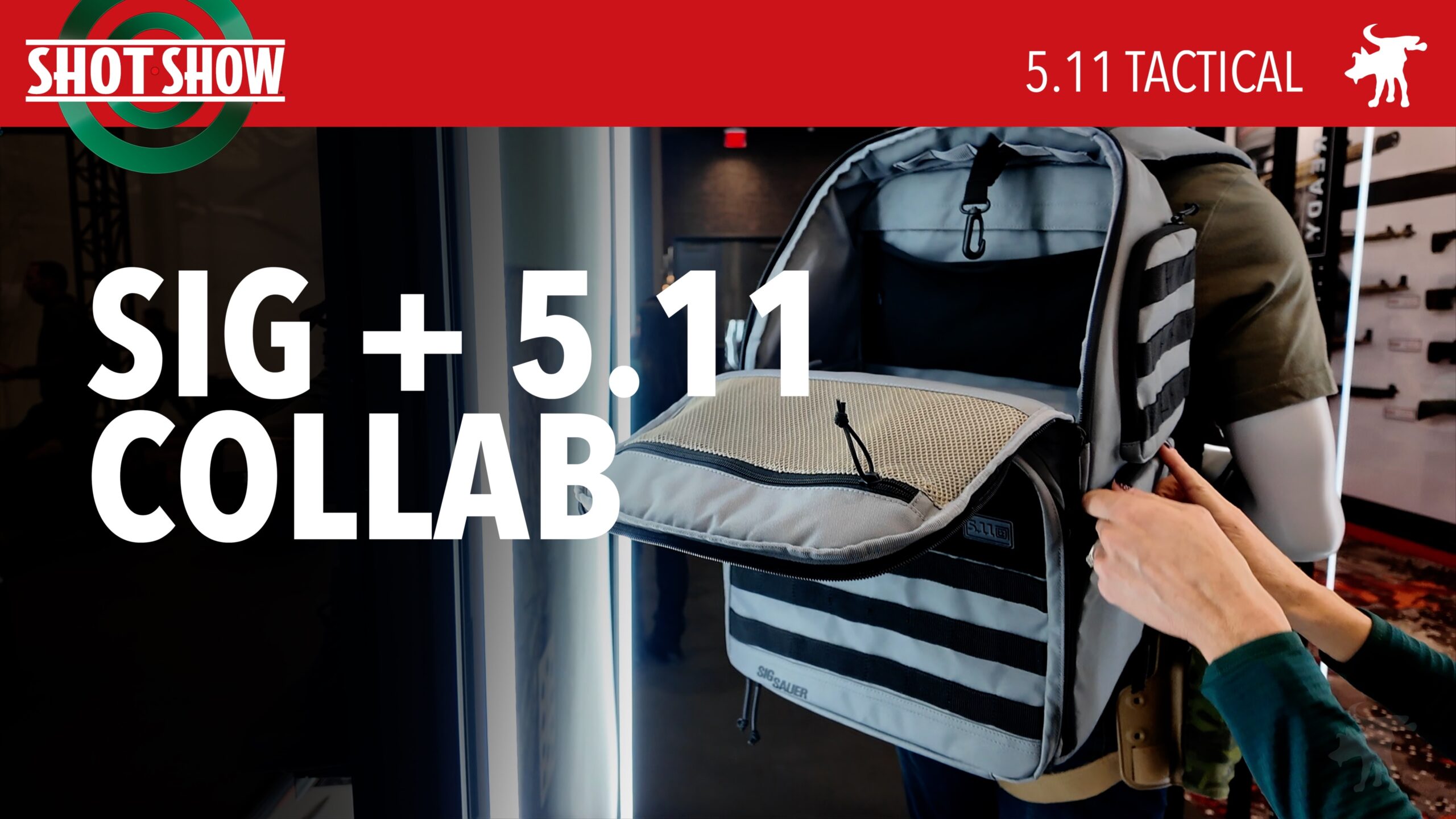
At SHOT Show 2025, 5.11 showed off the new SIG Sauer branded collection of apparel and range bags. SIG And 5.11 have shared athletes and have partnered in events and promotions in the past. This collection is their first collaboration, with 5.11’s designers creating custom range bags, training bags, and backpacks for instructors and shooters.
Monstrum Tactical asked me to compare their new Panzer 1-6x FFP to the LPVO that was chosen by the US Army, the Sig Sauer Tango6T 1-6x FFP. Monstrum sent me samples of both LPVOs new in the box. You can about each LPVO in greater detail in my previously posted reviews of the Tango6T and Panzer 1-6x
As a quick overview, the most striking difference between the two optics was the color. The Tango6 comes in a metallic Flat Dark Earth (FDE) color which was a US Army requirement. Their was far less difference between the two LPVOs when looking at their specs. One notable difference was that the Tango6T comes in MRAD and the Panzer comes in MOA. Moreover, the Panzer’s turrets have a range adjustment more than double that of the Tang6T.
Optically both are great but the Tango6T was ever so much better in brightness, flatness, detail, and sharpness despite having more visible chromatic aberration than the Panzer. Both had pretty good eyeboxes (for LPVOs) but again the Tango6T was just a little bit better, a bit more forgiving.
All in all both LPVOs preformed quite well in my range and live fire testing, holding zero. The Tang6T offers true daylight bright illumination of it donut-of-death. This new release (Gen2?) of the Panzer, just months newer than the model I tested in March, now offers daylight bright red illumination on par with the Tango6T.
Whilst the Tango6T is hands down the better optic, the Panzer is still a solid LPVO. But the Tang6T costs more than 10x the price of the Panzer. Yes, the Tango6T is a better but I don’t think 10x better. If given $2000 and the choice between the two, I’d pick the Panzer and use the left over money to buy Level 5 body armor, digital night vision nods, and extra ammo.
In 2019 the US Army selected the SIG Tango6T as the optic for their HK Designated Marksmen Rifles and for use by Special Forces. The model I tested is the civilian version, differing in its markings but effectively identical to the Army version. I have read conflicting articles stating that the DMR rifles is an SFP version of the Tango6T but I can not confirm this. Of the two Tango6T samples I tested, one lent to me by Monstrum Tactical and another was the personal optic of a friend in law enforcement.
The Tango6T is finally built with subtle body details that speak to extra time milling. The Tango6T has an Flat Dark Earth (FDE)/burnt bronze flat anodized finish specified by the Army. Its control surfaces have fine diamond checkering pattern for grip.
The scope came pre-installed on a SIG Alpha4, a high quality cantilever mount with convenient printed torque specs. Contrary to internet scuttlebutt, the Alpha4 is not a Geiselle mount (though superficially similar in look). The Alpha4 was designed by SIG for the Tango6T, fabricated in California and assembled at SIG’s factory in Oregon.
I had an opportunity to compare the newest model of this LPVO to a pre-DOD selection model of this optic. Superficially it appears identical save for a slightly darker shade of FDE which appears more burnt than bronze. After contacting the folks at SIG, they were very helpful in giving a historic background on the various versions of this LPVO. There are a number of configurations available from SIG, the current Mil and civilian reticle is the Hellfire DWLR-556 reticle.
The Tango6T has 11 levels of brightness on its illumination, 9 visible settings and 2 which are night vision compatible. It has a unique illuminator locking ring on which prevents the knob for changing or turning on or changing setting when engaged. The reticle appeared daylight bright though not quite the “red dot bright” intensity found on the Nightforce ATACR or Vortex RAzor. The unit is powered by a common CR2032 coin battery.
It has capped turrets which are wide diameter but low profile; the down side is that the area only allows for small font numbers which may be hard to read for some folks. Each click is 0.2MIL and is audible and tactile positive so you can infer your changes by click feel if you can’t do so visually.
The Tango6T’s DWLR6 is a BDC design with a Christmas tree of holdovers for long range shooting beyond 500yrds. As with most FFP LPVO’s the 1x seems to be an afterthought, feeling a bit too thin and easily lost against a dark or complicated background. The bright illumination makes up for this. It’s central horse shoe of death is intensely illuminated with a slight outline on the rest of the stadia elements.
Optically the LPVO had excellent brightness, and clarity. Even though it had noticeable chromatic aberration, I was still able to resolve detail at 6x that would only see in LPVOs that were 10x. At 1x the image was flat and much better than Razor or Riton FFP LPVO’s I’ve tested. This scope is world’s better than SIG’s similarly named Tango MSR 1-10x LPVO which I was underwhelmed by a few months ago. Save for it’s thin 1x reticle this is one of the best LPVO’s I’ve tested.
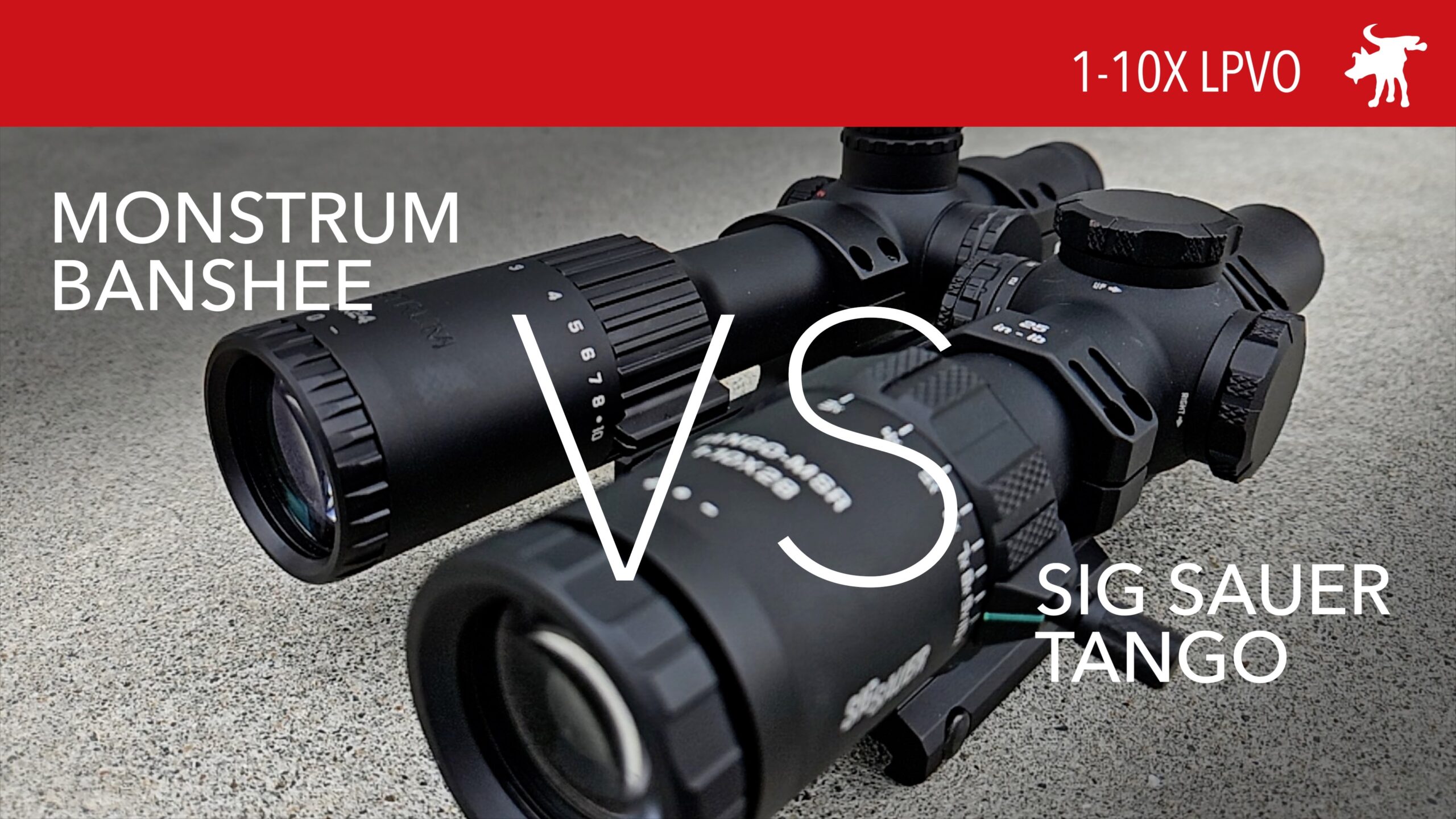
When I compared the new Monstrum Banshee 1-10x to the SIG Saur Tango the Banshee outshone the Tango in most aspects, save for one: its reticle. The Tango’s MSR reticle is a bullet drop compensating (BDC) reticle similar to the Primary Arms ACSS. But within weeks of completing my video, Monstrum released a new Banshee with their own BDC reticle: the BDC-B1.
The Banshee’s image quality is bright and clear with very no chromatic aberration (the 1-8x and 1-10x models have ED glass). The image is flat and with very little edge distortion. The eyebox and eye-relief are decent for an LPVO, especially for a 1-10x which are notorious for their unforgiving eyeboxes.
I’ve been using this Banshee for a few months now on my H&K G36/22 and it’s held zero and been an exemplary optic for action shooting matches. I sent a Banshee to my friend Mark on the GD Boomer channel. He mounted it on his Barrett .50cal rifle and confirmed that it would hold zero even under 50 BMG recoil.
The Banshee BDC-B1 is physically identical to the original version that I reviewed, save for the MX-1 reticle. The turrets are clearly audible and tactile positive. The BDC-B1 has a circular Donut of Death graphic with windage holdovers and a BDC vertical crosshair bar. It is significantly more tactical and faster to aim than the MX-1 but it is not perfect. That said, the Banshee is probably my favorite Monstrum LPVO and this BDC-B1 version is the best variant.
I do have a few suggestions for Montrum. Make the illumination brighter and truly daylight bright. The aiming donut should be both smaller and thicker, while the central aiming dot should be a smaller 0.5 MOA dot. In short, do a better job copying the Primary Arms ACSS like SIG did.
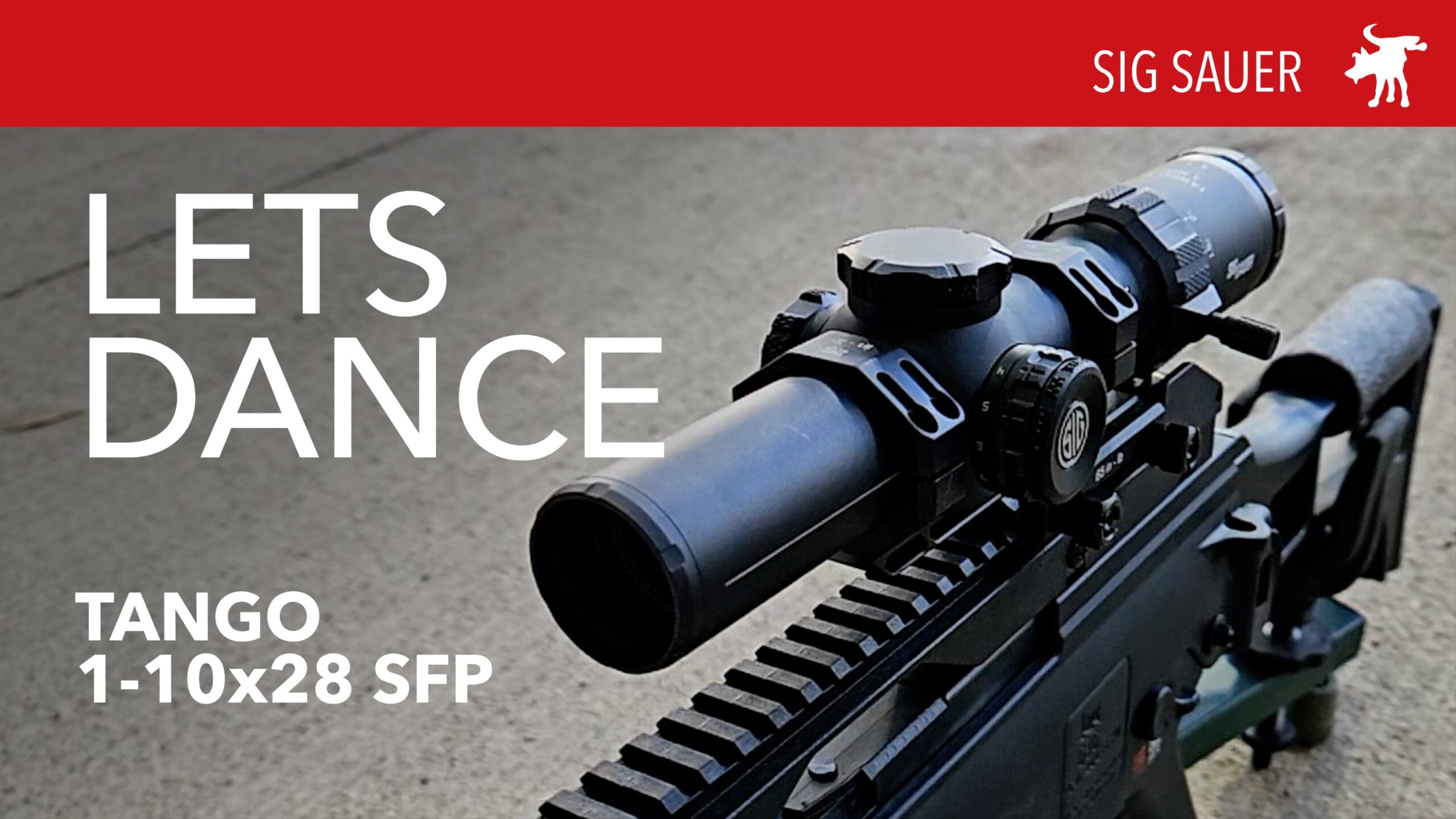
The Sig Sauer Tango MSR is one of the new breed 1-10x LPVOs. These scopes blur the lines between an LPVO and what many used to consider “high power” scopes of previous decades. At 10x the Tango actually has a higher magnification than standard issue US military Sniper Rifle optics (granted those scopes have clearer and brighter glass).
The Tango is nicely designed with great care evident in the build and construction. The contact surfaces on its controls are well textured for a firm grip. It features capped turrets that are resettable, though I found the numbers and scale on the dial a bit hard to read precisely from a shooting position. The turrets were loud but not particularly tactile positive.
The magnification ring has a removable throw lever but the design of the grooves and knurling seem to be sufficient to turn the ring without it. The kit comes with an very well designed 34mm offset mount. Sig thoughtfully printed a reference line on the front tube to help the user align the scope to the mount rings.
At low power the scope is truly 1x with no fish-eye distortion. At high power the scope does suffer from drop in brightness and noticeable chromatic aberrations. It typical LPVO distances under 300yrds on man-sized targets will be clear and recognizable despite this.
The MSR reticle looks like a hybrid between an ACSS style horse shoe and a traditional German style T-reticle. It features dots and arrows design to help the shooter lead a moving target. The TANGE features 11 levels of brightness on the horse shoe reticle but it is not noon day sunlight bright.
This scope has a Second Focal Plane (SFP) reticle; the majority of 1-10x LPVOs are First Focal Plane (FFP). A FFP is preferable in long range shooting but on an LPVO with a scale change of 1000% can often make for thin, hard to see center dots at 1x. Because of that, I tend to prefer the simplicity SFP reticles in an LPVO. Testing the scope running multiple target engagement drills at 25yrds, I found it easy to aim and center on my target.
While the TANGO is not the sharpest or brightest glass I’ve seen in a ≥$500 scope, its features, design, and construction certainly makes it feel worth the price.
After reviewing the Banshee 1-10×24, Monstrum offered to sponsor my next video if I would compare it to a higher end LPVO. I was hesitant thinking their scope would probably be optically inferior and I would not hide that fact in my video. Surprisingly they said they would be ok with me showing their LPVO’s shortcomings as long as I was honest and fair about it.
Monstrum agreed to cover my ammo, gas, range fees, and time. Most 1-10x LPVOs we could find were First Focal Plane. Wanting to compare apples-to-apples, we looked for a Second Folcal Plane (SFP) 1-10x. The Sig Sauer Tango MSR was the only higher end brand that fit that profile. And while SIG isn’t really a “high end” brand, Nightforce doesn’t make a 1-10x LPVO and Vortex and EOtech 1-10x are First Focal Plane, so those were not good comparisons. Primary Arms also makes a 1-10x SFP, but most consider Primary Arms to be also a “budget brand” so Monstrum agreed to send me a Sig Tango to compare to the Banshee. Both scopes were shipped directly from Amazon in new sealed boxes.
Both scopes come with offset mounts and similar accessories in the box. On paper they share many similar features.
BANSHEE
TANGO
Objective Lens:
24 mm
28 mm
Magnification:
1 – 10 x
1 – 10 x
Tube Diam:
30 mm
34 mm
Weight:
17 oz
20.4 oz
Eye Relief:
4.0 – 4.5 in
3.22 – 3.54 in
Reticle
SFP
SFP
Adjustments:
0.5″
0.5 MOA
Illumination:
Red & Green
Red
Battery Type:
CR2032
CR2032
Beyond the specs, looking at both LPVO’s side by side, it was easy to see which scope looked better built and expensive. The Tango had more refined design features and construction. The Banshee’s design could best be described as clean and spartan but in comparison looked like a budget scope. This design difference extended even into the scope mount.
Sig Sauer has a great reputation for making solid optics. The Tango costs more than double the price of a Banshee. I was sure before I began the testing that it would be better than the Banshee. The question would be how much better?
At the range I tested both out on the same reference targets and was surprised at the results. Optically, the Banshee was a bit brighter, sharper, and clearer than Tango. It also had an inch further eye relief and a more forgiving eye box than the Tango at 10x.
The Banshee held its own against the Tango save for one key feature, its reticle. The Banshee MX1 reticle is an old school crosshair with MOA sub-tensions, traditionally found on long range target scopes. The Tango has the MSR, a modern tactical reticle that provides the user with windage hold-overs and aim points to lead moving targets.
Despite the Banshee’s better optical qualities, I’d prefer the Tango because its MSR reticle makes it a more useful LPVO for action shooting and combat. On the other hand, at half the price of the Tango, the Monstrum is still a good value. If Monstrum were to upgrade a future version of the Banshee with a more useful reticle, it would be a done deal.
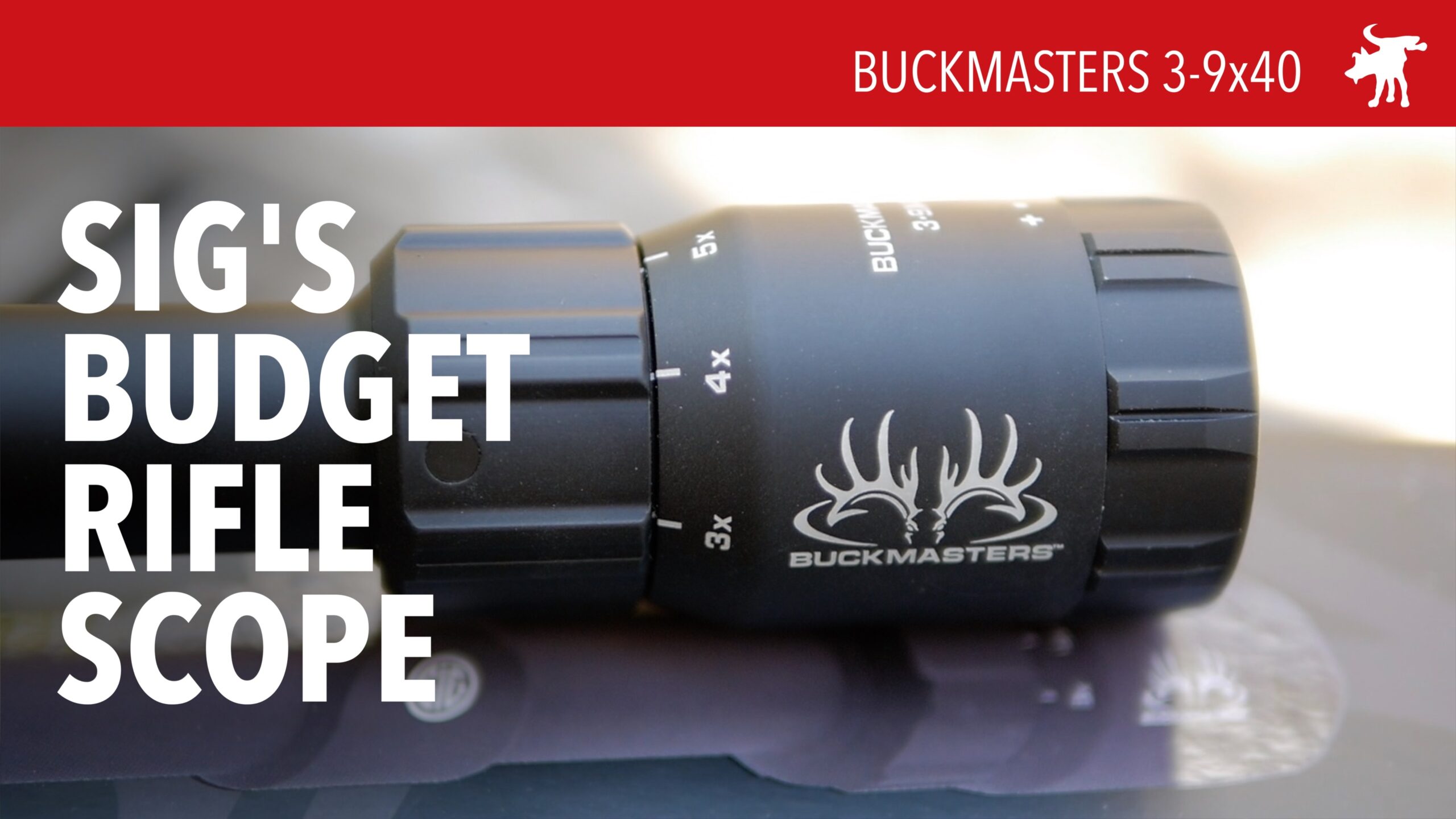
Sig Sauer is a Swiss firearms company with an historic reputation for making rifles and pistols built to Swiss engineered quality. But recently they’ve also been releasing a line of accessories and optics at a competitive price like their popular Romeo line of red dots. Their Buckmasters 3-9x40mm is their least expensive magnified hunting scope at around $100 or under.
Unlike other budget price tier 3-9x scopes, the Buckmasters appears to be well built. It has a tight and well built tube with clear markings and smooth moving components. A good indication is the moulded SIG branded lens caps. A company that was just cashing in their brand on trash optics would have settled for unbraded caps or cheap printing on generic caps.
Typical of hunting scopes, the caps are capped which protects the turrets from the elements, moisture, and accidental bumps. The turrets are resettable using the included Allen wrench. They turn with nice audable clicks and are tactile positive, with only a little slop. In testing, the turrets returned to zero in box tests.
The scope has a BDC reticle but oddly manual doesn’t provide information as to the ammo and rifle used to establish the reticles dope markings. Perhaps this is an admission to the failure of this reticle type to live up to its promise because it’s unlikely the buyer will have the exact same rifle and use the exact same ammo. That said, I prefer reticles with any type of hold mark to provide a reference point for applying hold overs with follow up shots.
Optically, the scope’s sharpness and resolution was typical of 3-9x, in the Group -2 category using a 8.5″x11″ USAF Optical Resolution chart at 100yrds. But unlike typical budget scopes, the Buckmasters displayed no chromatic aberration and maintained an even sharpness and focus from center to edge. In addition, the scope maintained about a 3.5″-4″eye relief and decent eye box.
For the price, this scope exhibits better optics than the similarly priced Bushnell Banner and much better build quality and clarity than cheaper CVLife and other no-name scopes. It does have a limited lifetime warranty which isn’t as forgiving as Vortex’s but if you don’t abuse your gear, it should be effectively the same.