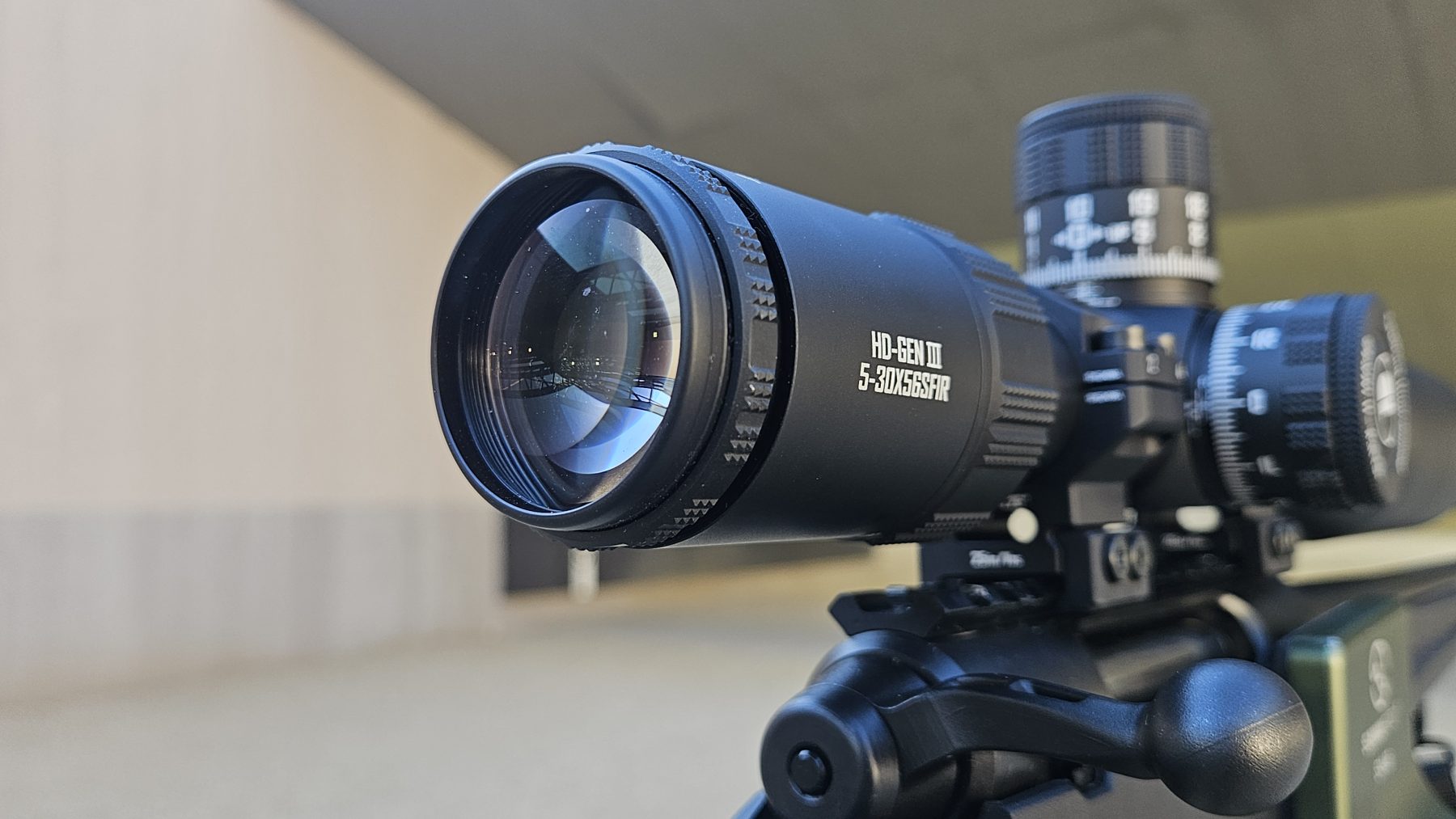
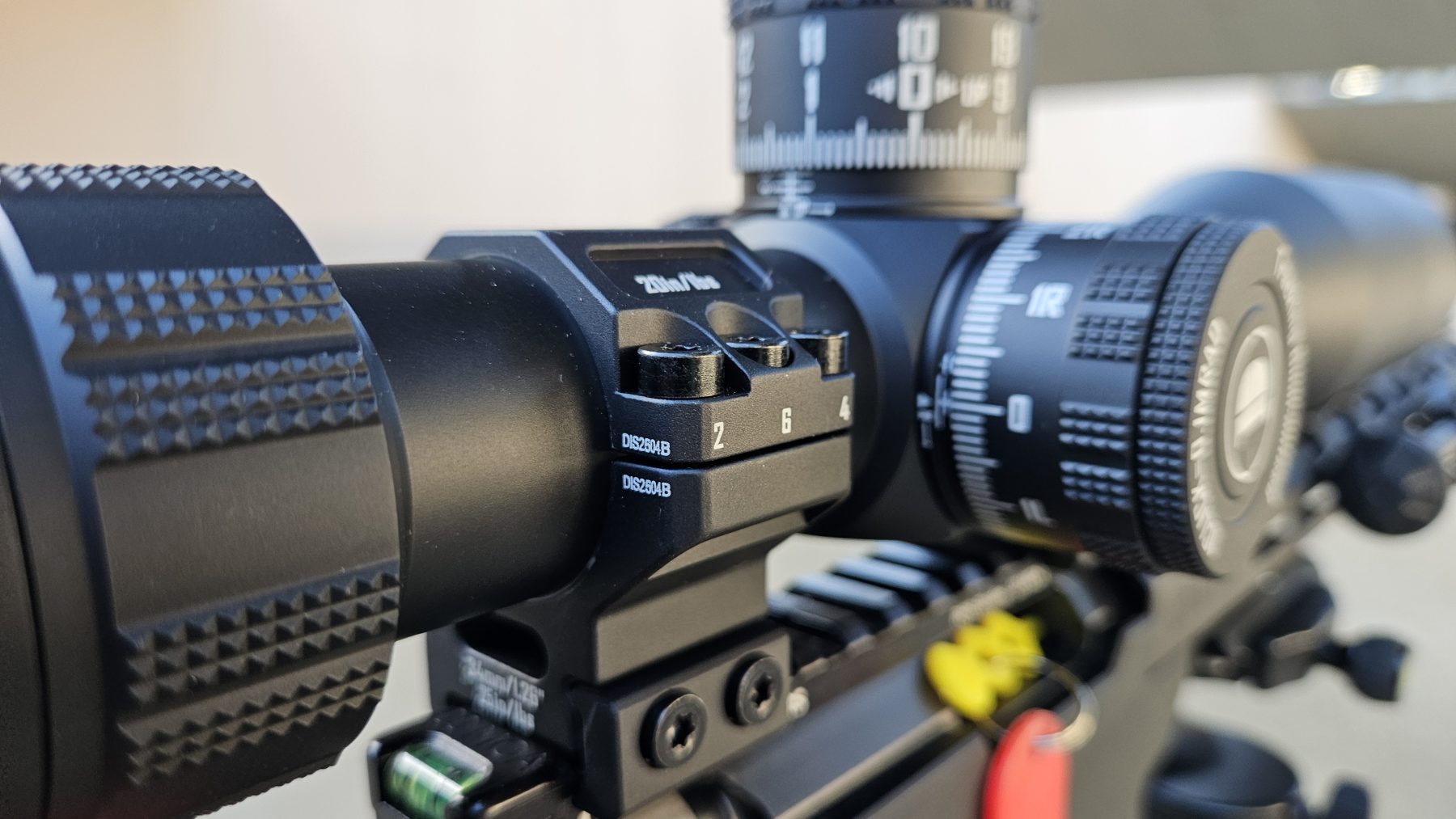
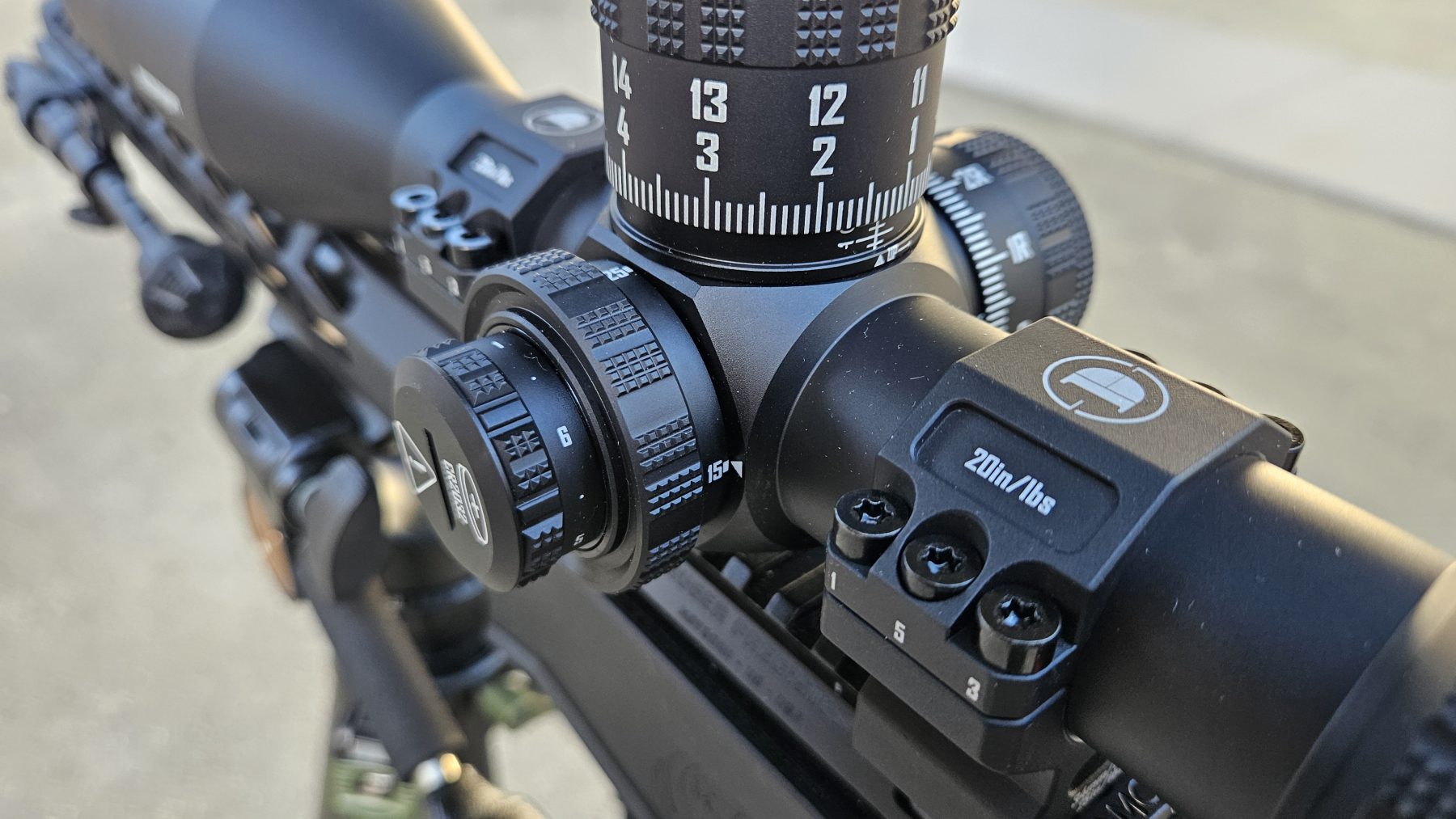
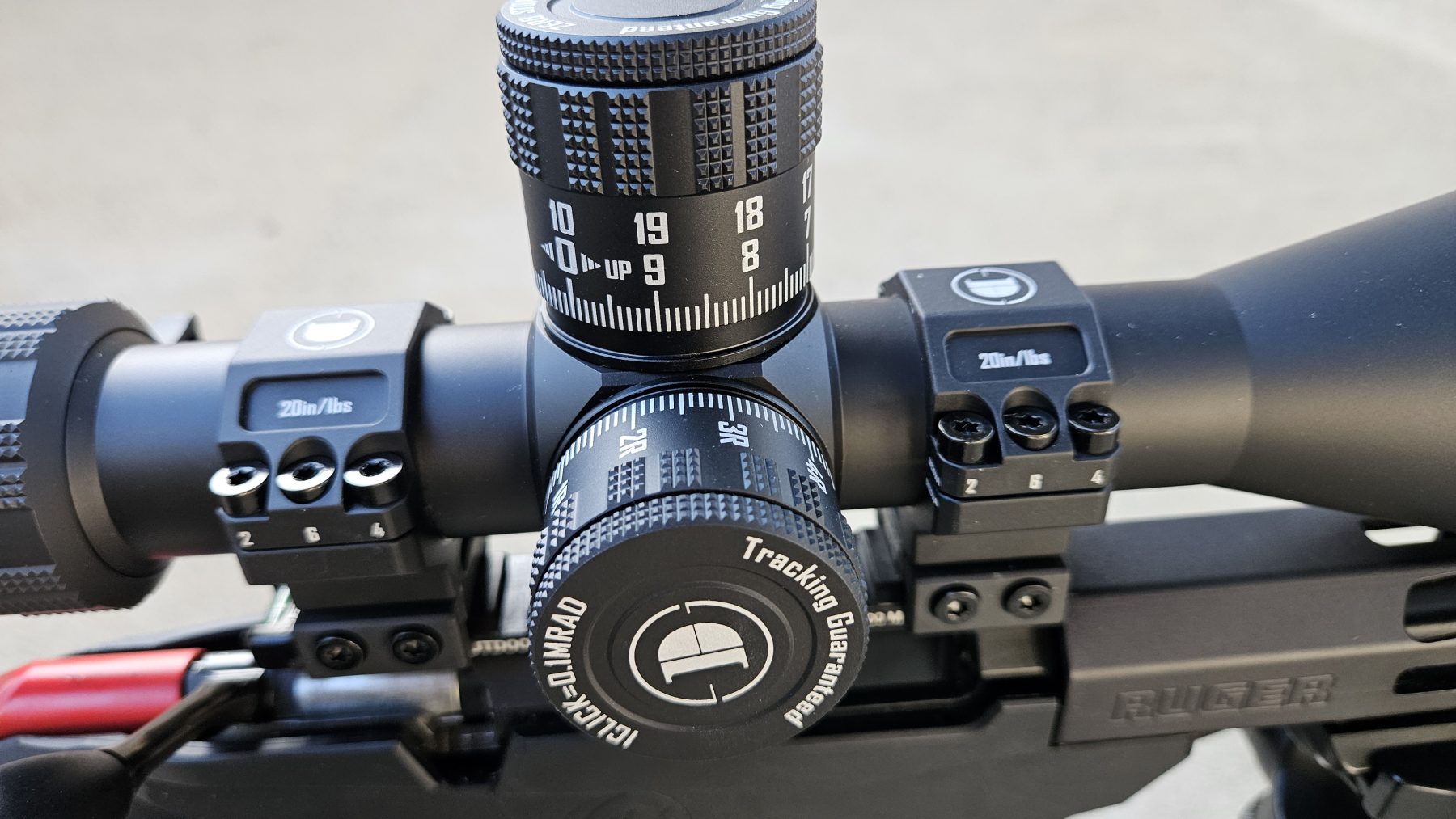
DiscoveryOpt updated its HD with the new Gen3 5-30×56. It adds a tool-less, resettable turret and zero stop. It keeps its multi-coated HD glass and 56 mm objective. 34 mm tube, FFP reticle, and most appreciated, it retains its mid $300 price-point.,
The standout feature is the fully tool-less turret and zero stop. No Allen keys required to reset to your established zero after dialing for long shots. Under the turret, a brass clamp with a quick-release lever sets your zero stop. Easy peasy.
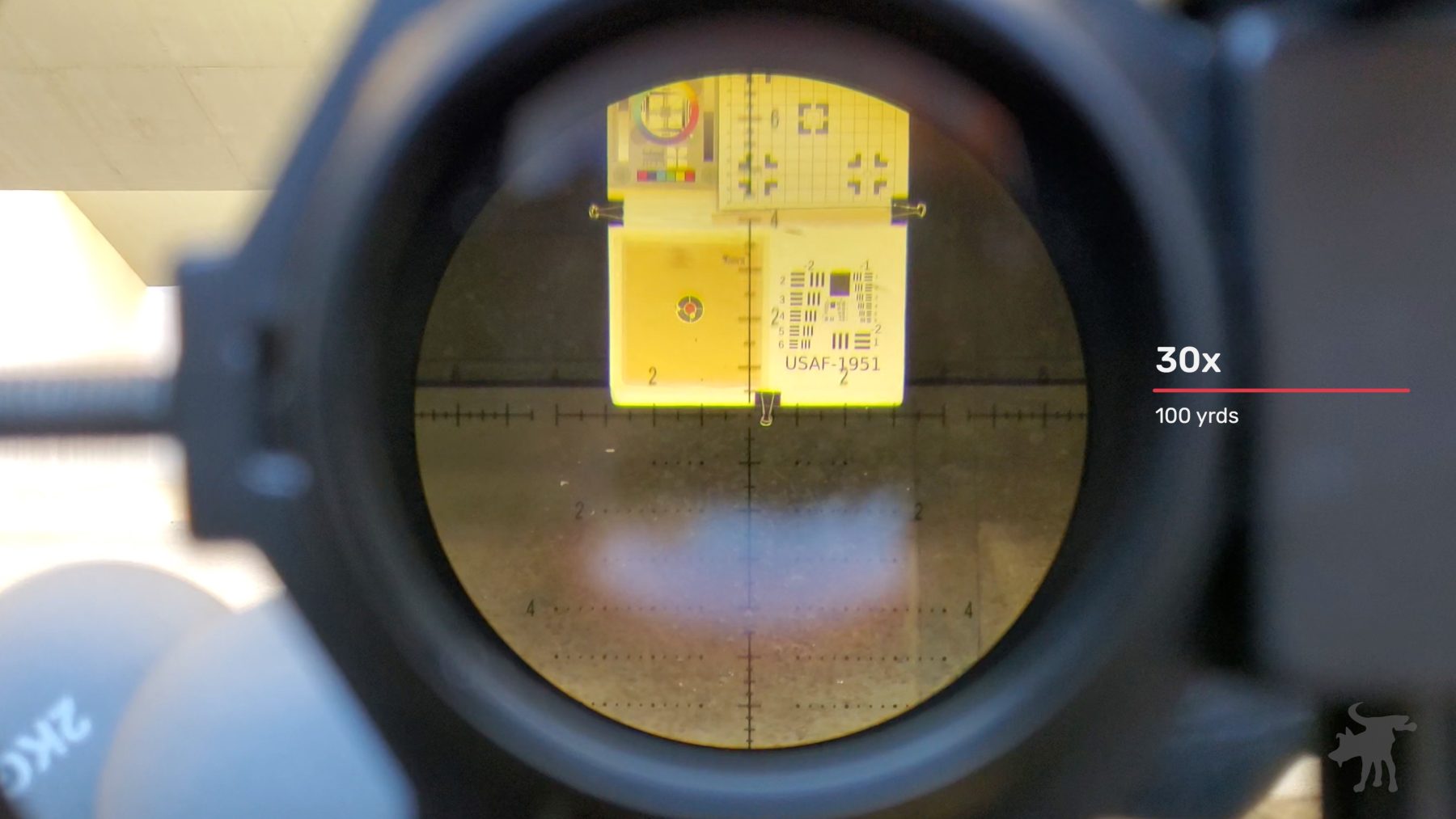
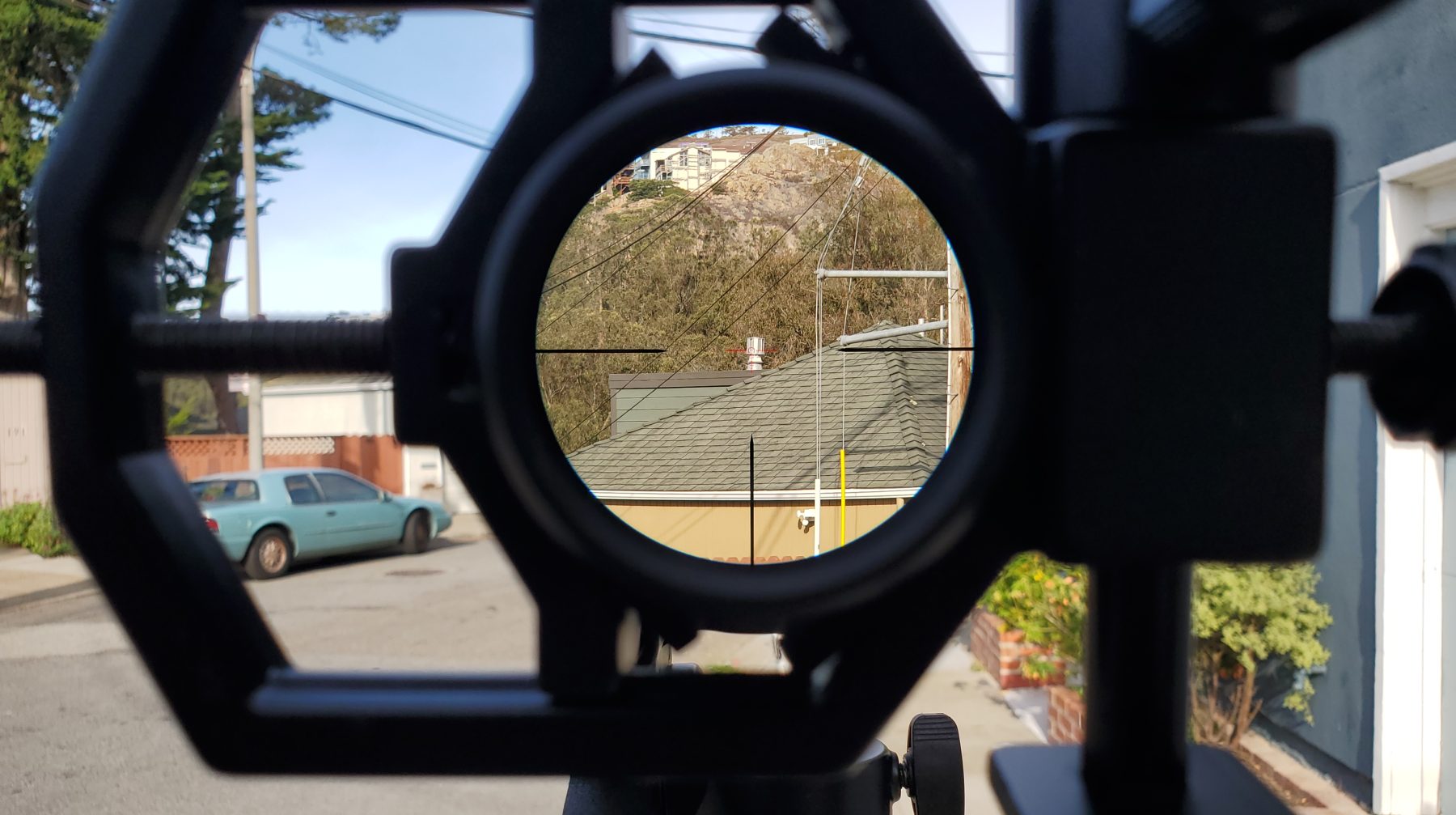
The Gen3 continues Discovery’s incremental improvement to the glass quality. Its clarity is good but with a warm cast and not quite the quality of its more expensive big-brother the ED Gen3. But the HD Gen3 is certainly impressive compared to entry-level offerings from Vortex or Burris at twice the price.
If you’re building a long-range hunting or range rifle and don’t want to spend four figures on glass (or even $700), the HD Gen3 5-30×56 is worth a look.
The S1 QHD offers all of the features of the S1 4K but in 2K resolution, and in a more affordable package. Part of the reason for its superior footage is that the S1 comes with a Circular Polarizing Filter (CPL) which can reduce glare and reflections in the windscreen and improve readability and contrast. In addition, the S1’s native incorporates image processing enhacement techology that improves the resultion of license plate numbers and letter.
Unfortunately the defualt image and resolution settings don’t use the enhanced license plate setting. You have to manually reconfigure the camera to 30fps HDR + Infinite Plate Capture. This setting produces enhanced readability of characters in license plates, especially at night.
There were two minor issues that I experienced with the S1. When starting the unit for the first time, the S1 takes some time to configure. But after this long configuration, subsquent activations are much faster to boot.
The S1 also offers GPS and speed logging, WiFi connectivity to a downloadable phone App to copy files and modify menu settings. When upgraded with the Vueroid OBD power adapter or using the included direct wiring kit to you car’s batter, the Vuerod is able to record while the engine is off and parked.
The S1 QHD is a little cheaper than the S1 4K but neither is cheap. But neither feels like the cheap plastic dashcams I have tested in the past. The S1’s preimum price is worth the premium quality footage.
The Academy Museum of Motion Pictures opened in 2021 with a Hayao Miyazaki retrospective. Four and a half years later, they exhibited Studio Ghibli’s Ponyo.
Ponyo (2008) is Miyazaki’s reinterpretation of the Hans Christian Andersen story The Little Mermaid. A tale of a magical goldfish princess named Ponyo and up, a five-year-old boy named Sōsuke.
The movie is almost entirely hand-drawn. Studio Ghibli donated more than 100 pieces to the Academy Collection: art boards, Japanese release posters, key animation drawings, Miyazaki’s own sketches, and an actual Ghibli animation desk.
I’ve ridden the TGV between Laussane and Paris. I rode the Shinkansen from Tokyo to Kyoto. I love high-speed rail.
In 2008, California voters approved a $33–45 billion bullet train from San Francisco to Los Angeles by 2020. Fast-forward eighteen years: Democrat Gov. Gavin Newsom and other politicians have done Photo Opps with laying fake train tracks and standing in front of banners claiming progress.
The only thing traveling at high speed is the cost estimate—now a cool $126–231 billion. Actual track laid that can carry a paying passenger? Zero. Not one mile. Not one foot.
Keep that in mind as you head to the voting booth this November. Whether you want to believe you’re “fighting the Trump Agenda” or making America Great Again, if you vote for more spending and vote for incumbent politicians in California, you’re voting for more red tape and wasted money. Good luck.
What’s the difference between Bourbon, Whiskey, and Whiskey? This Livestream is sponsored by Aura.com. Go to my link https://aura.com/moondog to get a 14-day free trial and see if any of your data has been exposed.
The word Whiskey comes from the Irish and Scottish Gaelic uisce beatha or uisge beatha (wiskuh bAha), a translation of the Latin term aqua vitae, “water of life”.
This episode is sponsored by MattHat jerky. Use code: MOONDOG to get 15% Order a free sample using my link https://matthatjerky.com/products/sample-pack?ref=moondog
DOWN THE RABBIT HOLE
What’s the difference between Whisky, Whiskey, or Bourbon?
Whisky is a distilled spirit made from a grain, traditionally malted barley, or other grains depending on the country. That spirit is flavorless and colorless until it is aged in wooden barrels.
Unaged whiskey is called moonshine in the US or poitin in Ireland.
Scotland, England, and most other countries spell it Whisky. Ireland and America spell it Whiskey, adding an ‘E’ to differentiate it from Scotch Whisky.
Scotch-Irish colonists brought whiskey to America in the 1600s, where a scarcity and price of barley led them to use corn and rye as the primary grain. Barley does not grow well in warm, humid climates. Corn is what differentiates Bourbon from other American Whiskeys.
There’s some debate as to whether the name Bourbon comes from Bourbon County, KY or the county got is name from the prevalence of distilleries.
Or the name may have come from Bourbon street district of New Orleans where Kentucky whiskey was loaded from Mississippi barges to ships bound for Northern cities and international export. Bourbon is the family name of the royal family of the Kingdom of France.
American Bourbon was legally defined by Congress in 1964 as an American whiskey (not just those in Kentucky) that is made using at least 51% corn as its primary grain. And it must be aged in newly charred oak barrels. And it can not contain added flavoring or coloring.
Popular American Bourbons and Whiskeys
Buffalo Trace (oldest) Maker’s Mark (2nd oldest) Jack Daniel’s Jim Beam Evan Williams Wild Turkey
BRAND CONTEST CLUE
This American brand is the oldest registered distillery in the United States, founded in 1866 in Lynchburg, Tennessee. It is technically a Bourbon but instead calls itself a Tennessee Whiskey to differentiate it from more numerous Kentucky distilleries.
Enter FIRST name of this 2-word brand name with starting with a #.
VIDEOS THIS WEEK
Moondog2A
Moondog Reviews
Moondog Go
DISCOUNTS AND DEALS
OLight has a contest going on right now
Arken 20% OFF Sitewide with code MOONDOG 25% OFF for Verified Veterans
This brand is the most popular and best-known American spirit worldwide. A bottle of it was burried with Frank Sinatra. And its the legendary liquid fuel for rock, drunk by the Rolling Stones, Motley Crüe, and what Ella Langley drinks in her eponymous song (shown in the thumbnail).
Enter FIRST name of this 2-word brand name with starting with a #.
When it comes to $150 budget optics, I’ve learned to temper my expectations. So when the TechHunters 3-12×44 medium power variable optic (MPVO) showed up on my doorstep, I was surprised. The scope feels surprisingly solid and its externals look well made.
It is a budget MPVO so it does have a tight eyebox, and at low power the view exhibits notable pincushion distortion. Chromatic aberration is present but actually less than entry-level offerings from big-name brands. Overall clarity and edge-to-edge sharpness were surprisingly good for a budget scope.
Brightness is adequate for dawn and dusk shooting, though the 44mm objective obviously limits light-gathering compared to a 50mm 18x bell. Color rendition is good for a non—ED glass scope.
Techhunters opted for a first focal plane (FFP) MIL reticle with a horseshoe center and floating dot. It features a minimal tree with wind hold-over dots. The entire high-power reticle is illuminated . The downside? The stadia around the horseshoe make for a blurry aimpoint at 3x. This is my only hesitation to considering this MPVO a cross-over scope for hunting.
This MPVO has the versatility to be considered a The 3-12x range bridges the gap between close-range hunting and mid-distance target work. At 3x, it’s fast enough for woods hunting; at 12x, it gives you enough magnification to identify targets and make ethical shots out to reasonable distances. It’s not an ELR optic, and it’s not pretending to be.
Is it perfect? No. The illumination makes the aimpoint blurry, the turrets could be crisper, and the eyebox is unforgiving. But the Z4 is about the price of a Vortex Crossfire 3-12×44 while offering a FFP reticle and features of the more expensive Diamondback.
OLight took their already-overachieving OClip 2 Ultra, slapped “Premiem” on an already long list of adjectives in its name. The Ultra 2 introduces a wealth of new features, in addition to its 580-lumen flood / 450-lumen spot, and new dual red/UV beam emitter.
It has a 360° rotating clip with detents, allowing you more flexibility in where you clip it. The head tilts to 115°, allowing you more flexibility and control of the direction of the beams. Clip it to a hat brim, pocket, pack strap, or steel surface and actually point the light where you need it instead of illuminating your shoes and half your face. You have 3 new ways to charge the unit: a USB-C port under an IPX6 hatch on the side, and a magnetic charging circle compatible with OLight flashlights.
The Premium adds a snap-on charging base to the Ultra 2 package. This charging base has its own USB-C port but also functions as a stand-alone power bank, effectively doubling the OCLip Ultra 2’s runtime.
OLight’s Ultra model flashlights are made with OAL aluminum alloy, which OLight claims to be nearly twice as hard as 6061. And their Ultra also features the highest battery capacity of their respective models (at least until they make another leap in technology and I guess they start adding numbers).
If you liked the original OLight but wished it allowed a little more control over the direction of the beam, the Ultra 2 is a welcome upgrade.
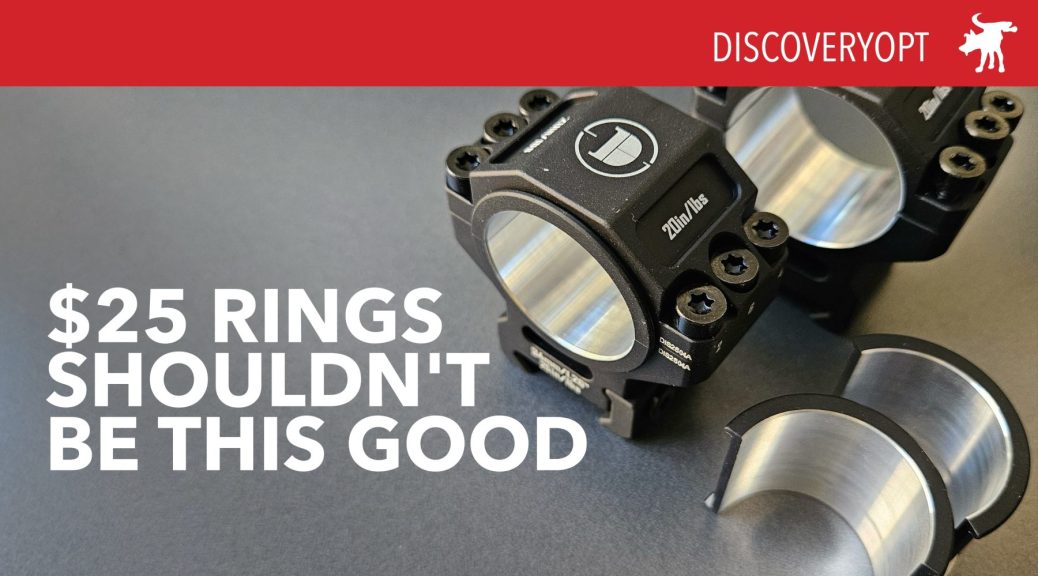
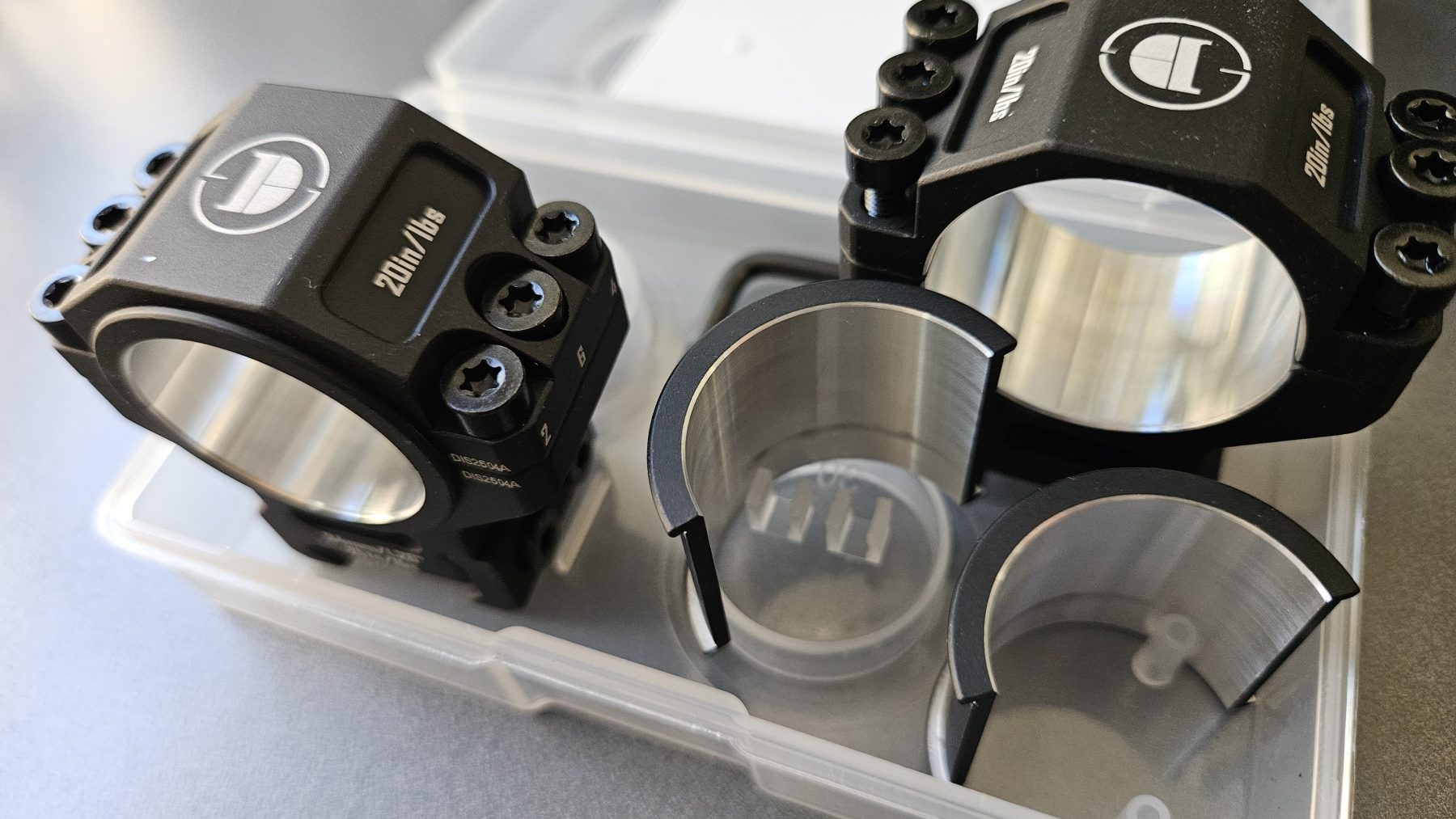
DiscoveryOpt makes high-quality scopes at a remarkably low price. The same value and performance are present in its scope rings. Their 6061 Precision Multi-Dimension scope rings are CNC machined from 6061 aircraft-grade aluminum, offering rock-solid reliability and strength.
The rings come with precision-machined shims, which allow the 34mm rings to hold 30mm tubes when attached. The precision rings and their shims are machined in pairs from a single piece of aluminum for accuracy and consistency. The rings are assembled with high-strength T-20 torx screw with designed with built-in recoil lugs in their bases.
These scope rings are serialized, vibratory tumbled, hand-bead blasted and finished with a Type III hard coat anodize, achieving a durable finish with exceptional scratch and impact resistance. The ring’s inner bore is pre-polished.
If all of this wasn’t impressive, perhaps its most unbelievable aspect is that all of this costs $25.
I went to the Weird Al at SMC (Fresno State’s Save Mart Center arena). It was part of the Bigger and Weirder Tour with Puddles Pity Party as the opening act. Unlike most music concerts I’ve been to, it felt more like going a table-top-gaming convention.
Weird Al and his band sang in sync to projected footage of his music videos. Visually, his concert was somewhat underwhelming, leaning heavily on projected footage of the music videos of his songs. Al’s vocal abilities are often overlooked and underrated, especially his rapping ability. The musical performances were excellent, and the evening was one of the most fun and positive concerts I’d attended.
Sadly I had to cut out some of the footage from my videos because of Copyright limitations.
Malfoid is a nerd war over a new hot genderswap character in the Potterverse. This Livestream is sponsored by Aura.com. Go to my link https://aura.com/moondog to get a 14-day free trial and see if any of your data has been exposed.
This week, videos started showing up on my feed, with a blonde anime girl in a Harry Potter student uniform with the word “Malfoid”. I decided to click one and bam, I dropped into a weird but ultimately cool Rabbit Hole.
Malfoid is the name of a new internet trend that is the center of a Venn Diagram of Harry Potter, AI, Anime, and also Woke Politics because nowadays anything entertaining has to offend some community on Blue Skey.
This episode is sponsored by MattHat jerky. Use code: MOONDOG to get 15% Order a free sample using my link https://matthatjerky.com/products/sample-pack?ref=moondog
DOWN THE RABBIT HOLE
Malfoid is the term given to the internet meme and fan art trend of a female Draco Malfoy instead of the original male character (played by actor Tom Felton in the movies)
Malfoid is a portmanteau combination of Malfoy and the incel term “femoid”. Whether this was coined as a derogatory term by Blue Sky Redditors against the popularity of the trend or used ironically by fans is debated.
Also oddly, in the Malfoid content, the character is not called Malfoid but simply named “Malfoy”. By the way, in my research it appears that FanFic female versions of the Draco character are more commonly named Draconica, Dracaena, or Draconia.
Fan-generated fiction aka FanFic, that expands on the Harry Potter story and characters has been around since the books first came out in the late 1990s. A common sub-genre is called shipping (derived from the word “relasionSHIP”). And another common sub-genre is gender-swapping characters (ie. What if Harry Potter was Harriet Potter?). None of this is new.
On September 22, an anime version of a female Malfoy was posted on X by @redten and it went viral with over 20M views. https://x.com/redteneri
It inspired the trend that others would term Malfoid. In less than a month, there has been an explosion of fanfic short stories, art, anime, and even AI videos like these.
#Malfoid has competition. https://t.co/iB1znyuAd9— Zey (@ZeyHashimoto) October 12, 2026
One side of this popularity is the outrage and hate this character is receiving among haters on Blue sky and Reddit. Claiming it’s misogynistic or a Manosphere dog whistle. It seems like they’re upset with anything supporting anything organically cute and attractive to heterosexual men, especially if its supporting JK Rowling because they consider her transphobic. Whatever. Haters gonna hate.
But on the fan side, I find this level of creative output inspiring. I like the Tsundere character of Malfoy better than Harry’s canonical wife, Ginny Weasley.
Malfoid got a lot more aura, and I root for her like Elizabeth in Pride and Prejudice or Helga in Hey Arnold! And she’s kind of hot in a femme-fetal kind of vibe, like Femke Jensen in 007’s GoldenEye. As @SmugAlana put it in her livestream on the subject, by changing Malfoy into a Tsundere girl, normie guys finally get why women were into Malfoy.
Also, I find the level of artfulness in these AI-generated anime and “live-action” to be surprisingly good.
Based on the story and comic by @Grin2702 and writing by @Axolotl52032346 (post in replies) If you like this please follow them, as it would not possible otherwise, I'm not able to come up with as good of stories.
This American multinational book publishing media company has been a fixture in American education for decades. It’s famous for its “Book Fairs” in elementary schools, where many of us bought our first books.
VIDEOS THIS WEEK
Moondog2A
Moondog Reviews
Moondog Go
DISCOUNTS AND DEALS
Arken 20% OFF Sitewide with code MOONDOG 25% OFF for Verified Veterans
This book company’s mascot is Clifford the Big Red Dog, is one of its best-selling franchises since its debut in 1963. It is also notable for publishing The Hunger Games, Goosebumps, and the Harry Potter series.