I got a first look at the upcoming Panzer 1-6x LPVO. This is a lower power version of the 1-10x which I previously reviewed back in 2023. That LPVO impressed me with how well it compared to the Razor 1-10x at a 1/10th of the price.
All things being equal, a 1-6x power should offer the same sharpness as a 1-10x with a slightly smaller length (and weight). In some cases some 1-6x even offers slightly better eyeboxes. But it’s actual performance remains to be seen. I just received an early release sample and will be testing it soon. Be sure to Subscribe and press the Notification “bell” icon on my YouTube channel to be updated when it posts.
You can also get early access to all of my upcoming videos when you become a paid Member of my channel.
When I compared the new Monstrum Banshee 1-10x to the SIG Saur Tango the Banshee outshone the Tango in most aspects, save for one: its reticle. The Tango’s MSR reticle is a bullet drop compensating (BDC) reticle similar to the Primary Arms ACSS. But within weeks of completing my video, Monstrum released a new Banshee with their own BDC reticle: the BDC-B1.
The Banshee’s image quality is bright and clear with very no chromatic aberration (the 1-8x and 1-10x models have ED glass). The image is flat and with very little edge distortion. The eyebox and eye-relief are decent for an LPVO, especially for a 1-10x which are notorious for their unforgiving eyeboxes.
I’ve been using this Banshee for a few months now on my H&K G36/22 and it’s held zero and been an exemplary optic for action shooting matches. I sent a Banshee to my friend Mark on the GD Boomer channel. He mounted it on his Barrett .50cal rifle and confirmed that it would hold zero even under 50 BMG recoil.
The Banshee BDC-B1 is physically identical to the original version that I reviewed, save for the MX-1 reticle. The turrets are clearly audible and tactile positive. The BDC-B1 has a circular Donut of Death graphic with windage holdovers and a BDC vertical crosshair bar. It is significantly more tactical and faster to aim than the MX-1 but it is not perfect. That said, the Banshee is probably my favorite Monstrum LPVO and this BDC-B1 version is the best variant.
I do have a few suggestions for Montrum. Make the illumination brighter and truly daylight bright. The aiming donut should be both smaller and thicker, while the central aiming dot should be a smaller 0.5 MOA dot. In short, do a better job copying the Primary Arms ACSS like SIG did.
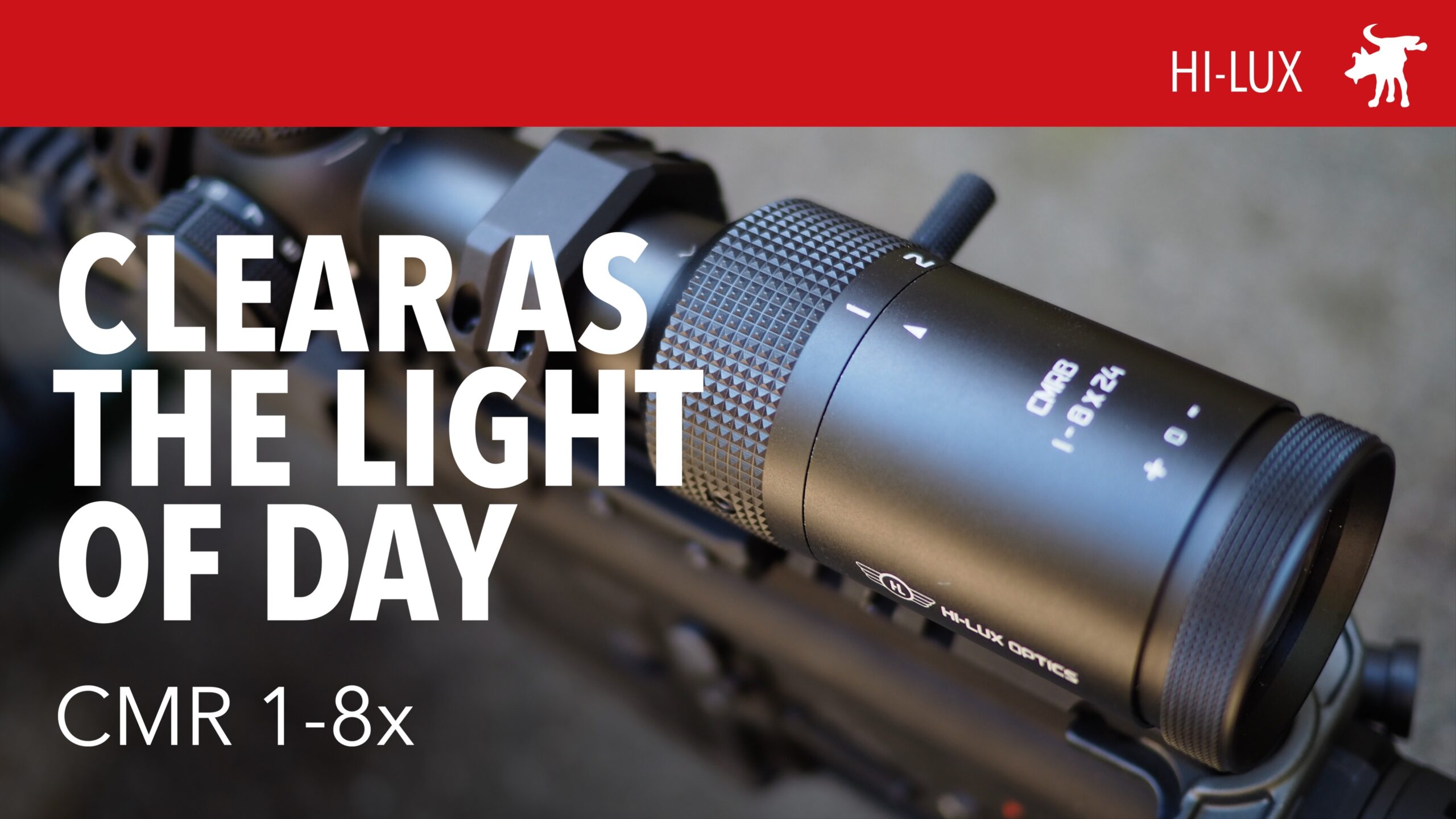
Hi-Lux is best known for making replica antique optics for 19th century and early 20th century firearms. After visiting their booth at SHOT Show this year, they showed me their newest optic that is decidedly 21st century: their new CMR (Close to Medium Range) 1-8×24 LPVO.
The CMR has capped 1/2MOA turrets and a removable throw lever. It has a 30mm tube and an overall typical design for an LPVO. The package contains the scope and lens covers but like most non-budget scopes, ships without mounts.
Hi-Lux sent me a CMRB which has a SFP ‘B’ullet Drop reticle that utilizes fiber optic illumination. This provides a true Daylight Bright dot in the center of the reticle. In my testing the dot remained bright and visible even looking into the sky in bright noonday sun.
Optically the image is bright and sharp at 100yrds with a bit of chromatic aberration. But at 1x the scope exhibits edge distortion and parallax shift. This is disappointingly not uncommon even with premium scopes costing twice or even three times as much as the CMR.
The Hi-Lux is a mid-tier optic at just under $400 retail. With a lifetime warranty from a US company, this scope is a good contender against similar scopes like the Vortex Venom. Its the scope for those that don’t want to put out a grand or more for a daylight bright LPVO but want a boojier brand than an Athlon or Primary Arms.
OLYMPUS DIGITAL CAMERAOLYMPUS DIGITAL CAMERAOLYMPUS DIGITAL CAMERA
Nightforce is one of the most highly regarded combat optics used by Special Forces and Law Enforcement officers. Their ATACR and NX8 are 1-8x LPVOs with truly daylight bright illumination. Moreover, the NX8 is one of the shortest FFP 1-8x you can buy. And while they’re over a thousand dollars, professionals say they’re worth every penny.
Some scopes and binoculars advertise the fact that they use: ED Glass. And no this is not short for ‘erectile disfunction’, ‘Dept. of Eduction’ or ‘Edward’. ED stands for Extra low Dispersion glass, a special type of glass that has been formulated with chemical compounds that are designed to reduce chromatic aberration.
Chromatic aberration is a prismatic effect caused by light passing through a highly curved lens or lenses; such as in scopes with a high magnification factor. With 1-10x LPVO’s chromatic aberration is all too common. The light is refracted and slightly separated into its component colors like in a prism. ED glass compensates for this refraction, producing a clearer image that is in register.
So why don’t all scopes use ED glass? There are some trade-offs. ED glass is more expensive, can be more brittle, and has a little less light transparency. The practical benefits of ED glass can outweigh these trade-offs in many use cases. For long range precision, having a scope that is slightly darker but clearer would arguably be better than a scope that’s better in low light but blurrier.
The scopes in this video are available on Amazon through these affiliate links which support my channel:
At SHOT Show, Monstrum showed off a concept optic named the Archangel. This LPVO has the internals of their upcoming 1-6x Panzer FFP LPVO but with a radically different body. It has a very angular futuristic body design that reminds me of video games like Halo or Mass Effect. Their Marketing Director told me they took inspiration from Vortex’s Next Generation Squad Weapon system optic being developed for the US Army and Marine Corp.
This is still a concept design. I am puzzled by the utility of a piggy back red dot on an LPVO? This would be more practical on an MPVO. Post a comment in the YouTube video if you would like Monstrum to move forward with producing this eye catching optic.
The Razor HD is Vortex Optics top tier LPVO. With its destinctive trademark burnt-bronze color, the Razor certainly stands out. And up close it has the looks of a premium optic.
The HD Gen iii has a very precise low-profile capped turrets, with a fine 1/4 MOA per click adjustment. It has a lockable illuminator knob and offers 11 levels of brightness that at its highest settings is truly daylight bright; almost too bright for indoor use.
The Razor’s 34mm sized tube body allows it 120 MOA of internal adjustment. This is useful for extreme long distance shots made possible with it’s 10x maximum magnification and a fine, detailed, Christmas Tree reticle. In many ways this is an LPVO optimized for 10x rather than 1x. Because that FFP reticle become a small, simple floating ‘T’ at 1x which can be somewhat hard to acquire under rapid fire. Thankfully its crazy bright reticle illumination solves that problem, making this LPVO as quick to aim as a red dot at 1x.
The image through the scope at all magnifications is satisfyingly bright and sharp. Unfortunately it has “Fish Eye” at 1x and quite noticeable chromatic aberration at 10x. These issues shouldn’t be found Vortex’s top scopes, yet here it is. The Razor is a premium LPVO that sells for $2499 on Amazon. The Razor is clearly a higher quality scope. But for a weekend shooter like me, I was able to shoot just as accurately with either scope.
These optics are available on Amazon through these affiliate links which support my channel:
Red dot magnifiers have been around for over almost two decades. These specialized scopes allow users to add magnification to their red dots. But for prism scopes, magnification has been fixed due to their limited eye relief. Monstrum did something innovative.
The Ghost magnifier is the first of its kind that I’m aware of that fits forward of the aiming optic instead of behind it. This allows the GHOST to work with both red dots and prism scopes; converting a 4x prism scope to an 8x. It comes with a side-flip mount.
Many LPVO’s claimed to have “daylight bright” illumination, but until recently that was largely a boast. Monstrum sent me a 1-6×24 Banshee. This LPVO appeared physically identical to the 1-6×24 Banshee I previously reviewed but this sample comes with their new BDC-C1 fiber optic reticle.
The package comes with the an offset mount and flip-up caps. The scope has capped turrets that are resettable to zero. This sample’s turrets had audible clicks but were a bit sloppy indexing.
Unlike the standard Banshees, this version’s illuminator rheostat only has red as its color and has an ‘off’ setting between its numerical intensity levels. To make the reticle daylight bright, a hair thin fiber optic strand is embedded inside a BDC duplex reticle to provide a bright illuminated point at the center of the crosshair. In my tests, I found that at at its maximum intensity the reticle was red-dot bright, easily visible in broad daylight even pointed into the sunlight sky.
It checks the boxes. At 1x it’s a flat 1x view with no fish eye. It provides a surprisingly clear and sharp image with little to no chromatic aberration even at maximum magnification. It’s held zero over multiple range visits. This makes the Monstrum the most affordable daylight bright LPVO that’s worth a damn.
This optic is available on Amazon through this affiliate links which support my channel:https://amzn.to/3SndrLQ
Vortex was one of the first optics companies to roll out true “daylight bright” illumination on their LPVOs; bright enough to be seen outdoors in daylight sun. Monstrum recently released their first LPVO with a reticle that claims to be “daylight bright”.
Monstrum sent me a sample of their newest Banshee with a new BDC-C1 fiber optic reticle. They also sent along a brand new Vortex PST Gen2 and asked me to test and compare them. Both are 1-6x SFP LPVO’s with 30mm tubes so it would make for a fair apples-to-apples comparison.
Both LPVOs looked broadly similar. The Viper has larger diameter turrets and some small details in its construction that cue anybody who has milled metal that it’s a higher value scope. Both have 30mm tubes but the Viper manages to offer more than twice the range of adjustments of the Banshee’s 70MOA.
Both have illuminator rheostat that offer an ‘off’ setting between its numerical intensity levels. The Viper offers 10 levels whilst the Banshee offers 6; and unlike the other Banshee models, only in the color red. The Vipers rheostat dial had an annoying slop that made me turn past and accidentally turn the unit off when changing intensity levels.
Both have capped turrets with 1/2 MOA adjustments per click; which were clear and loud. The Monstrum’s turrets were mildely tactile positive with a fair bit of slop between clicks. The Viper’s turrets were crisp, tactile clicks with very little slop. I didn’t bother with tracking tests as capped LPVOs, the designs intent wasn’t for futzing during use. These turrets were meant for zeroing the reticle and then shot adjustments should be made by the user using the reticle’s sub tensions.
The Viper had a smoothly turning power ring but was stiff enough that I would have wanted a throw lever that the Viper’s retail package lacks. It did come with a 2″ sun shade which none of the Monstrum LPVOs include in their package. The Banshee’s power ring was stiffer and not as smooth but compensates for it with a built in fin-style throw lever.
Looking through each scopes, the Viper had a brighter view. But both appeared crisp and sharp at 1x. The Vortex had very, very, slight fish eye curve at the outer edge of the view. In most other ways, the LPVOs were evenly matched. Only at the covered range did the Vortex show a clearly greater sharpness and brightness offering 3 levels of resolution better than the Banshee and less chromatic aberration.
The reticles were also very similar looking semi t-style; the Viper having MOA sub tensions whilst the Banshee has bullet drop calibrated sub tensions. Both have a bright central point which illuminates creating a red-dot like focus point. Comparing both at their brightest settings, both were similarly daylight bright and visible even when aimed into the sky near the sun.
At this point there really wasn’t much else to test. While the Viper at 11 may be a bit brighter than Monstrum’s new BDC-C1 Banshee at 6, both are truly is daylight bright. How much brighter do you need?
At the range, I could quickly and accurately aim and hit my targets. Like so many of their features, I found the eye boxes to be effectively identical. Because these scopes were short-term loaners, I wasn’t able to test durability or ruggedness but both held their zero during my day at the range on my 5.56 AR.
Both scopes come with lifetime warranties on workmanship but the Viper comes with Vortex’s no-fault policy, covering accidental damage and user error. Recently Monstrum revised their warranty to cover accidents but their fine print requires a receipt and I haven’t had any feedback with ease of returns. Vortex seems to have an easier return policy but recently has a reputation for sloppy QC.
By far the biggest difference between the Banshee and the Viper is their price. The Viper is one of Vortex mid-range models and sells for $599 on Amazon, which is 4 times the price of the Banshee ($149). Moreover, the Banshee includes a quality offset mount. The Viper does not include a mount and the Vortex Sports mount costs an additional $100.
Comparing the Monstrum Panzer vs Vortex Razor HD 1-10x FFP the differences in the quality of the scopes was significant. But comparing the Banshee to the Viper, the differences were harder to find. Certainly the Viper was sharper, brighter, had more range of adjustments and a better warranty. But if I had to the choice to buy either of these scopes, I think I’d choose the Banshee because its a better value.
These optics are available on Amazon through these affiliate links which support my channel: