I’ve tested the Monstrum Banshee and discovered it was a surprisingly good for a budget LPVO. No, it’s not just as good as a Leupold, Vortex, or [INSERT YOUR FAVORITE PREMIUM OPTIC BRAND HERE]. But optically, features, and performance it checks the boxes, especially for a street price under $200.
One most common question about the optic is, does it hold zero? Over the course of five months, I’ve put the Banshee through hundreds of rounds of 5.56mm and .22LR and it’s held zero. And it’s not just me, regular viewers of my channel have posted similar results shooting the Banshee on their .308 AR10s. Regardless I still get the occasional doubter challenging the number of rounds shot or the caliber of the rifle used.
To address doubters I proposed a torture test. I asked my buddy Mark on the GD Boomer Channel if he would try a Monstrum Banshee on his Barrett M107A1 rifle to see if it could handle the recoild and hold zero after 10 rounds of 50BMG. I contacted Monstrum Tactical and they agreed to sponsor the video to reimburse GD Boomer for the ammo he would use. Monstrum ordered a brand new Banshee 1-10×24 from Amazon and shipped to him directly.
At his local rifle range, GD Boomer zero’d out the scope at 100yrds and set up a two targets. He was able to print a decent 5 shots group on the first and a similar sized 5 shot group on the second, with one flyer on the 9th round. He was shooting military surplus rounds so nothing close to match grade or hand loaded cartridges, or user error jerking the shot, or both. Ok, it was user error.
Hopefully this test will satisfy most folks that the Monstrum Banshee is capable of holding zero on their rifle.
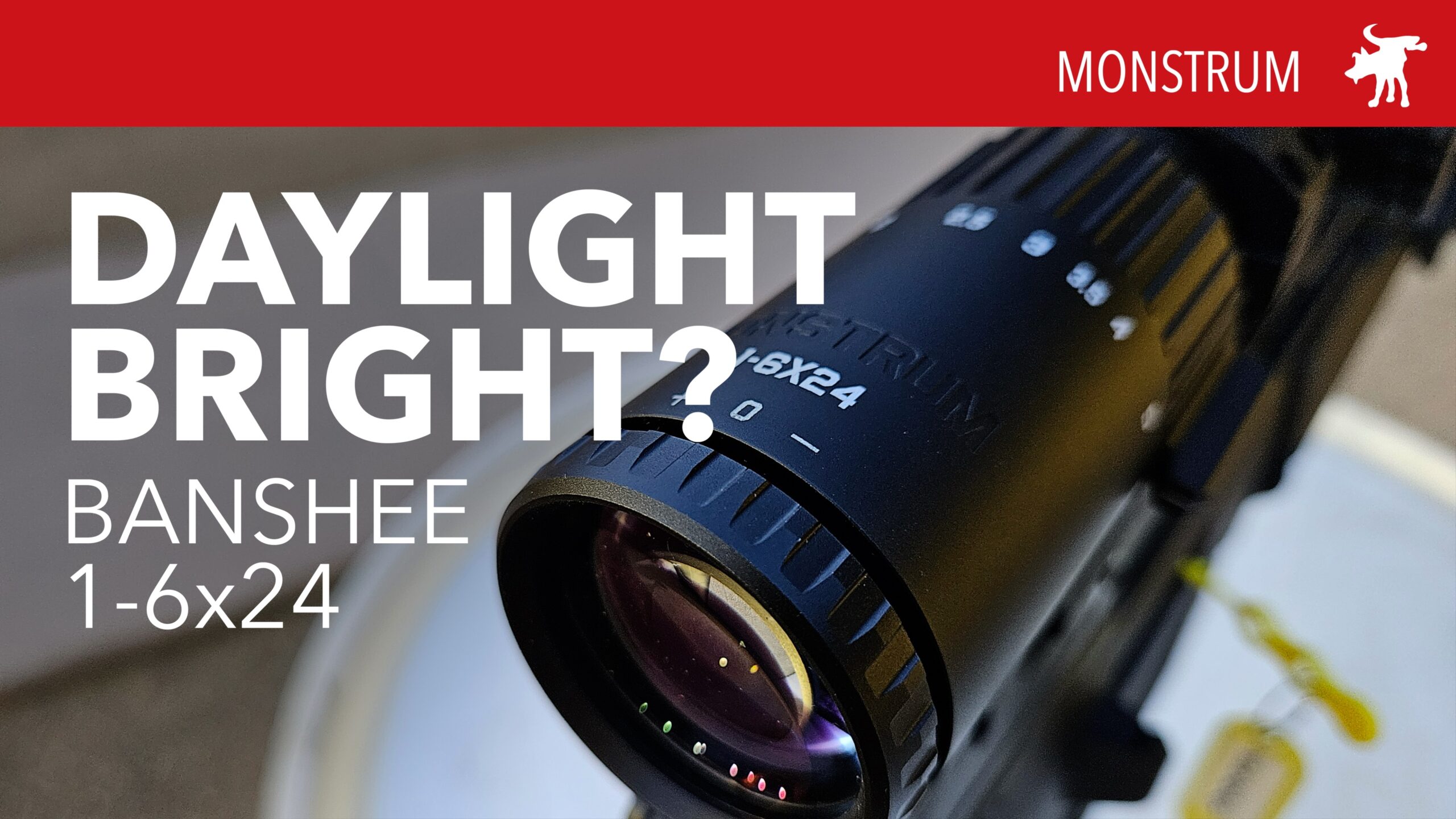
Many LPVO’s claimed to have “daylight bright” illumination, but until recently that was largely a boast. Monstrum sent me a 1-6×24 Banshee. This LPVO appeared physically identical to the 1-6×24 Banshee I previously reviewed but this sample comes with their new BDC-C1 fiber optic reticle.
The package comes with the an offset mount and flip-up caps. The scope has capped turrets that are resettable to zero. This sample’s turrets had audible clicks but were a bit sloppy indexing.
Unlike the standard Banshees, this version’s illuminator rheostat only has red as its color and has an ‘off’ setting between its numerical intensity levels. To make the reticle daylight bright, a hair thin fiber optic strand is embedded inside a BDC duplex reticle to provide a bright illuminated point at the center of the crosshair. In my tests, I found that at at its maximum intensity the reticle was red-dot bright, easily visible in broad daylight even pointed into the sunlight sky.
It checks the boxes. At 1x it’s a flat 1x view with no fish eye. It provides a surprisingly clear and sharp image with little to no chromatic aberration even at maximum magnification. It’s held zero over multiple range visits. This makes the Monstrum the most affordable daylight bright LPVO that’s worth a damn.
This optic is available on Amazon through this affiliate links which support my channel:https://amzn.to/3SndrLQ
Vortex was one of the first optics companies to roll out true “daylight bright” illumination on their LPVOs; bright enough to be seen outdoors in daylight sun. Monstrum recently released their first LPVO with a reticle that claims to be “daylight bright”.
Monstrum sent me a sample of their newest Banshee with a new BDC-C1 fiber optic reticle. They also sent along a brand new Vortex PST Gen2 and asked me to test and compare them. Both are 1-6x SFP LPVO’s with 30mm tubes so it would make for a fair apples-to-apples comparison.
Both LPVOs looked broadly similar. The Viper has larger diameter turrets and some small details in its construction that cue anybody who has milled metal that it’s a higher value scope. Both have 30mm tubes but the Viper manages to offer more than twice the range of adjustments of the Banshee’s 70MOA.
Both have illuminator rheostat that offer an ‘off’ setting between its numerical intensity levels. The Viper offers 10 levels whilst the Banshee offers 6; and unlike the other Banshee models, only in the color red. The Vipers rheostat dial had an annoying slop that made me turn past and accidentally turn the unit off when changing intensity levels.
Both have capped turrets with 1/2 MOA adjustments per click; which were clear and loud. The Monstrum’s turrets were mildely tactile positive with a fair bit of slop between clicks. The Viper’s turrets were crisp, tactile clicks with very little slop. I didn’t bother with tracking tests as capped LPVOs, the designs intent wasn’t for futzing during use. These turrets were meant for zeroing the reticle and then shot adjustments should be made by the user using the reticle’s sub tensions.
The Viper had a smoothly turning power ring but was stiff enough that I would have wanted a throw lever that the Viper’s retail package lacks. It did come with a 2″ sun shade which none of the Monstrum LPVOs include in their package. The Banshee’s power ring was stiffer and not as smooth but compensates for it with a built in fin-style throw lever.
Looking through each scopes, the Viper had a brighter view. But both appeared crisp and sharp at 1x. The Vortex had very, very, slight fish eye curve at the outer edge of the view. In most other ways, the LPVOs were evenly matched. Only at the covered range did the Vortex show a clearly greater sharpness and brightness offering 3 levels of resolution better than the Banshee and less chromatic aberration.
The reticles were also very similar looking semi t-style; the Viper having MOA sub tensions whilst the Banshee has bullet drop calibrated sub tensions. Both have a bright central point which illuminates creating a red-dot like focus point. Comparing both at their brightest settings, both were similarly daylight bright and visible even when aimed into the sky near the sun.
At this point there really wasn’t much else to test. While the Viper at 11 may be a bit brighter than Monstrum’s new BDC-C1 Banshee at 6, both are truly is daylight bright. How much brighter do you need?
At the range, I could quickly and accurately aim and hit my targets. Like so many of their features, I found the eye boxes to be effectively identical. Because these scopes were short-term loaners, I wasn’t able to test durability or ruggedness but both held their zero during my day at the range on my 5.56 AR.
Both scopes come with lifetime warranties on workmanship but the Viper comes with Vortex’s no-fault policy, covering accidental damage and user error. Recently Monstrum revised their warranty to cover accidents but their fine print requires a receipt and I haven’t had any feedback with ease of returns. Vortex seems to have an easier return policy but recently has a reputation for sloppy QC.
By far the biggest difference between the Banshee and the Viper is their price. The Viper is one of Vortex mid-range models and sells for $599 on Amazon, which is 4 times the price of the Banshee ($149). Moreover, the Banshee includes a quality offset mount. The Viper does not include a mount and the Vortex Sports mount costs an additional $100.
Comparing the Monstrum Panzer vs Vortex Razor HD 1-10x FFP the differences in the quality of the scopes was significant. But comparing the Banshee to the Viper, the differences were harder to find. Certainly the Viper was sharper, brighter, had more range of adjustments and a better warranty. But if I had to the choice to buy either of these scopes, I think I’d choose the Banshee because its a better value.
These optics are available on Amazon through these affiliate links which support my channel: