At the Leupold booth in SHOT Show 2025 I was brought into their meeting room to see just one scope. But this scope was the Gen 2 update of their flagship VX hunting line. The VX HD Gen2 features ED glass and a newly redesigned tool-less resetable turrets. These turrets have a lever which sits flush into the circular turret, which swings out to release the turret top to reset the zero.
Last year, Discovery impressed me with the ED-PRS Gen2 5-25×56 scope with its high-quality glass, features, and street price under $500. They told me they were working on a 6-36x version but had delayed production until they were satisfied with the results. The wait is finally over with the XED 6-36×56 with a street price of just under $700.
This scope is share many of the features of the new ED-PRS Gen2 MOA like its new throw lever design and its tool-free turret screw tops. The XED is slightly longer and heavier overall with a noticeably wider parallax dial than the ED-PRS. The biggest change is the XED’s 35mm tube which allows a wider range of adjustments.
The XED utilizes Japanese ED glass for excellent optical clarity and brightness while minimizing chromatic aberration. Most high power scopes have tight eyeboxes, the XED is unforgiving at 36x. Tight eyebox aside, for those that require a bit more magnification than the ED-PRS 5-25x, the XED is tough to beat.
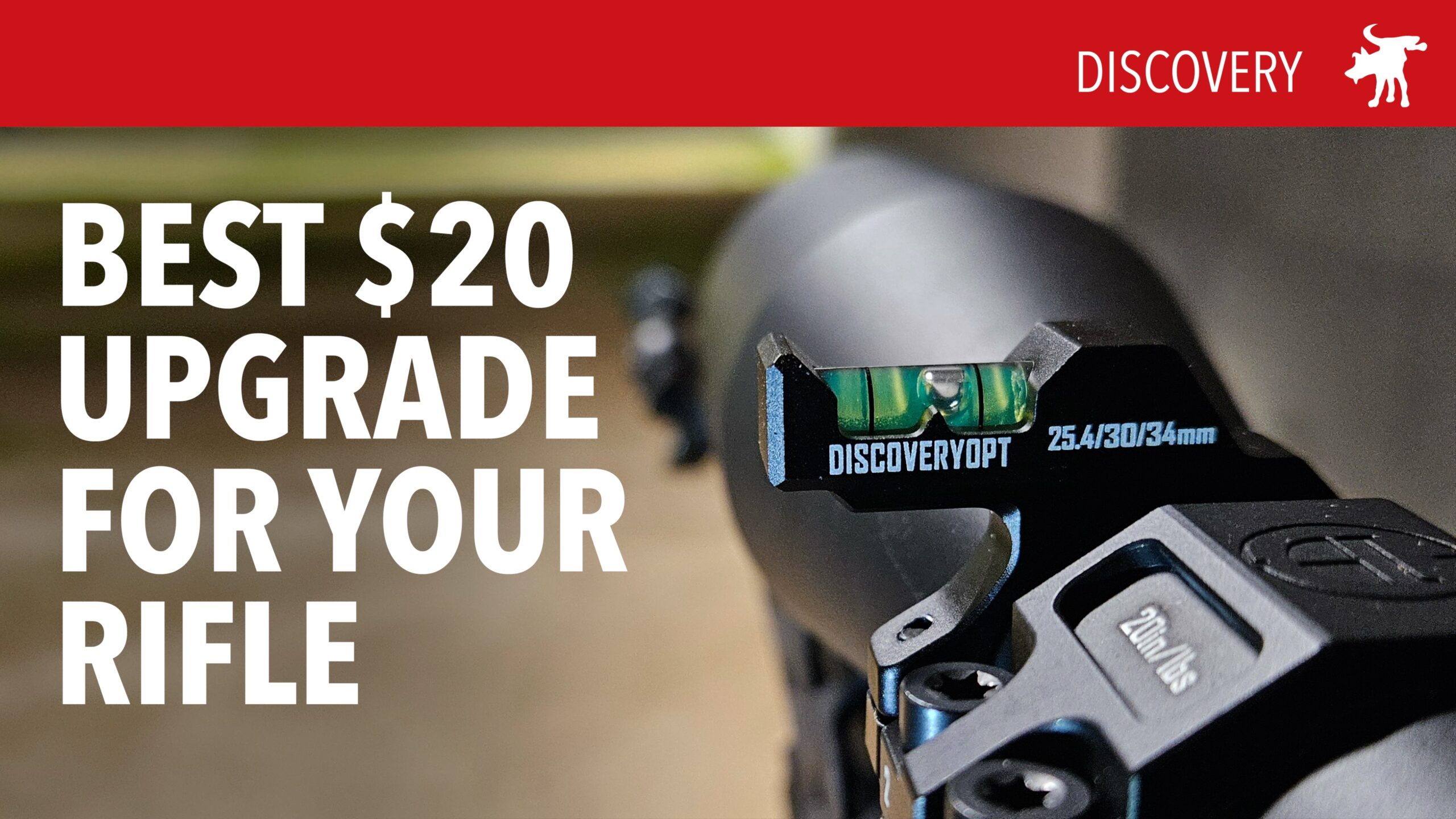
It’s hard to believe, but you can improve your long range accuracy for less than $20 by simply attaching a spirit bubble level to your scope. Discovery Optics makes such an accessory. It’s a spirit level mounted in a metal ring which you can clamp onto your scope tube to you can read the angle and levelness of your scope and rifle setup.
If your scope is not 100% directly above your rifle bore, which can happen as you press your cheek to your stock or simply adjusting your shooting position, or when setting up a hasty shooting position, this can create a slight canted angle either to the right or left of center. This will in turn can make your shot land ever so slightly to the right or left of your aim point. By assuring your scope is level to your bore with a spirit level, you can avoid this simple mistake.
This scope level is made of aircraft grade 6061 aluminum alloy with an easy-to-read bubble bead in the spirit tube. It comes with two ring adapters allowing the bubble level to be mounted on either 1″ (25.4mm), 30mm, or 34mm scope tubes. It is probably the best $20 you’ll spend on your scope set up.
Before I knew anything about high power scopes, I purchased a CVLife 6-24×50 AOR scope for my AR15 and happily used it at 100 yard targets. It was basic, out-dated, but cheap, and surprisingly reliable. “Walmart” quality is where I’d position their scopes, but recently they’ve attempted to bring themselves up to the level of “Target” or “Sheels”.
The Eagle Blaze is CVLife’s most ambitious attempt to date to put out a true long-range optic. The scope has 5-25x magnification range, a usable first focal plane (FFP) Christmas tree reticle, a zero stop, and using Japanese ED glass. On paper this looks like a legitimate PRS-style scope with an eyebrow raising $299 street price.
To achieve this low price, there must be compromises. The turrets are user resetable with a coin, come with a zero-stop ring lock, and have audible and tactile positive clicks. But they have a flaw. Unless the turret top is insanely cinched down, the turret will turn lose after locking down losing, rendering its push-to-lock feature useless.
In my testing I found that twisting free a “locked” turret does not move the reticle. It essentially makes the turret free floating. You are better off leaving the turret in the up-position at all times, otherwise your numbers will not sync to your zero.
Optically, the ED glass did reduce chromatic aberration. But in low light (in a shaded target cove), the scope lost a lot of detail and contrast. While this is a liability to hunters who need the ability to take game after sunset, the Eagle Blaze is a surprisingly good scope in broad daylight.
CVLife continues to improve the quality and features of their long-range optics line. This scope fumbled the execution but the play was solid. I look forward to a correction and improvement soon.
Telson is a new optics company out of Texas that I’d never heard of prior to making this video. A fellow Pewtuber asked if I’d be interested in reviewing a premium, mid-range scope with Japanse ED glass. A few days later, I got a box sent to me from @GunTotinMinnosotan
The plain white sample box is not the retail version and I can’t confirm what sort of accessories a consumer will receive such as lens caps, throw levers, etc. My sample was the actual production version, albeit with scope rings attached (which may not be present in the retail version either).
Physically the scope reminded me of a Leupold Mk5 or a US Optics. It had a unique diamond-weave design motif in the contact surfaces of the turrets and rings. It came with a removable throw lever with a diamond-shaped design. The rings turned smoothly and the turrets were crisp, audible, and tactile positive.
The elevation turret has a zero-stop which is engaged by lowering the turret onto an internal pin. The turret has a pop-up indicator when the turret is turned past its second revolution. This indicator is actuated by the zero-stop pin under the turret and does not function when the zero-stop is deactivated. Neither the windage or the elevation are locking.
The image through the glass is impressive owing to its quality ED glass. Bright, clear, and color-accurate with minimal chromatic aberration. I liked its thin clean Christmas tree reticle with a small floating central dot. The only disappointing aspect I found was its tight eyebox.
I had one other disappointment: I had to return the Toxin. I handed this scope back to Telson at SHOT Show so that they could display it at their booth. But they did give me something back in return: a coupon code to share with my readers to get 6% off buying one for yourself.
Telson is a new Premium Optics company based in Texas. I had never heard of them prior to testing their Toxin 3-18×50 scope. I met their founders (Canadian precision shooters) for the first time at this year’s SHOT Show.
Their scopes are all over a $1000 but have features usually found on scopes that cost many times more. Telson scopes feature high end Japanese glass, practical design features and quality construction. I was also impressed by the thought they put into the quality of their mounts and accessories.
Only time will tell if Telson succeeds in the crowded and competative PRS optics market but the quality of their products, design, and marketing are on target and all center X.
The Vortex Strike Eagle 5-25×56 is one of the top-rated long-range scopes under $1000 (MSRP over $1250 but with a street price of around $700) when it first came out a few years ago. Vortex took many of the features found in their top-tier Razor HD and created a virtually identical-looking scope for a 1/3 of the price. But is it a “Budget Razor” or a “cheap knockoff”?
The Strike Eagle shares a nearly identical-looking external design to the Razor, save for the Razor’s MilSpec FDE/Burnt Bronze finish. But on closer inspection, there are some differences. The illumination knob does not lock and the elevation and windage turrets don’t feel as crisp or precise as the more expensive Razor. While the controls are lackluster, its glass is not.
Looking through the scope, I was treated to Vortex’s glass. The image was bright, sharp, color accurate and high contrast. At the range, I did notice some chromatic abortion at high magnification, but not as pronounced as seen in the video footage. The Strike Eagle is able to resolve fine details to a degree I usually see in much more expensive scopes.
The Strike Eagle is not cheap. With the arrival to the market of brands such as Arken and Discovery Optics, its performance has been matched or even exceeded to some degree by budget High-Performance scopes. The Strike Eagle is still Vortex’s best glass for long-range under $1000.
Discovery Optics is known for making high-quality shooting optics for ridiculously affordable prices. I’ve reviewed a number of their scopes over the last two years. Discovery Optics attended SHOT show for the very first time this year. At their booth, they showed off a brand new version of their flagship ED-PRS scope.
The ED-PRS is a Chinese-made scope that uses Japanese ED glass and is designed for PRS shooters. Almost all of Discovery Optics’ tactical and competition scopes are built with MIL reticles and turrets. But many American hunters and long-range shooters, prefer MOA measurements for their finer level of adjustment. Discovery listened to user feedback have released the 5-25×56 ED-PRS in MOA.
At their booth, I got my first-hand look at the new ED-PRS MOA and met fellow YouTube reviewer GunTotinMN who was working for Discovery as their presenter for SHOT 2025.
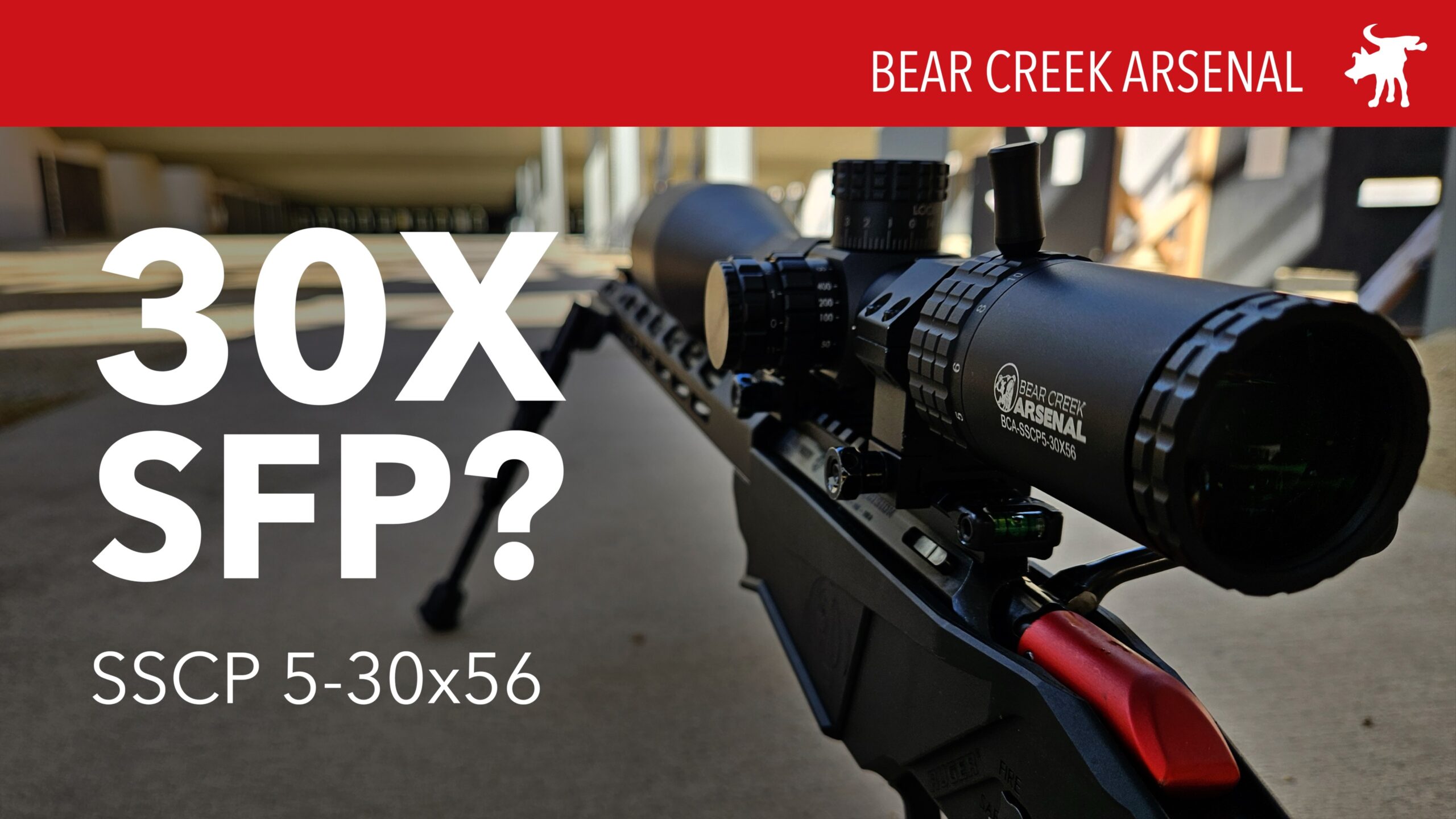
Bear Creek Arsenal is a value-priced ARs, firearms, and components maker. But it isn’t as well known as some other value-priced brands like Palmetto State Armory. What’s surprising to many more is Bear Creek Arsenal also sells branded rifle scopes and red dots. But more surprising to me is that they make a low-priced 30x scope.
The BCA SSCP is a 5-30x scope with a Christmas Tree reticle but in SFP which means the reticle doesn’t change size or thickness when changing the magnification. This means the ranging marks are only shown accurately when using it at 30x (without using mental math) but it also means the reticle is visually prominent and usable at 5x. For many hunters, this is a desirable trade-off.
Given its low price, there will be compromises. The turret numbers do not line up to the witness mark. Optically, it has a tight eye box and noticeable chromatic aberration. The image gets milky and dark at 24-30x.
For hunters looking for more magnification than a typical 4-16x scope but with a very tight budget the SSCP is a scope to consider. For someone interested in getting into long-range shooting on a shoestring, the optical limitations may be frustrating.
Maven has some of the sexiest looking scopes on the market in terms of build quality, materials, and styling. But don’t let a hot body fool you. Like an exotic sports car the Maven RS.4 has serious engineering under the hood.
The RS.4 is Maven’s scope for PRS competition or long range Western hunting. It offers many features optimized for long range enthusiasts. Maven offers it in MIL or MOA with a variety of Christmas tree and specialty reticles. I got the CFR-MIL reticle which is similar to the PR2 reticle on the Leupold Mk5.
The turrets are oversized and large diameter to provide quick turns to adjust dope and fine adjustments. The turret have a hidden tool-less locking top to allow the user to reset them. Under the elevation turret you’ll find a black metal ring that can be dropped to engage a pin on the turret base to engage a precise zero-stop.
All the nobs and rings turn smoothly. The turrets offer precise tacticle clicks that are audible. The reticle illumination is powered by a CR2032 coin battery and is split between red and green settings with an off in-between brightness settings. The illumination dial layout is a little unusual with the highest settings in both red and green are on the same side of the dial. Unfortunately it’s illumination is only so-so. Only the very central cruciform of the reticle is illuminated with a faint glow on the Christmas tree. The RS.4’s brightest isn’t noon-day daylight which a liability for certain lighting conditions.
The RS.4 has ED glass which gives it excellent sharpness, clarity, and color balance. Chromatic aberration was greatly minimized in all but the highest contrast conditions. Even in those extreme cases, I noted an orange fringe rather than a purple or green one. The eyebox was a bit unforgiving, even with the magnification dialed down to 10x. At 30x it’s very tight, so it’s imperative the shooter have a firm and comfortable cheek weld on their rifle.
The RS.4 is a beautifully designed scope with long range shooters in mind. Especially the kind of shooter who step out of their custom Cybertruck wearing their ironed T.A.D. outfits and matching Canadian Goose parka.