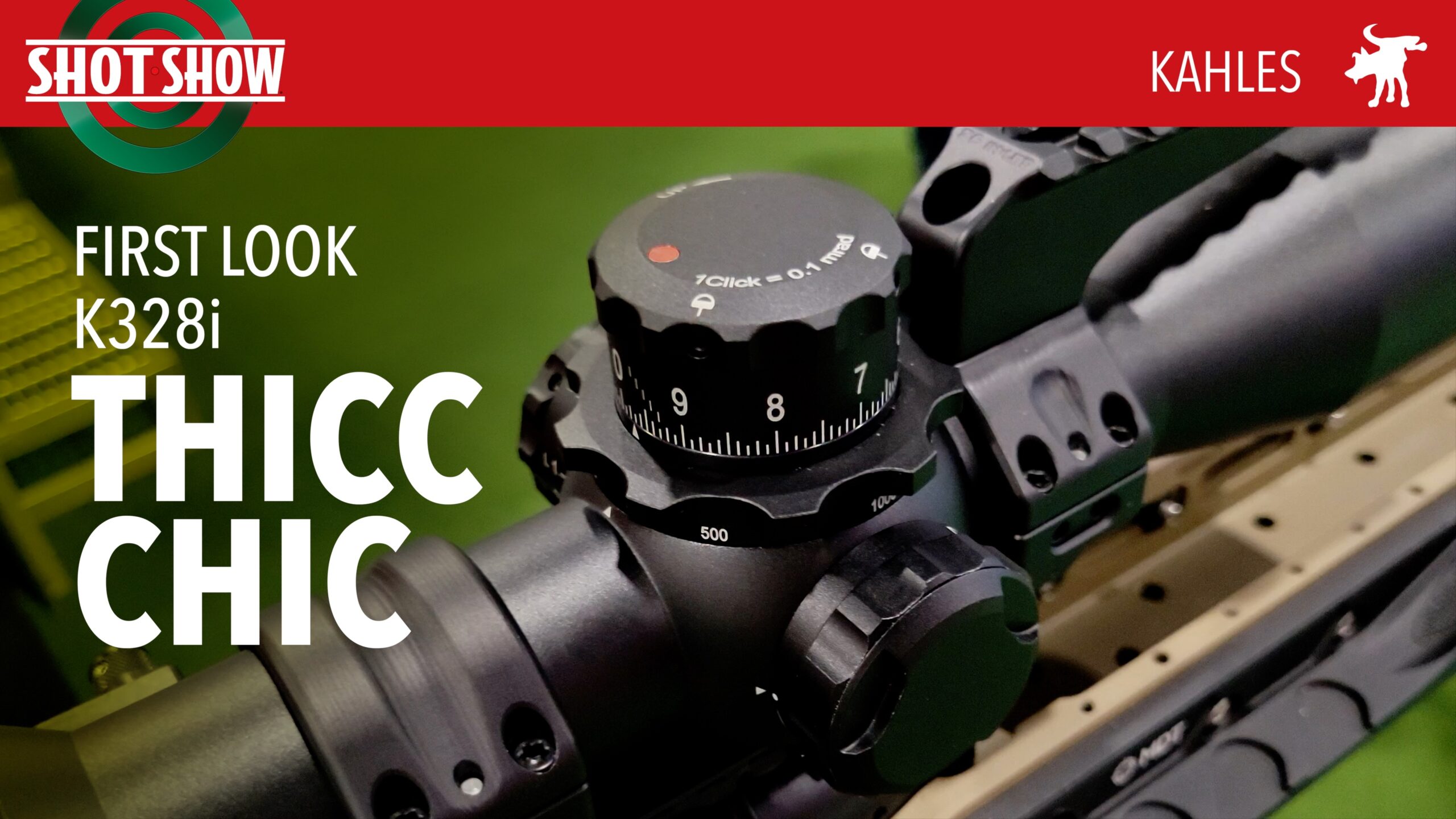
Kahles is known in the PRS world for having some of the sharpest, clearest scope when going after targets at 1000yrds or more. After 5 years of development Kahles was eager to show off their newest long range precision scope at SHOT Show. This features not a 36mm tube (good luck finding a many choices for mounts) for an extended range of adjustment and a 40% wider field of view.
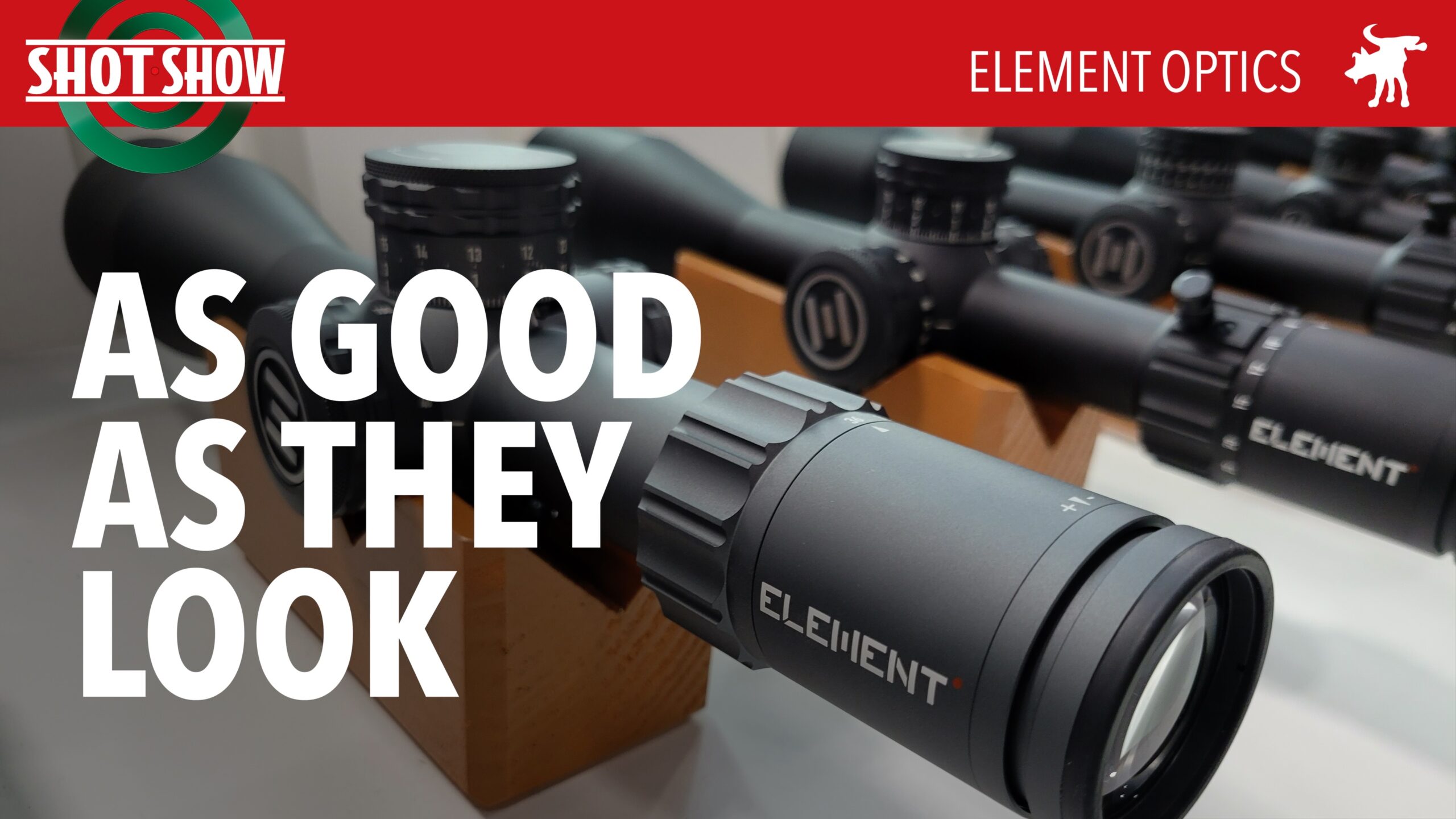
At this year’s SHOT Show I spoke with one of Element’s owner’s, Shane Keller. This Utah based company with design offices in Sweeden and South Africa. While a relatively new company in sporting optics, this company was founded by professional shooters and optics designers with decades of experience. Their Nexus and Helix scopes quickly gained a following among competition PRS shooters for their quality design, features, and optics which rivaled established premium brands.
At this year’s booth they showcased their new Tier 1 PRS scope, the Theos. This scope effers not just superb optical performance but innovative and practical features such as tool-less turret and zero-stop reset, and a pop-out turret rotation indicator. Their Theos, Helix, and Nexus, feature a stylish gunmetal grey finish and are built in Japan.
In addition to their new rifle scopes, they also offer a 10x binocular and I was surprised to also find out they offered a variety of range finding accessories. Their handheld laser rangefinder that connects via Bluetooth to their ballistic App. What really intrigued me was an unusual small laser rangefinder unit that is designed to piggyback on your existing scope. About the size of a AA EDC light, this unit has an LCD ballistic display on its tail to offer the shooter immediate data to take their shot.
I hope to get my hands on Elements products soon to test them out and learn for myself what all the buzz is about.
While testing the new Gen2 ED-PRS Discovery Optics sent me to review, I was filled with deja vu. It felt like I had just reviewed the ED-PRS though that was a year ago. Visually the Gen 1 and the Gen 2 are nearly identical save for slightly bolder font on the turrets.
The Gen 2 comes in a slightly smaller box than the Gen 1. Discovery scopes come with a ludicrous amount of accessories including high-quality scope rings, a scope base leveler, a lens cleaning cloth, a lens cleaning brush, and sun shade. Missing are the two additional 3″ sun shade tube sections present in the Gen 1.
The size and weight of this scope are hard to forget at nearly 4lbs and over 16″ long; over 19″ with the sun shade attached. One important difference with the Gen 2 is its greater range of adjustments, doubling the Gen 1’s numbers. The Gen 2 is also 4 oz heavier.
The ED-PRS has huge turrets. It’s like they looked at Arken’s turrets and said, “Hold my beer”. That said, the turrets are quite audible and tactile-positive with no slop. The elevation turret has a ring and cog tooth style zero stop.
The Gen 2 sports Japanese ED glass. Optically the image is quite bright and clear, with a slight warm tint but with little chromatic aberration; noticeably less than the Gen 1. The sharpness and resolution were quite impressive.
The only disappointing aspects is the Gen 2’s unforgiving eye box (which it shares with other Discovery scopes I’ve tested) and illumination. The maximum illumination isn’t visible in shaded daylight but is sufficient for low light. Neither of these issues is a deal breaker.
Then Gen 2 has excellent features and performance, a plethora of quality accessories, and an Amazon price of $400 If you need a long-range scope and weight and size aren’t an issue, the Gen 2 is arguably the best value scope. Period.
Hi-Lux is known for making vintage style optics, They make the Malcolm, possibly the best reproduction Unertl style scopes on the market. They also make modern tactical optics; last year I tested their PR5 long range scope and found it a solid long range tactical optic if a tad heavy.
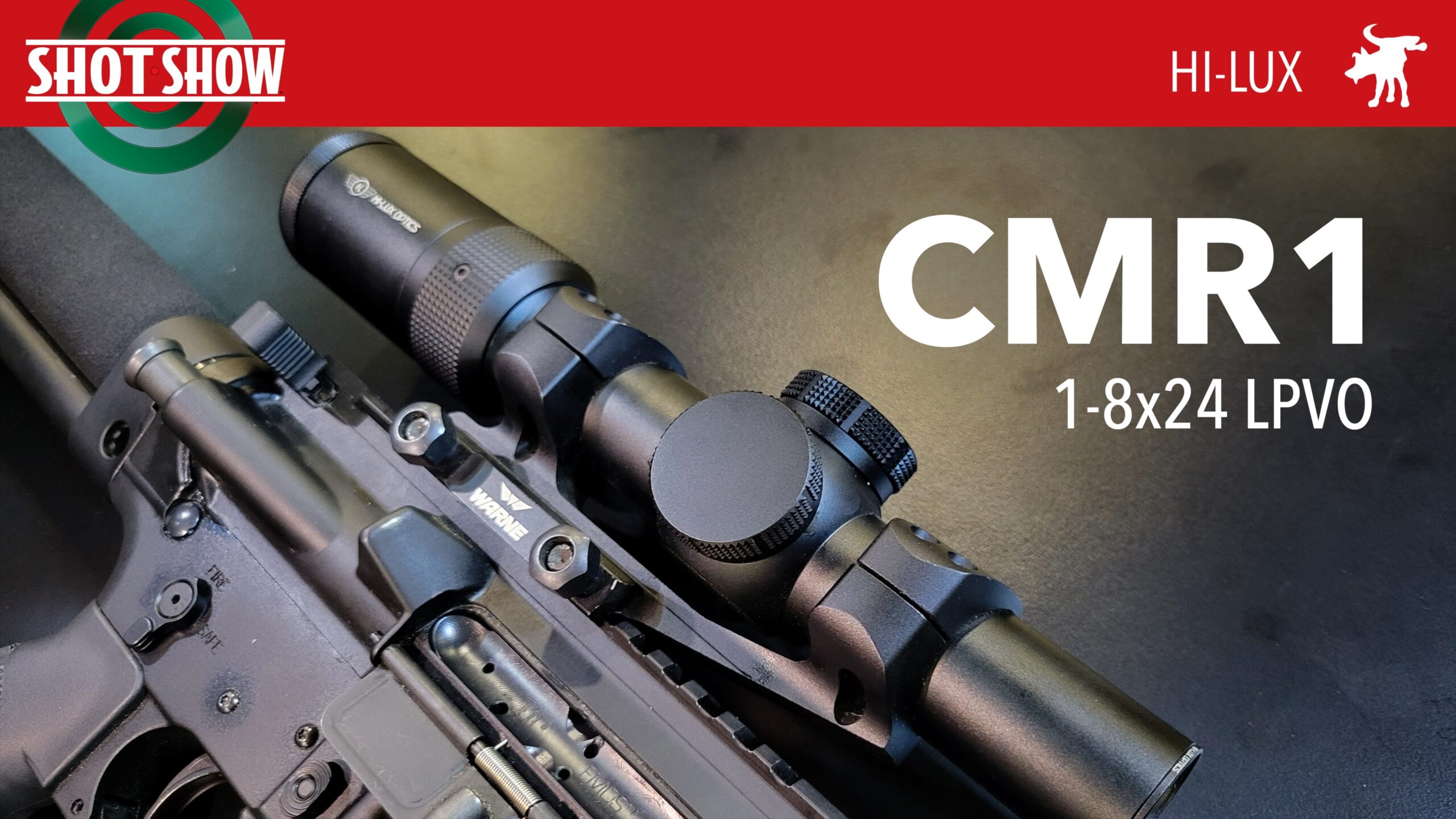
At SHOT Show this year, they showed me their new 1-8x LPVO the CMR1. This utilizes fiber optics to achieve a daylight bright central point like a red dot. I hope to get a sample to see how good it performs optically.
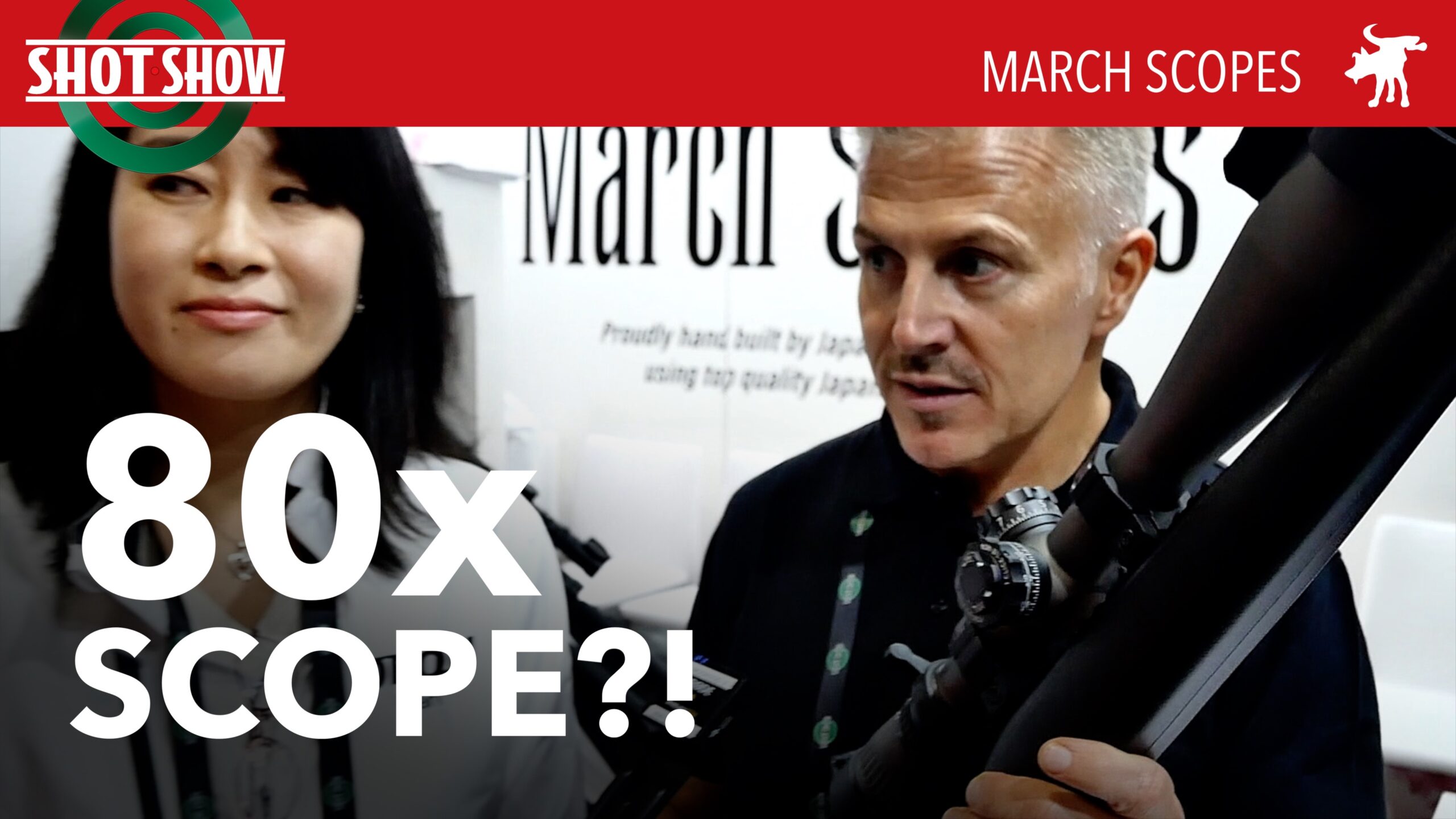
Since the departure of Nikon from sporting optics, March Scopes has stepped up to become Japan’s maker of premium rifle scopes. They are known among competition Precision Rifle Series (PRS) shooters for their high power scopes. At SHOT Show I was introduced to their new 80x Majesta scope, the highest power rifle scope I’ve ever seen. And the Genesis, a 4x-40x scope that puts the Extreme in Extreme Long Range (ELR) shooting with 400 MOA (116 MIL) of adjustment.
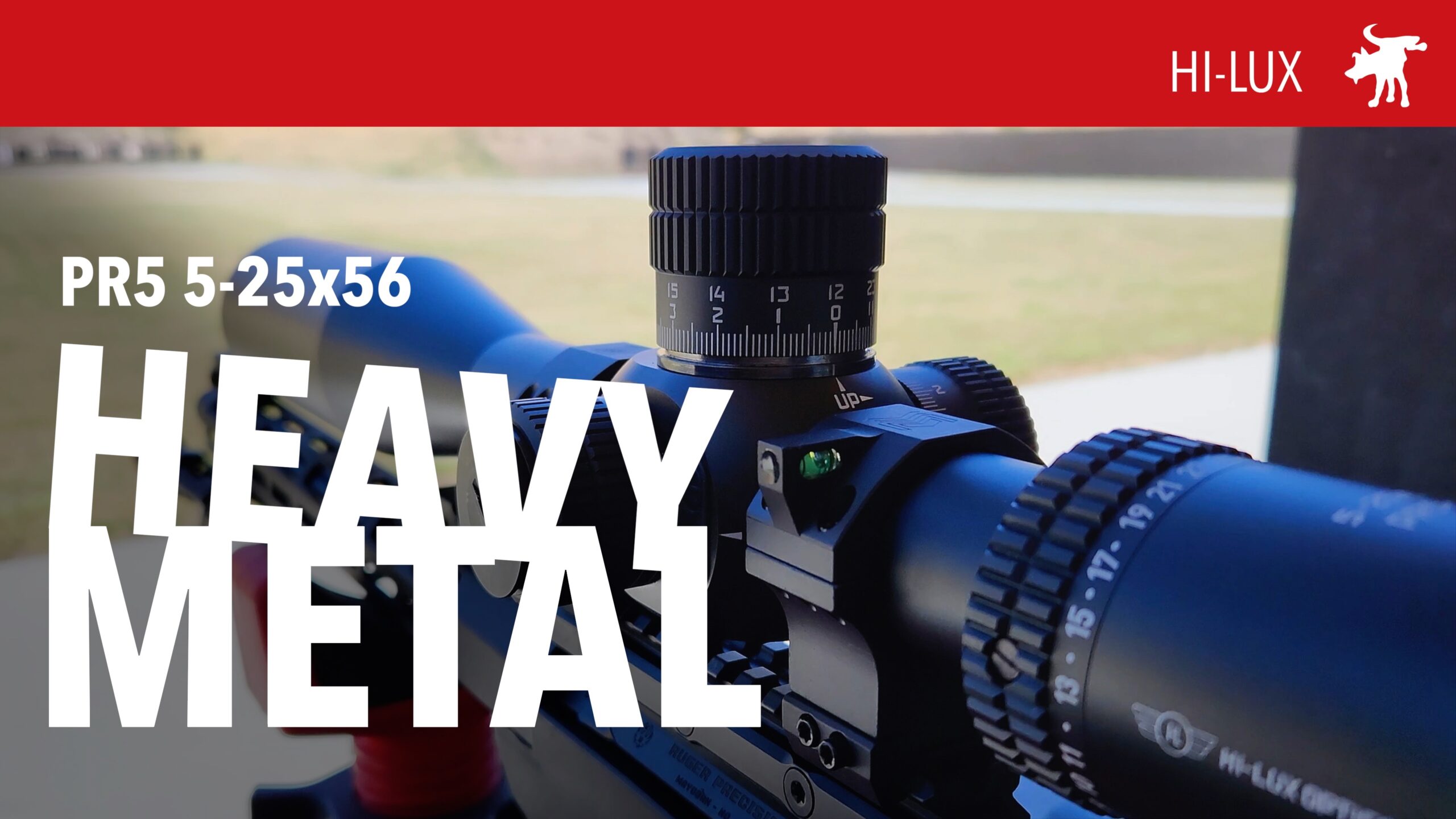
Hi-Lux is an optics company best known for making reproduction vintage-style scopes. But at Shot Show this year, their show stopper was their newest modern ELR/PRS scope, their PR5-R a 5-25x56mm beast of a scope. They were kind enough to send me a sample to text and evaluate.
Out of the box the scope is massive. It is 16″ long even without the included sunshade. It is perhaps the heaviest scope I’ve yet tested, weighing in at 2.5lbs (40oz). The package includes the aforementioned 56mm sunshade, front and rear flip-up caps, and a throw lever.
The scope has equally massive and oversized turrets which have nice loud clicks and are tactile positive. The elevation has a zero-stop reminiscent of Leupold’s spiral groove design but with the spiral under the cap instead of the base of the turret. While interesting, I found correctly lining up the stopping pin in the grove to be sometimes finicky.
In addition, Hi-Lux’s “Zero Stop” is designed to stop 1 MIL past 0. So perhaps they should call it a “1 Stop” or “+1 Stop” instead? Moreover, my turret didn’t stop at 1 MIL, instead stopping sometimes at 1.2 or 1.3 MIL. While you can correct for this by adjusting your initial zero, I find this lack of precision problematic. But as I so not use Zero Stops my disappointment is somewhat moot.
The magnification dial was moderately stiff but movable without the throw lever. The ocular focus was smooth and the eye-piece features rotation markings making. This is an often overlooked feature on scopes and I wish more makers put them on their scopes because this makes it easier to return to a known focus when sharing a rifle with a guest shooter.
The most interesting feature of the scope is it’s digital illumination controls. The brightness and activation on controlled by two rubberized buttons next to the paralax focus knob. The model I tested had red illumination but Hi-Lux also sells a green illumination model.
The entire central sub-tensioned cross-hair and Christmas tree is illuminated. The two lowest brightness settings are designed for night vision and were not visible to my naked eye. The highest level (11) was not daylight bright but more than bright enough for dusk. It is powered by a CR2032 coin battery in the parallax knob, which can focus down to 10 yards.
At the range I noted distortion along the outer edge of the image and chromatic aberration at 5x which is usually the best image seen through a scope. I was therefore surprised when the outer edge and color distortion improved at 25x. We did lose light and there was a noticeable reduction in the eye-box.
In overall sharpness and contrast the scope was middling to average for a $800 scope (I’ve seen street price ranges from $800-$1300 depending on retailer) but its resolution was as good or better than similarly priced Athlon and Arken scopes I’ve reviewed.
This scope was designed to appeal to ELR and Bench Rest Precision shooters for whom a +40oz tank of a scope is not a problem but an advantage. It’s turrets are oversized, easy to read and control. But it’s finicky Zero Stop may be a deal breaker for some competitive shooters.
I was contacted by Discovery Optics a few months ago to review their new ED-PRS scope. What I got was a scope in a large box filled with accessories. Usually when you get a ton of stuff with a scope this is a bad sign; they are cheap accessories designed to distract you from a mediocre scope. The Discovery ED-PRS on the other hand contained some high quality accessories that were a step above what you’d often get with some other scope brands.
Instead of a simple sheet of fabric cleaning cloth, the ED-PRS came with a soft chamois. In addition to the chamois, it also included a photography lens cleaning pen with an optical nano carbon cleaning tip. It included a set of high-profile scope rings with recoil lugs and printed torque markings.
In the box was an all metal scope level kit which helps you level and square your scope to your rail. I’ve only seen this tool is usually sold as an after-market accessory. And perhaps the most unusual items was a 3-piece sun shade tube which ads about another 10″ to the 13″ long scope.
The scope itself was sizable. It weighs 24oz but feels heavier. Its most notable feature are its oversized turrets. The ED-PRS’s turrets are even wider and taller than an Arken EP5. The turrets are non-locking, resettable and contain a cog wheel style zero-stop similar to Athlon’s Gen2 scopes. The turrets have brass cores and were loud and tactile with no slop.
The turrets, wheels, and nobs feature aggressive fine knurling, which along with being oversized make them generally easy to turn even when wearing gloves. All except for the magnification power ring which was exceedingly stiff and difficult to turn; even with the removable throw lever attached. I found myself really having to manhandle the lever to change magnification which severely impact performance for hunting or competition.
Not that I would take this scope hunting. I think it’s probably too bulky and heavy for most hunters (except those shooting from pimped out blinds or truck beds). The ED-PRS is probably best suited for precision bench-rest shooting with its easy to read markings and fine lined first focal plane reticle. While the scope features a ELR style Christmas tree reticle, serious long range shooters may be disappointed with the glass.
The ED-PRS has what they call a SFIR reticle, which looks a lot like the Arken VPR reticle but with more subtension markings. Like the Arken, the Discovery’s reticle only illuminates the very center cruciform of the reticle, creating something of a red-dot effect when used in low magnification. The illuminator has 6 brightness settings each separated by an OFF setting.
The first unit I received also had a very dim illuminator. Even with the scope cap on I could barely see the illuminated center cross at its highest illumination setting. Discovery sent me and a replacement scope and return label for the defective scope but the process took 3 weeks. They did warm me of the delay due to Lunar New Year which causes many delays in factory production in China. The new scope had a much brighter illumination but even this was not quite daylight bright.
Looking through the scope the image was surprisingly good for a budget scope. Bright with good center to edge sharpness. The other edge of the sight picture had only a hint of distortion even at 25x. The scope kept focus and point of aim throughout its magnification range. The eye box and eye relief were good for a budget scope.
The scope advertises ED glass but I noted some softness in detail at long range that I attribute to chromatic aberration. This was noticeable in mid day light with the target backlight. Overall resolution was better than average for the scopes price tier but not the best in its class. The ED-PRS was still sharp enough to allow me to pick out .22cal holes on paper at 100yrs.
The ED-PRS’ glass is not in the same league as a Leupold VX, Athlon Argos, Vortex Diamond Back Tactical, or even an Arken EP5. But when comparing what you get in the box for a street price of $399 (as of this writing) I would still consider the ED-PRS a good value. If you’re a beginning long-range shooter with a limited budget, this scope is something to consider.
This scope is available through my Affiliate links
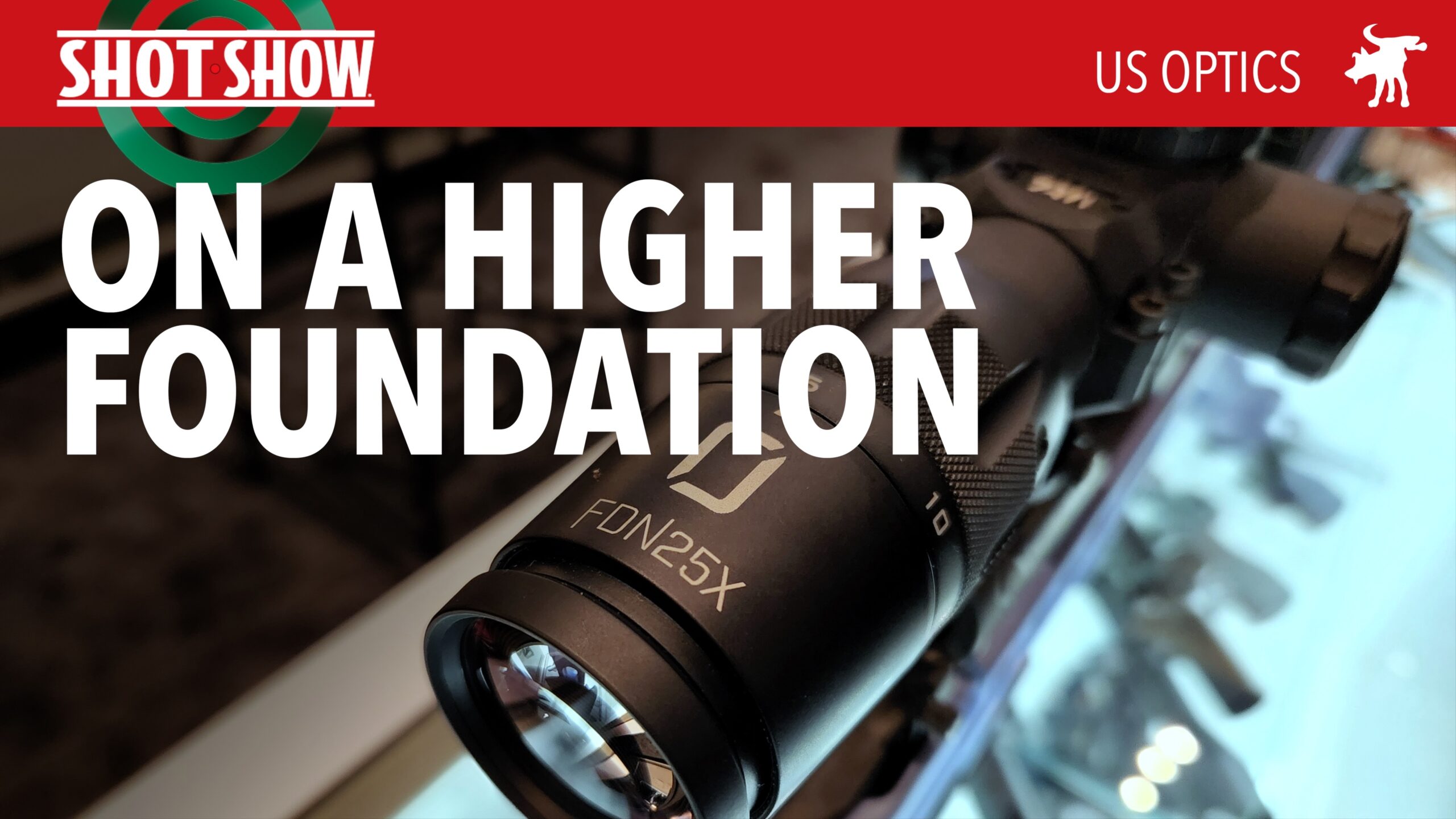
U.S. Optics got its start back in 1992 repairing and maintaining the US Marine Corp’s sniper rifles. Fast forward to 2023 and they’re in the rarified top tier of brands like Nightforce, Leupold, Schmidt & Bender, and Tract; producing +$3000 rifle scopes. Among this elite tier of scope makers, they are perhaps one of the least well known. But in terms of the Industrial Design of their turrets and tubes, they are one of the more progressive and stylish.
The Foundation 5-25×52 is available on Amazon through my Affiliate link: https://amzn.to/3IFNCAt
Hi-Lux is well known for their Leatherwood hunting scopes and Malcom vintage reproduction scopes. But they also make modern tactical and target scopes. At SHOT Show 2023 I got a chance to see the PR5 5-25x56mm FFP, their newest precision tactical scope that is ready to compete in both NRL22 and PRS competitions.
The PR5 has all the features you’d want in a long-range scope like HD glass, 32 Mil-Rads of internal adjustment and a modern FFP Christmas Tree reticle. In addition, the PR5 has a more modern digital controlled illuminator with auto shut-off, a feature found in most red dots but still lagging in even more expensive rifle scopes.
What sets this scope apart from bigger brand name PRS scopes, is that the PR5 has a minimum parallax focus distance of just 10yrds. That means it’s perfect for airgun competitions, NRL22, Precision Rimfire, and indoor ranges. While far from a budget scope, it still manages to come in at a street price bellow $900, which is remarkable for all these features.
At the booth I also got a walk-through of Hi-Lux’s vintage scope line. With the recent heightened interest in lever action Western guns, Hi-Lux is one of the few scope makers that offers vintage looking optics that utilize modern mounting standards and contain HD glass.
Aero Precision is well known for making some of the best built ARs. They brought their engineering experience in aerospace manufacturing to firearms, hence their name. Recently they’ve diversified into other rifle platforms including Pistol Caliber Carbines (PCCs) and this year officially released their first bolt-action precision riles: the SOLUS.
At Shot Show 2023’s Industry Range Day, I got a chance to shoot a SOLUS rifle in 6.5 Creedmoor. The PRS Competition rifle I shot is modeled after the Remington 700 action with a lot of parts compatibility. Aero made some improvements including a 20MOA Picatinny optics rail integral to the receiver, a short 60º throw and a reinforced 3-lug bolt.
I shot a mag and half and got a good first impression. I don’t know how many rounds my sample rifle has had through it, but the bolt pulled smoothly. The trigger was crisp. The Aero designed chassis was well built with a nice thin profile hand guard with an integral ARCA/Swiss rail. I was able to reliably hit the 900m gong with a 10-30 mph gusting cross-winds.
The SOLUS system is available as a drop-in barrel and action or as a complete rifle. And sadly one of the few new guns I saw at SHOT show that will be coming to California.