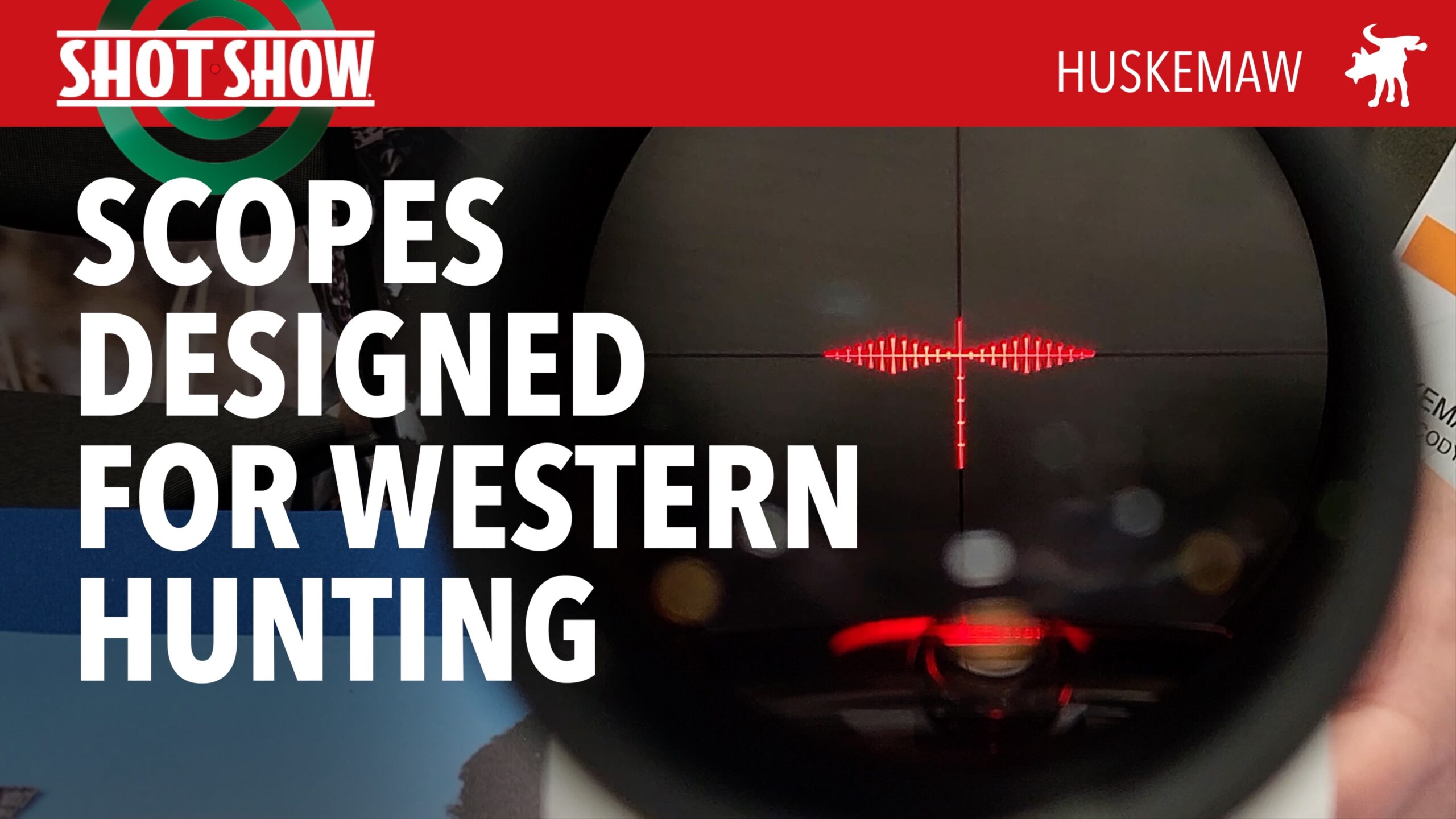
Perhaps because I’m not a Western Big Game hunter, but I wasn’t familiar with Huskemaw Optics. They’re a hunting scope maker based in Cody Wyoming that makes some of the most unique scopes I’ve come across. By chance I stopped by their booth at SHOT Show on the very last day of the show.
These scopes are purpose built for Western style hunting of big game, where distances are typically beyond 500yrds in high country with sustained cross-winds. These scopes are also pricy but high quality, built in Japan using German or Japanese glass depending on the model. These are the kind of scopes for well heeled hunters who hire guides or go on package hunting lodge trips in the Western high country.
I was struck by the unusual dragonfly shaped double-diamond reticle design of their scopes. And after striking up a conversation with Jim at their booth, I discovered the uniqueness doesn’t stop there. They have a two part elevation turret which is calibrated for wind holds of 10mph. An extra set of “wind hold” numbers at the top of the turret inform you of the number of minute/sub-tensions you’ll need to hold over to compensate for a cross-wind.
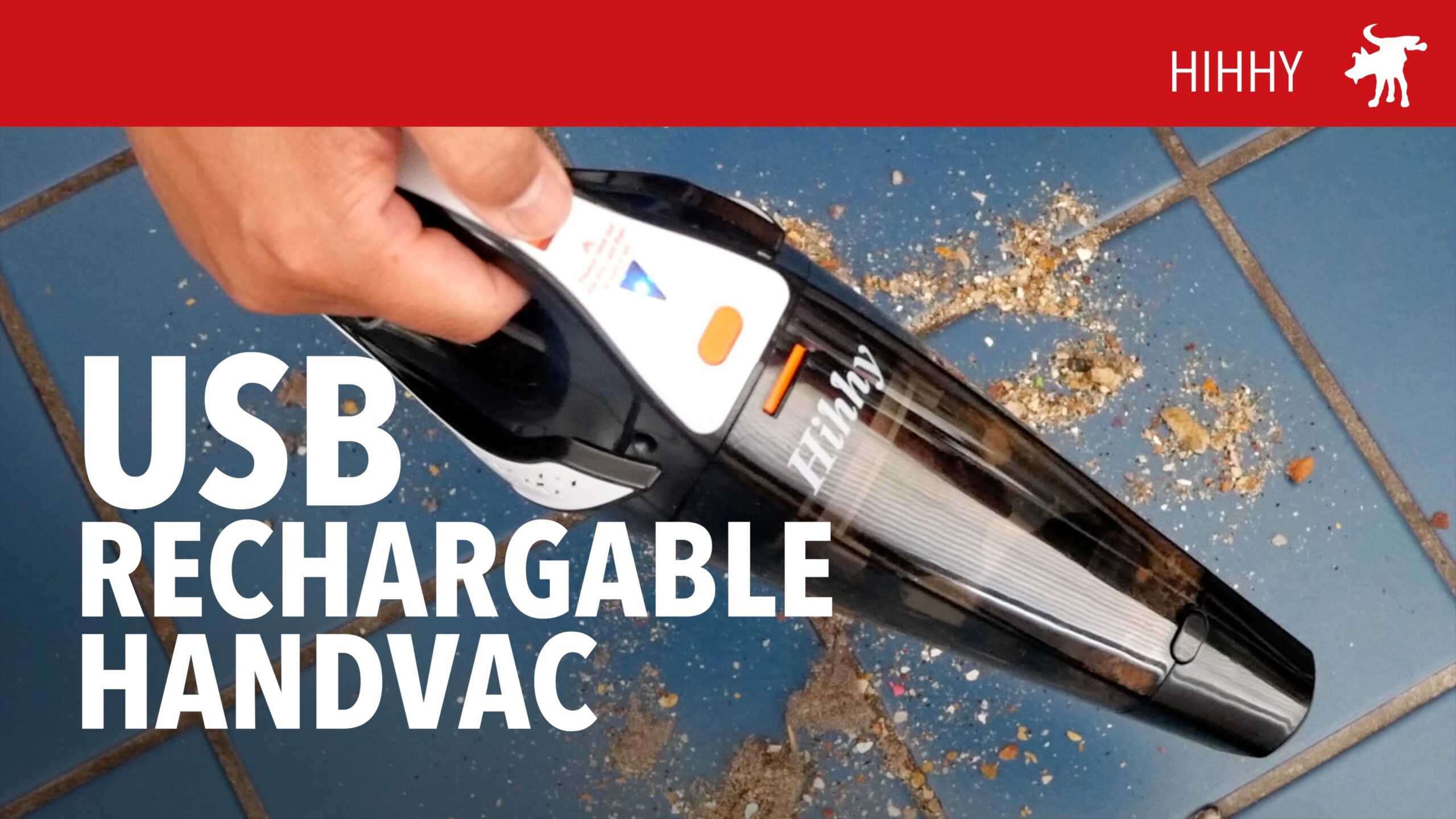
I recently reviewed a HiHHY corded stick vacuum. Much of my impression of that stick vacuum are repeated in this handheld cordless model: it looks and feels a bit cheap but despite appearances, it performs as well as my Dyson whilst being much quieter and costing hundreds less.
The overall design of this handvac is conventional. It features a cone-like clear collection canister with accessory brush and crevice nozzle attachments. Unlike the stick model is cordless, with an internal rechargeable battery. What makes this model particularly appealing and innovative is that it is recharged via a ubiquitous USB-C port.
The HiHHY comes with a USB-C cable but does not ship with an AC power adapter. Regardless, USB-C is now the standard with all new phones, one simply needs to borrow a phone charger and Bob’s your uncle, you can recharge this little handvac anywhere.
Moreover, this USB-C compatibility makes the HiHHY the perfect vacuum for a car. It is small enough to keep in a trunk or under a seat. When you need to, you can simply recharge it using your car’s phone USB-C cable.
NO PURCHASE IS NECESSARY TO ENTER. YOUR CHANCES OF WINNING DO NOT INCREASE WITH A PURCHASE. VOID WHERE PROHIBITED.
1. Eligibility
Void where prohibited by law. Must be legal resident within the USA or Canada. Moondog Industries employees, subsidiaries, affiliates, suppliers, advertising and promotion agencies, employees’ immediate family members, are ineligible to participate in the contest/giveaway.
Entrants must be willing and able to appear on YouTube to discuss the contest and post images of the prize on their social feed should they win the contest.
2. Sponsors and Platforms
Moondog Industries (known as the SPONSOR) is a video Edutainment producer and game promotor based in San Francisco, CA. YouTube, TikTok, Rumble, and online video platforms (known as PLATFORMS) are not SPONSORS or in any way affiliated with the contest or content.
3. Agreement to Rules
By entering your contest, participants agree to abide by the SPONSOR’s Official Rules and decisions. The SPONSOR retains the right to refuse, withdraw, or disqualify entries at their sole discretion. By submitting an entry, the participant agrees to accept the decision of the SPONSOR as final and binding.
4. Entry Period
Contest email entries must be received between: 12:00pm EST 11 JUNE 2023 and 12:00pm EST 17 June 2023
5. How to Enter
This contest requires your skill in navigating your phone or computer controls to screen capture an image of the following YouTube channels/Social Media accounts. Subscribe or Follow and make a screen capture of those pages showing a greyed out Subscribe button or indicator that your account is Following that page. Send a screen capture image file of any of those sites to contest@moondogindustries.com . One entry per person or per Social Media account. Fraudulent methods of entry, photo retouched, or other methods of circumvention of the rules may result in the SPONSOR invalidating a participant’s entries.
6. Prizes
Winner must be able to receive the prize by e-mail or by physical mail. Prize may be substituted at the sole discretion of the SPONSOR. Acceptance of the prize grants SPONSOR permission to use the Winners entry, name, and likeness for advertising, promotion, and trade without further compensation or remuneration unless prohibited by law.
7. Odds
The odds of winning is dependent upon the number of eligible entries received.
8. Selection and Notification of the Winner
The winner will be chosen at random by the SPONSOR from among the entrants that demonstrated the skill to navigate the electronic entry and have met the minimum requirements. Winners will be contacted via the email used to enter the contest no later than December 31, 2023.
SPONSOR is not liable for the winner’s failure to receive notification of winning if he or she provided the wrong email address or if their email security settings caused your prize notification to go into the spam or junk folder. If a winner does not respond within 24hrs of sending a notification, the SPONSOR will select an alternate winner. Receipt of the prize is upon the condition of compliance with federal, state, and local laws.
9. Rights Granted by the Entrant
The SPONSOR, upon submission of an entry into the giveaway or contest, has the right to use the participant’s submission, voice, likeness, image, statements about the contest, etc., for publicity, news, advertising, promotional purposes, trade, and so forth, without any further notice, review, consent, compensation or remuneration.
Participants shall defend or settle against such claims at their sole expense, and shall indemnify, defend and hold harmless the SPONSOR from any suit due to damage of or by the prize.
10. Terms & Conditions
The SPONSOR reserves the right to modify, suspend, cancel or terminate in the event that non-authorized human intervention, a bug or virus, fraud, or other causes beyond your control impact or corrupt the security, fairness, proper conduct, or administration of the contest/giveaway.
11. Limitation of Liability
Entry into this contest constitutes the participant’s agreement to release and hold harmless the SPONSOR and PLATFORMS, subsidiaries, affiliates, employees, etc., against all claims liability, illness, injury, death, loss, etc., that occurs directly or indirectly from participation in the contest or use/misuse of the awarded prize.
12. Disputes
As a condition of participating in the promotion, the participant agrees to resolve all disputes with an arbitrator designated by the SPONSOR in the state of California, without resorting to any form of class action. Entrants waive all rights to punitive, incidental, or consequential damages, and waive all rights to have damages multiplied or increased.
13. Privacy Policy
Participants agree to abide by all privacy and NDA laws in the State of California and any federal laws of the United State of America.
14. Winners List
Participants may request a list of winners by submitting a request in writing to Moondog Industries for up to 30 days after the contest ends.
15. Social Media Platform Rules
Winners will agree to post a photo of the prize on their social media channels in such a way as does not violate any rules of that platform. The winners also agree to appear for an interview where they will discuss the prize and its performance. If there are functional problems with the prize, the winner agrees to make a good-faith effort to resolve all issues with the SPONSOR prior to posting reviews or opinions about the prize.
16. Affirmation of Acceptance of and Agreement to All of the Official Rules
By entering the contest, the entrant has affirmatively reviewed, accepted, and agreed to all of them.
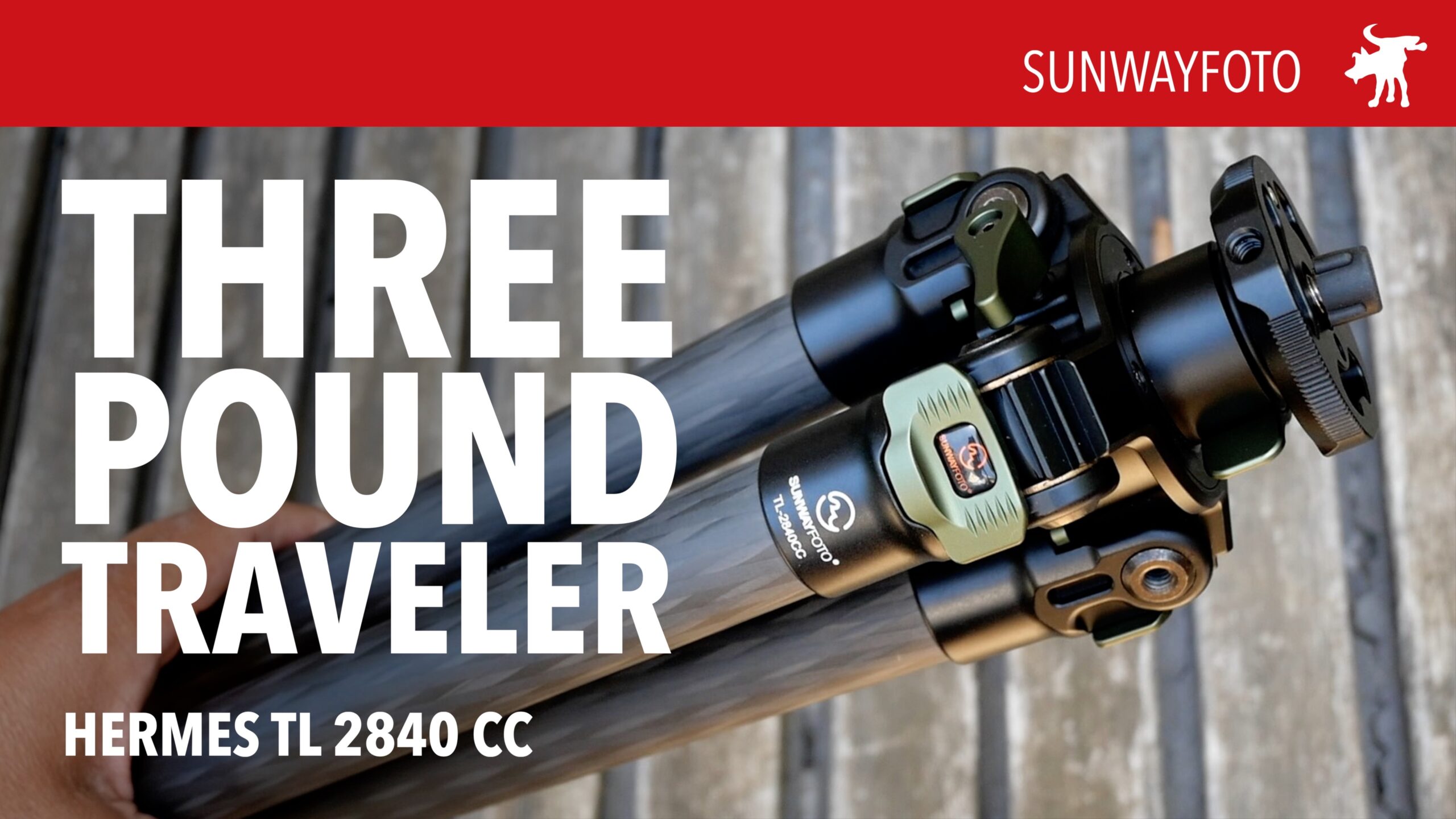
Sunwayfoto offered me a new carbon fiber tripod to test out. I’ve tested their T3240CS hunting tripod and their TC2340CE travel tripod, so I was eager to try their Hermes which is heavy duty enough to handle heavy cameras and video gear, but nearly as light as a travel tripod at 3lbs (without a tripod head).
What arrived was on point. The entire package looks top notch and well made. The Hermes TL2340 CC tripod has solidly built carbon fibre legs with lever segment locks. The feet were broad rubberized pads that could be swapped with the included set of metal spikes.
The locking lugs for the legs offered 4 locking positions with one nearly 90º offer very low shooting positions. The central carbon fiber pillar is reversible allowing added flexibility for camera mounting the positions. Sunwayfoto cleverly added additional 1/4″ photo gear sockets to the hinge points of the legs allowing a multitude of mounting options for lights, monitors, or ball-head arms.
Fully extended the tripod stands at nearly 60″ tall. More than tall enough for most photo and video projects. The entire tripod stores in Sunwayfoto’s well padded nylon case (included).
All in all I’m well pleased with this medium-weight tripod that weighs like a light-weight. It’s going to be my go-to tripod for my future video reviews.
2. Take a screen shot of the channel screen showing you have subscribed/followed.
3. Email me with the Subject:June 11 Contest • Attach the JPG or PNG screen shot • Include your full name and ship-to address in the email (so I can confirm you live in the US or Canada)
4. BONUS ENTRY: Email the answer to the question “Why have Smoke Markers been banned from OPBB this year?”. The answer is in the first 5 minutes of our June 4th Livestream
NO PURCHASE IS NECESSARY TO ENTER. YOUR CHANCES OF WINNING DO NOT INCREASE WITH A PURCHASE. VOID WHERE PROHIBITED.
1. Eligibility
Void where prohibited by law. Must be legal resident within the USA or Canada. Moondog Industries employees, subsidiaries, affiliates, suppliers, advertising and promotion agencies, employees’ immediate family members, are ineligible participate in the contest/giveaway.
Entrants must be willing and able to appear on YouTube to discuss the contest and post images of the prize on their social feed should they win the contest.
2. Sponsors and Platforms
Moondog Industries (known as the SPONSOR) is a video Edutainment producer and game promotor based in San Francisco, CA. YouTube, TikTok, Rumble, and online video platforms (known as PLATFORMS) are not SPONSORS or in any way affiliated with the contest or content.
3. Agreement to Rules
By entering your contest, participants agree to abide by the SPONSOR’s Official Rules and decisions. The SPONSOR retain the right to refuse, withdraw, or disqualify entries at their sole discretion. By submitting an entry, the participant agrees to accept the decision of the SPONSOR as final and binding.
4. Entry Period
Contest email entries must be received between: 12:00pm EST 4 JUNE 2023 and 12:00pm EST 10 June 2023
5. How to Enter
This contest requires your skill in navigating your phone or computer controls to screen capture an image of the following YouTube channels/Social Media accounts. Subscribe or Follow and make a screen capture of those pages showing a greyed out Subscribe button or indicator that your account is Following that page. Send a screen capture image file of any of those sites to contest@moondogindustries.com . One entry per person or per Social Media account. Fraudulent methods of entry, photo retouched, or other methods of circumvention of the rules may result in the SPONSOR invalidating a participant’s entries.
6. Prizes
Winner must be able to receive the prize by e-mail or by physical mail. Prize may be substituted at the sole discretion of the SPONSOR. Acceptance of the prize grants SPONSOR permission to use the Winners entry, name, and likeness for advertising, promotion, and trade without further compensation or remuneration unless prohibited by law.
7. Odds
Odds of winning is dependent upon the number of eligible entries received.
8. Selection and Notification of the Winner
The winner will be chosen at random by the SPONSOR from among the entrants that demonstrated the skill to navigate the electronic entry and have met the minimum requirements. Winners will be contacted via the email used to enter the contest no later than December 31, 2023.
SPONSOR are not liable for the winner’s failure to receive notification of winning if he or she provided a wrong email address or if their email security settings caused your prize notification to go into the spam or junk folder. If a winner does not respond within 24hrs of sending a notification, the SPONSOR will select an alternate winner. Receipt of the prize is upon the condition of compliance with federal, state, and local laws.
9. Rights Granted by the Entrant
The SPONSOR, upon submission of an entry into the giveaway or contest, has the right to use the participant’s submission, voice, likeness, image, statements about the contest, etc., for publicity, news, advertising, promotional purposes, trade, and so forth, without any further notice, review, consent, compensation or remuneration.
Participants shall defend or settle against such claims at their sole expense, and shall indemnify, defend and hold harmless the SPONSOR from any suit due to damage of or by the prize.
10. Terms & Conditions
The SPONSOR reserves the right to modify, suspend, cancel or terminate in the event that non-authorized human intervention, a bug or virus, fraud, or other causes beyond your control impact or corrupt the security, fairness, proper conduct, or administration of the contest/giveaway.
11. Limitation of Liability
Entry into this contest constitutes the participants agreement to release and hold harmless the SPONSOR and PLATFORMS, subsidiaries, affiliates, employees, etc., against all claims liability, illness, injury, death, loss, etc., that occurs directly or indirectly from participation in the contest or use/misuse of the awarded prize.
12. Disputes
As a condition of participating in the promotion, the participant agrees to resolve all disputes with an arbitrator designated by the SPONSOR in the state of California, without resorting to any form of class action. Entrants waive all rights to punitive, incidental, or consequential damages, and waive all rights to have damages multiplied or increased.
13. Privacy Policy
Participants agree to abide by all privacy and NDA laws in the State of California and any federal laws of the United State of America.
14. Winners List
Participants may request a list of winners by submitting a request in writing to Moondog Industries for up to 30 days after the contest ends.
15. Social Media Platform Rules
Winners will agree to post a photo of the prize on their social media channels in such a way as does not violate any rules of that platform. The winners also agree to appear for an interview where they will discuss the prize and its performance. If there are functional problems with the prize, the winner agrees to make a good-faith effort to resolve all issues with the SPONSOR prior to posting reviews or opinions about the prize.
16. Affirmation of Acceptance of and Agreement to All of the Official Rules
By entering the contest, the entrant has affirmatively reviewed, accepted, and agreed to all of the them.
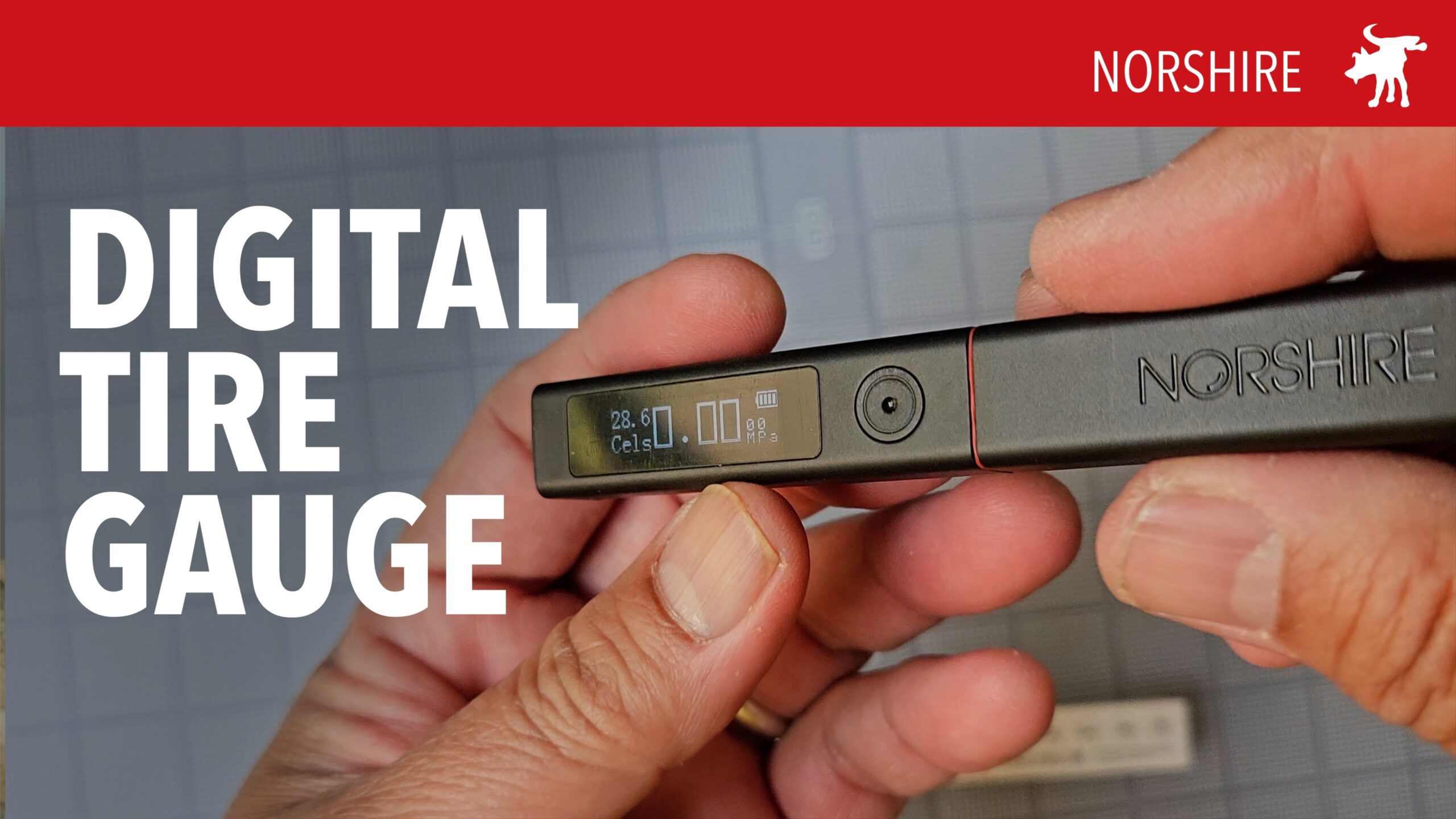
I needed a new tire gauge when my car was ransacked and my emergency tool bag was stolen from my car in front of our home in San Francisco. While surfing through Amazon, the Norshire caught my eye. This digital tire gauge is as thin as a pen.
When I got it, the package was scarcely larger than the product itself. The instructions were printed in minuscule lettering outside of the box obscured by a stuck-on UPC inventory label. Fortunately it proved easy to figure out.
The Norshire looks a 2000’s minimalist modern, black-on-black, squared plastic tube, reminiscent of a fancy fountain-pen or draftsman ruling-pen. It has a circular black button next to a black LCD screen. Pressing the button activates the system and tapping cycles through metric, Bar, and PSI settings. The unit also displays ambient temperature and air pressure.
It has powered by a single AAA NiMH battery which can be recharged through a USB-C port. One end of the gauge has black raised nub to use as a tire deflater. The other end, with a red rubber washer, pushes into a tires Schrader valve to measure the pressure.
The Norshire proved to be accurate. Comparing it against my car’s onboard tire sensors and to the analogue gauge of my tire inflator, the Norshire returned consistent readings which aligned with my other sources. And unlike any other pressure gauge I’ve ever used, the Norshire had such a good seal that I scarcely heard the hiss of any leaking air while pressing onto the tire’s valve.
The Norshire hovers around $15-19 on Amazon and I plan to purchase a few more when the price dips, as a backup and they would make great holiday stocking stuffers.
Hi-Lux is an optics company best known for making reproduction vintage-style scopes. But at Shot Show this year, their show stopper was their newest modern ELR/PRS scope, their PR5-R a 5-25x56mm beast of a scope. They were kind enough to send me a sample to text and evaluate.
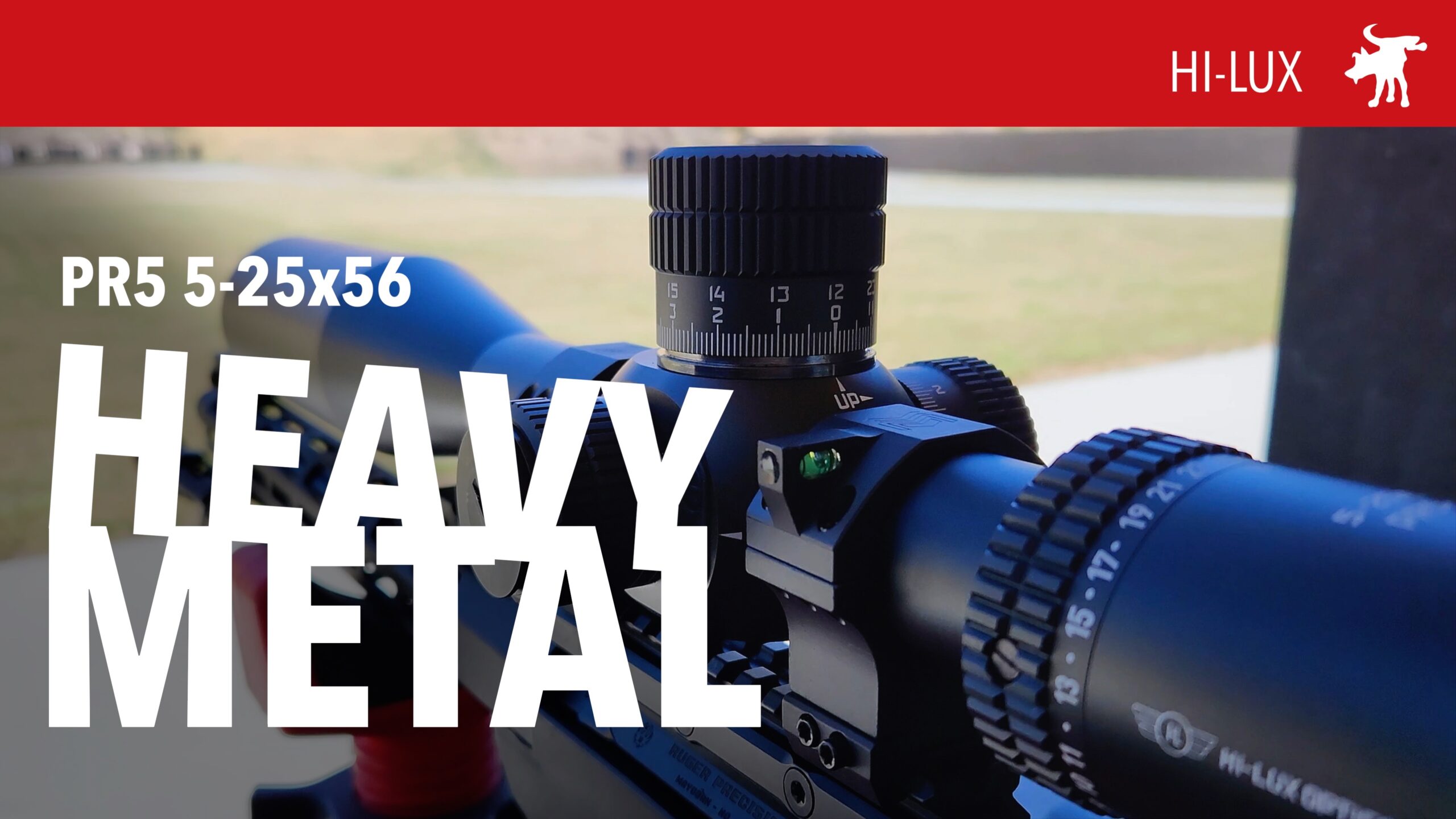
Out of the box the scope is massive. It is 16″ long even without the included sunshade. It is perhaps the heaviest scope I’ve yet tested, weighing in at 2.5lbs (40oz). The package includes the aforementioned 56mm sunshade, front and rear flip-up caps, and a throw lever.
The scope has equally massive and oversized turrets which have nice loud clicks and are tactile positive. The elevation has a zero-stop reminiscent of Leupold’s spiral groove design but with the spiral under the cap instead of the base of the turret. While interesting, I found correctly lining up the stopping pin in the grove to be sometimes finicky.
In addition, Hi-Lux’s “Zero Stop” is designed to stop 1 MIL past 0. So perhaps they should call it a “1 Stop” or “+1 Stop” instead? Moreover, my turret didn’t stop at 1 MIL, instead stopping sometimes at 1.2 or 1.3 MIL. While you can correct for this by adjusting your initial zero, I find this lack of precision problematic. But as I so not use Zero Stops my disappointment is somewhat moot.
The magnification dial was moderately stiff but movable without the throw lever. The ocular focus was smooth and the eye-piece features rotation markings making. This is an often overlooked feature on scopes and I wish more makers put them on their scopes because this makes it easier to return to a known focus when sharing a rifle with a guest shooter.
The most interesting feature of the scope is it’s digital illumination controls. The brightness and activation on controlled by two rubberized buttons next to the paralax focus knob. The model I tested had red illumination but Hi-Lux also sells a green illumination model.
The entire central sub-tensioned cross-hair and Christmas tree is illuminated. The two lowest brightness settings are designed for night vision and were not visible to my naked eye. The highest level (11) was not daylight bright but more than bright enough for dusk. It is powered by a CR2032 coin battery in the parallax knob, which can focus down to 10 yards.
At the range I noted distortion along the outer edge of the image and chromatic aberration at 5x which is usually the best image seen through a scope. I was therefore surprised when the outer edge and color distortion improved at 25x. We did lose light and there was a noticeable reduction in the eye-box.
In overall sharpness and contrast the scope was middling to average for a $800 scope (I’ve seen street price ranges from $800-$1300 depending on retailer) but its resolution was as good or better than similarly priced Athlon and Arken scopes I’ve reviewed.
This scope was designed to appeal to ELR and Bench Rest Precision shooters for whom a +40oz tank of a scope is not a problem but an advantage. It’s turrets are oversized, easy to read and control. But it’s finicky Zero Stop may be a deal breaker for some competitive shooters.
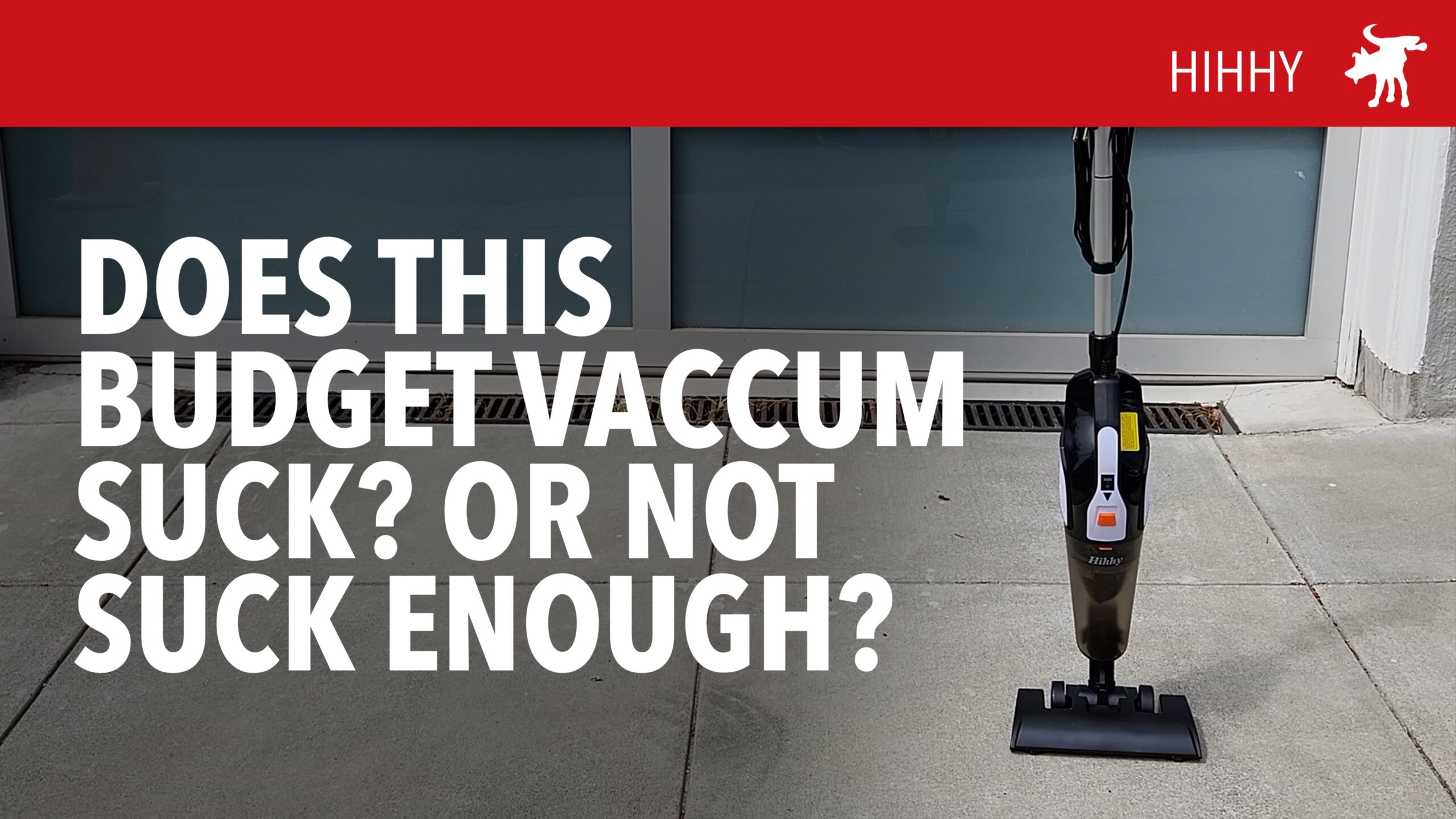
When I was asked to review a Hihhy vacuum I said, “Hihhy, who?” When I found out I was being sent a $35-$40 plug-in stick vacuum, I didn’t have high hopes. When I first opened the box, my first impression didn’t impress.
The vacuum looked and felt cheap. To be more accurate, it looked like a $40 vacuum. The body and accessories were a bit too light weight, flexing and bending in ways that a plastic bodied Dyson does not.
The vacuum is conventional looking hand-vac with a handle that screws into the rear of the motor body. Assembly was easy and straight-forward. The box included a packet of replacement internal dust filters and 3 vacuum heads: a rolling floor sweeper, brush nozzle, and a crevice funnel nozzle.
To test it’s performance, I emptied the contest of the waste canister of my Dyson stick-vac onto the floor. If my first impression was disappointment, my impression after testing was surprise. The Hihhy was able to suck up all of the debris and dust in under a minute.
The floor was as clean as if I had used my Dyson. This despite the fact that my Dyson has a motorized brush head to sweep up debris and costs a couple hundred more than this Hihhy. And it was quiter; much quieter. The Dyson is notoriously loud (an intentional design feature of the Dyson to make it appear more powerful than other hand-vacs)
It remains to be seen if this Hihhy is as durable as my Dyson or any other brand name vacuum. If I went by appearances, I doubt it. But if we go by performance, I may be surprised again.
The contest Prize will be chosen from all entries submitted from April 30, 2023 through may 6, 2023. Entries must be received no later than 12pm EST on May 6, 2023.
The contest Prize will be chosen from all entries submitted from May 27, 2023 through June 3, 2023. Entries must be received no later than 12pm EST on June 3, 2023.
2. Take a screen shot of the channel screen showing you have subscribed/followed.
3. Email me with the Subject:June 4 Contest • Attach the JPG or PNG screen shot • Include your full name and ship-to address in the email (so I can confirm you live in the US or Canada)
4. BONUS: Share this with a friend and get them to enter the contest too. Ask them to reference your name and email address in the body of their message ie. “My buddy johndoe@gmail.com clued me into the contest”, and I’ll award you an extra-bonus entry to the contest. It’s important that they reference your email so I can easily look up your entry. Each friend that subscribes and refers to you in their email will earn you another bonus entry for a maximum of 10 entries (including yours).
NO PURCHASE IS NECESSARY TO ENTER. YOUR CHANCES OF WINNING DO NOT INCREASE WITH A PURCHASE. VOID WHERE PROHIBITED.
1. Eligibility
Void where prohibited by law. Must be legal resident within the USA or Canada. Moondog Industries employees, subsidiaries, affiliates, suppliers, advertising and promotion agencies, employees’ immediate family members, are ineligible participate in the contest/giveaway.
Entrants must be willing and able to appear on YouTube to discuss the contest and post images of the prize on their social feed should they win the contest.
2. Sponsors and Platforms
Moondog Industries (known as the SPONSOR) is a video Edutainment producer and game promotor based in San Francisco, CA. YouTube, TikTok, Rumble, and online video platforms (known as PLATFORMS) are not SPONSORS or in any way affiliated with the contest or content.
3. Agreement to Rules
By entering your contest, participants agree to abide by the SPONSOR’s Official Rules and decisions. The SPONSOR retain the right to refuse, withdraw, or disqualify entries at their sole discretion. By submitting an entry, the participant agrees to accept the decision of the SPONSOR as final and binding.
4. Entry Period
Contest email entries must be received between: 12:00pm EST 27 May 2023 and 12:00pm EST 3 June 2023
5. How to Enter
This contest requires your skill in navigating your phone or computer controls to screen capture an image of the following YouTube channels/Social Media accounts. Subscribe or Follow and make a screen capture of those pages showing a greyed out Subscribe button or indicator that your account is Following that page. Send a screen capture image file of any of those sites to contest@moondogindustries.com . One entry per person or per Social Media account. Fraudulent methods of entry, photo retouched, or other methods of circumvention of the rules may result in the SPONSOR invalidating a participant’s entries.
6. Prizes
Winner must be able to receive the prize by e-mail or by physical mail. Prize may be substituted at the sole discretion of the SPONSOR. Acceptance of the prize grants SPONSOR permission to use the Winners entry, name, and likeness for advertising, promotion, and trade without further compensation or remuneration unless prohibited by law.
7. Odds
Odds of winning is dependent upon the number of eligible entries received.
8. Selection and Notification of the Winner
The winner will be chosen at random by the SPONSOR from among the entrants that demonstrated the skill to navigate the electronic entry and have met the minimum requirements. Winners will be contacted via the email used to enter the contest no later than December 31, 2023.
SPONSOR are not liable for the winner’s failure to receive notification of winning if he or she provided a wrong email address or if their email security settings caused your prize notification to go into the spam or junk folder. If a winner does not respond within 24hrs of sending a notification, the SPONSOR will select an alternate winner. Receipt of the prize is upon the condition of compliance with federal, state, and local laws.
9. Rights Granted by the Entrant
The SPONSOR, upon submission of an entry into the giveaway or contest, has the right to use the participant’s submission, voice, likeness, image, statements about the contest, etc., for publicity, news, advertising, promotional purposes, trade, and so forth, without any further notice, review, consent, compensation or remuneration.
Participants shall defend or settle against such claims at their sole expense, and shall indemnify, defend and hold harmless the SPONSOR from any suit due to damage of or by the prize.
10. Terms & Conditions
The SPONSOR reserves the right to modify, suspend, cancel or terminate in the event that non-authorized human intervention, a bug or virus, fraud, or other causes beyond your control impact or corrupt the security, fairness, proper conduct, or administration of the contest/giveaway.
11. Limitation of Liability
Entry into this contest constitutes the participants agreement to release and hold harmless the SPONSOR and PLATFORMS, subsidiaries, affiliates, employees, etc., against all claims liability, illness, injury, death, loss, etc., that occurs directly or indirectly from participation in the contest or use/misuse of the awarded prize.
12. Disputes
As a condition of participating in the promotion, the participant agrees to resolve all disputes with an arbitrator designated by the SPONSOR in the state of California, without resorting to any form of class action. Entrants waive all rights to punitive, incidental, or consequential damages, and waive all rights to have damages multiplied or increased.
13. Privacy Policy
Participants agree to abide by all privacy and NDA laws in the State of California and any federal laws of the United State of America.
14. Winners List
Participants may request a list of winners by submitting a request in writing to Moondog Industries for up to 30 days after the contest ends.
15. Social Media Platform Rules
Winners will agree to post a photo of the prize on their social media channels in such a way as does not violate any rules of that platform. The winners also agree to appear for an interview where they will discuss the prize and its performance. If there are functional problems with the prize, the winner agrees to make a good-faith effort to resolve all issues with the SPONSOR prior to posting reviews or opinions about the prize.
16. Affirmation of Acceptance of and Agreement to All of the Official Rules
By entering the contest, the entrant has affirmatively reviewed, accepted, and agreed to all of the them.
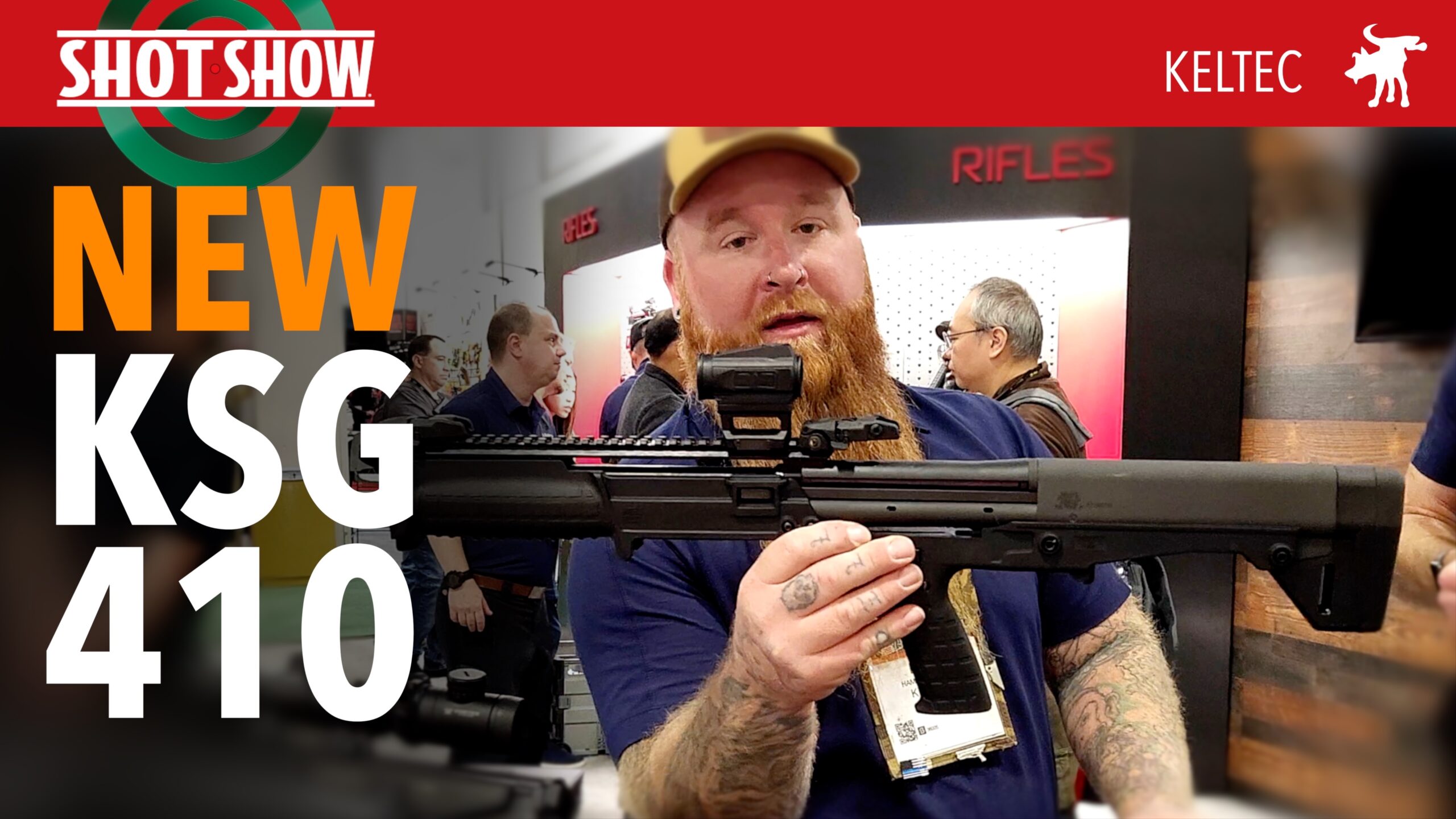
KelTec came out with KSG, an innovative double-tube bullpup pump shotgun a few years ago. I got a chance to shoot the single-tube KS7 model during a video review two years ago. It was very easy to maneuver and point due to its compact size but it’s light weight and polymer construction really transferred the recoil energy, making even birdshot feel like shooting slug.
In reaction to the desire for a lighter shooting defensive shotgun, KelTec developed a KSG chambered in the svelt .410 shell originally designed by Elley in the late 1800’s for backyard pest control, birding, and self-defense (in cane guns!). These shells are the size of chapstick tubes but shoot slugs bigger than a 9mm bullet. While shooting with the same recoil as a Sub-2000.
While small compared to a 12 ga. shell, .410 shells are still quite formidable at close range where the KSG excels. It’s not then surprising that KelTec (always the iconoclast), chose to chamber their next KSG variant in .410 instead of a 20 ga. This new pump shotty is due to hit retailers later in Q3 2023.