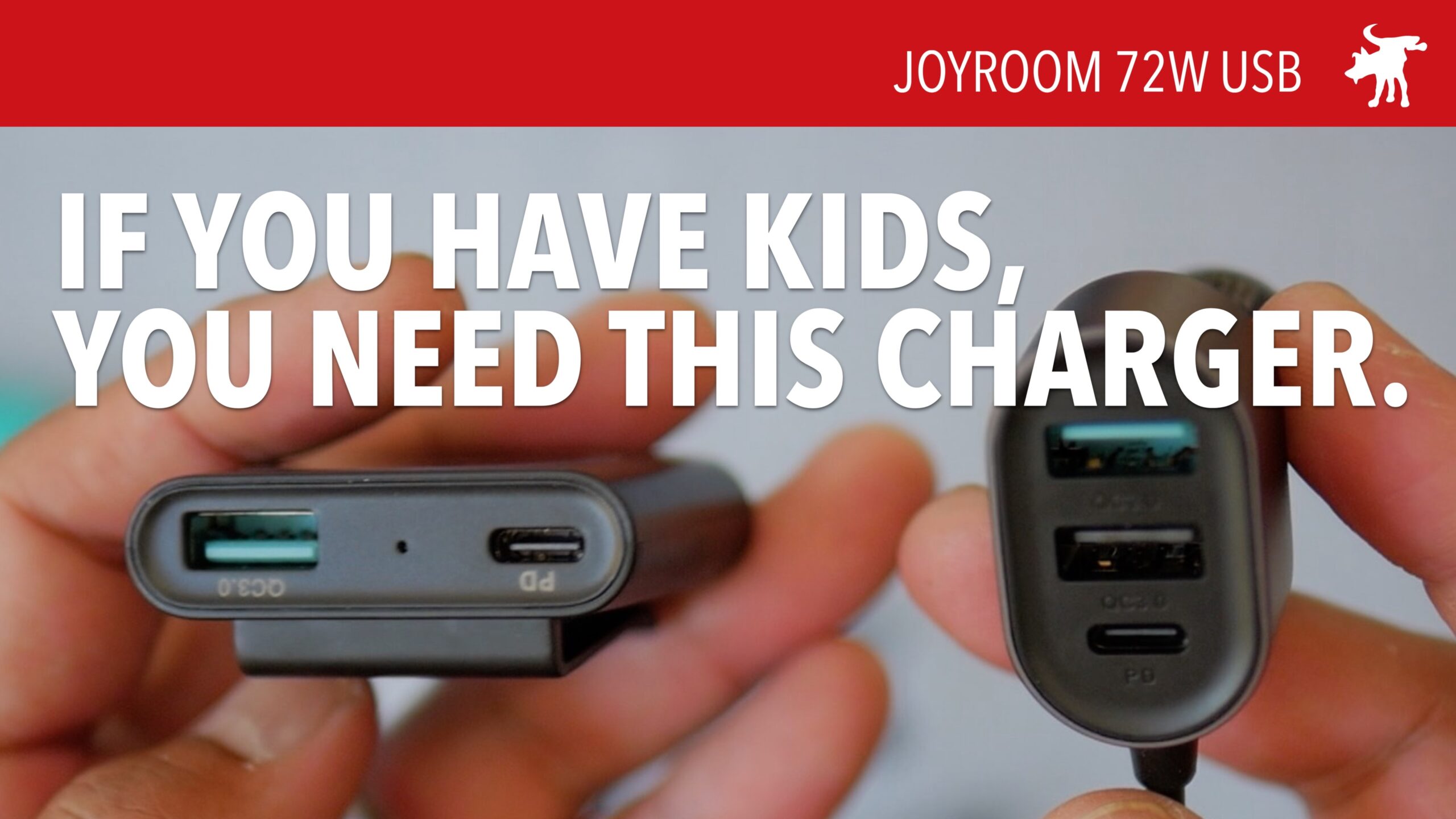
Joyroom sent me their 5-port USB 72W car charger to test and evaluate. This charger plugs into a standard car lighter port and provides 5 USB ports of up to 12V of power (3 x USB-A and 2 x USB-C ports). The 3 USB-A ports are QC 3.0 compatible which means you can quick charge Samsung and Apple devices. In my casual testing on my Samsung S21 which had a 30% battery charge, I was able to draw a ≥2000mA current through each of the ports. This would allow me to fully charge my phone in about 10 min.
The unusual feature of this charger is that the charging ports are split between the main cigarette plug (2 x USB-A and 1 x USB-C) and satellite clip-on charger block connected by an integral power cable (~length of 4ft). The allows you the flexibility to provide passengers in the rear seats USB charging. A boon to any parent with kids with power hungry devices (like a Nintendo Switch). This is an especially useful when traveling as compact and budget rental cars rarely have rear USB charging ports.
This unit is available on Amazon through this Affiliate Link. Any purchases made through this link support my efforts to review new products. Thanks. https://amzn.to/3ImTGO1
Biometric gun safes used to be the realm of spy-fiction and the well heeled. But now, they’re not only widely available, they’re also affordable. But a quick glance of some Amazon 1-star reviews of budget gun safes talk about their weak locks and unreliable biometric security.
A Chinese marketing company contacted me to ask if I would test and evaluate a Rexmeo biometric gun safe, a brand I’d never heard of. Upon initial inspection I was surprised at the weight topping 15lbs. This didn’t appear to be to be some cheap, thin-skinned lock box.
The unit comes with 2 sets of keys to open the box. Inside it has a enough space to contain 2 full sized pistols and a fair number of spare magazines and/or accessories (or a single pistol with a hard case holster depending on the model). The interior is padded with foam to protect its contents and has cut-outs to allow the safe to be securely screwed into a wall or furniture. The unit comes with a cable lanyard and pass-through hole to allow it to be secured to a post, pipe, or vehicle seat.
Activation was straight forward, you open the safe with the keys. Insert 4 x AA batteries (included) and following the instructions, you set up your finger to be read by the biometric sensor circle on the top of the unit. The unit requires multiple contacts with your finger to set up but once read, the unit would only open with my right thumb. I attempted other fingers and my left thumb but none of them would activate the lock.
Impressively the unit can store up to 50 different fingerprints! Not only could you use all 10 of your fingers but you could also allow access to other individuals through their fingerprints. I wonder if more fingerprints degrades the specificity of the biometrics (allowing for less precise biometric activation?)
Upon opening a digital voice informs you that the unit is unlocked. You can disable this voice but turning off the sound output. But this can lead to unintended issues as I’ll get into.
The unit also has a password entry through a 1-6 number keypad on the top of the unit. The unit allows for passwords between 6-8 numbers as well as adding non-opening scramble codes. When the correct passcode is entered the biometric sensor turns green and opens the safe. My initial unlocking occurred without issue but later in testing I ran into a troubling series of “wrong password”, the unit signaled a red light and would not open.
I discovered that this was because I was pressing the keypad buttons too quickly. The keypad required about a 1-second press per button to register correctly. When I had the Digital Voice/Sound on, I could get audible cues when a button was pressed correctly, when the Voice/Sound was turned off there was no positive feedback.
This degree of user-error in the interface could give some gun owners pause. But I consider biometric or electronic locks a secondary rather than a primary entry method. Think of it is a standard key-entry gun safe with biometric backups.
The makers did include some clever features to make the battery power less of an issue. The unit has a low-battery audible alert and if the batteries completely die, there is a USB-C port next to the key lock which allows you to power the biometrics or keypad through a powered USB cable. In addition, the unit claims to have a pick-lock alarm though I was not able to test the mechanism of how the unit knows the lock is being physically picked?
The safe could also be improved with some additional changes. I wish it had a way to turn off the annoying digital voice while retaining the keypad beeps at a lower volume. It could use an automatic red LED light to illuminate the interior contents when opened like with some other safes by Wincent and Vaultek. But for the price, the Rexmeo is a solid gun safe with generous interior space that most gun owners.
Sony pretty much invented Portable Hi-Fidelity Audio with the WalkMan back in the 1980’s. While one can debate the validity of cassette tapes as an audiophile format, you can’t argue that Sony has a history of offering some of the best affordable, high quality headphones for both professionals and consumers. I still use the same pair of Sony MDR V-150 Studio Monitor Headsets I bought 20 years ago for my video editing today.
In my ongoing quest to find the best “cheap” headphone I tried out Sony’s ZX110 heaphones. They come in a range of colors, I picked up a white colored pair on Amazon which were on sale for under $10 (regular retail price $15). They come shipped in a cleanly designed cardboard box. This is a nice step up from the usual vacuform clamshell packages of their competitors like Panasonic and JVC.
The headphones retained my V-150s design cues on the ear cup , while improving on their compact stowability. Cord was an ample 4ft long with good solid feeling amount of wire insulation for durability. The audio jack had a clever dimple design on a right-angled 3.5mm jack.
Wearing them, I found them to be more comfortable than my old V-150’s, which have to fit tightly on the head to reduce sound-leak along the ear pads. The ZX110 head a looser more light feel along the ears while providing decent sound isolation. The earpads are replaceable.
Audio quality was balanced but underwhelming compared to my studio headphones. Performance was very similar to Pansonic HF100’s with slightly weaker bass response but clearer in the mid-range. The bass was its weak point, sounding more rattling than thumping on a House music track. Those used to bass-biased power speakers, like Beats will be disappointed. But the overall balance was good and likely to be straining on the user when listening to spoken word, Classical, Jazz, or Acoustic Pop.
Overall the headphones were among the performers in the Budget sub $20 price tier. These headphones are available on Amazon. Please use my Affiliate link to support my work: https://amzn.to/3764DoW
The HF100 is one of Panasonic’s most affordable wired headphones. They feature a clean modern design in a semi-open headset; the ear cups do not completely cover all of your ear. The ear cups do feature padding that provides a good sound isolating seal around your ear though some may find the squeeze uncomfortable over long periods of time.
They are a step up from their HT21 budget headsets but sound quality is very similar. They are well balanced for headphones under $30, though far from audiophile quality. Those looking for thumping bass will be disappointed. They are better than the free headphones issued on flights (unless you’re in Business class).
Unlike the HT21, these headphones also include an inline microphone and volume controls in the audio cord. The flat insulated wire cord feel somewhat silicone coated and ends in a standard 3.5mm TRRS jack. These lend themselves for use as inexpensive gaming or Zoom headsets, though they lack the heavy bass and venting for the former.
For the price and the microphone feature, these headphones are a good option for travel headsets or headsets you can send with your kids to school. They are inexpensive enough that you won’t have to cry about losing or breaking them. Though their lightweight construction does make me question their durability?
They come in a variety of colors (white, red, pink, black, and blue). I purchased these blue headsets from Amazon and they are also available from Best Buy, Walmart, and other retailers. Purchase through my Amazon Affiliate link to support my channel: https://amzn.to/3LmZoQr
VeGue sent me their VM30 USB Condensor Microphone to test and evaluate. It is powered by a USB 3.0 cable which connects via USB-A or USB-C to your device or PC. Connecting via USB eliminates the need for a microphone mixer/pre-amp. While audio engineers and audiophiles will insist that a budget mic with a built-in, analog-to-digital audio converter will probably be sub-standard for master recordings, I doubt the average user or consumer will notice any difference or deficiency; I can not.
The shortcomings of this budget mic are a low sensitivity and dynamic range. One really needs to get very, very close to the microphone to achieve a warm resonance in tone. But the mic often clips when you get too loud but sounds very muted if you get more than a few inches away from it.
It has some nice features such as a 3.5mm headphone monitoring jack, a built-in gain dial, and a mute button (for Zoom meetings this is handy). Its shortcomings are its cheap plastic build, unforgiving dynamic range, and low audio sensitivity. This budget mic retails for about $30 and is a good starter microphone to give a boost in quality to any Zoom meeting or for recording Voice-Overs for Powerpoint Presentations or for beginning vloggers and podcasters.
I was asked to supply a CD of music for the school’s Talent Show. A CD? In 2022?! While I still buy my games on DVD and movies on Blue Ray, it’s been well over 10 years since I last owned a computer that had a DVD burner in it. So how the heck was I supposed to supply a CD?
So I went on Amazon and looked up their Editor’s Choice for an inexpensive USB CD/ROM drive. This USB 3.0 is a step up from an older USB 2.0 drive that has since broken on us years ago. This drive is powered directly from a single USB 3.0 cable integrated into the bottom of the drive making it super portable.
No drivers were required to install on my 2015 Macbook Pro (Big Sur v11.6). The drive showed up on my desktop and the 20 year old contents of the CD I tested showed up (albeit with a lag). The drive is made by Gotega, a brand I’d never heard of. It retailed for less than $25 and is available from Amazon: https://amzn.to/3KDyDaa
Wincent sent me their π1 Biometric Portable Gun Safe Lock Box to test and evaluate. I was hesitant after reading some negative Amazon reviews. Some early models of this safe had issues with the biometrics lock, which would unlock using any body part.
But this new lockbox worked correctly. I set the biometric reader to my right thumb and was unable to open it with any other finger (or palm). It opened every time with my right thumb. As with any gun accessory, two is one and one is none. Biometric reader may fail at the most inopportune time. That’s why it come with a key to open the box manually. So keep the key hidden but accessible.
The box had enough internal space to fit my Glock 17 with an attached Streamlight TRL-1. It would not accomodate my O-Light Valkyrie or Surefire X300. But there was ample enough room for 2-3 spare magazines and a backup EDC light, in addition to my pistol.
The Liberfeel is a 10,000mAh wireless powerbank sent to me by Peakode to test and review. It has a decidedly feminine aesthetic with rounded edges somewhat reminiscent of a bar of Dove soap. It comes in a choice of 4 pastel colors: pink, blue, purple, and beige.
It features a wireless fast-charging plate (it will only fast-charge if wireless charging only 1 device) with a built in magnetic to help keep your phone in place while charging, though not strong enough to keep a phone attached to the charger if held up sideways. In addition it has a built-in Apple Lightning, a USB-C charging cable, a USB-A output port, and a USB-C in/out port, allowing it to charge up to 5 devices simultaneously. It can also recharge itself via it’s USB-C port, while charging 4 other devices at the same time. This makes the Liberfeel a useful travel charger.
Comsoon J25 Bluetooth Receiver allows you to add Bluetooth audio to your old wired headphones or earbuds or your car through its AUX audio port, for less than $20. Far less than the cost of a new pair of Bluetooth headsets or even the cost of a J25 and a new pair of non-Bluetooth earpro.
It’s small enough to mount directly onto your earpro and with the right connector cable, you can get the firing tucked away and even make it look like original equipment.
A marketing Rep with SANAG contacted me and offered a pair of sports headphones for me to test out. They appeared to be bone-conductive headsets but the Rep said they were not. Oddly the box says they are but my tests seem to indicate that the Rep was correct.
My first impression was positive. The box made it look like a piece of electronics that you would spend +$50 on (MSRP $80).
My initial impression upon taking it out was also positive. The headset appeared well made and completely covered in a rubber-like coating which would be expected from a “sweat-proof” headset.
Bluetooth pairing was easy. It also comes with 32GB of onboard memory so you can play music directly from the headset by loading up songs from your PC or phone via the included USB-C cable. It came with about 40 pre-loaded Mandarin songs (ummm ok).
Its audio quality was disappointing. The sound was thin and distant, like when you pull your earbuds out of your ear and hang them. The sole positive feature is that as over-the-ear headsets, these allow you to hear your real-world environment while listening to tunes. But for the price, I’d want better audio fedelity.