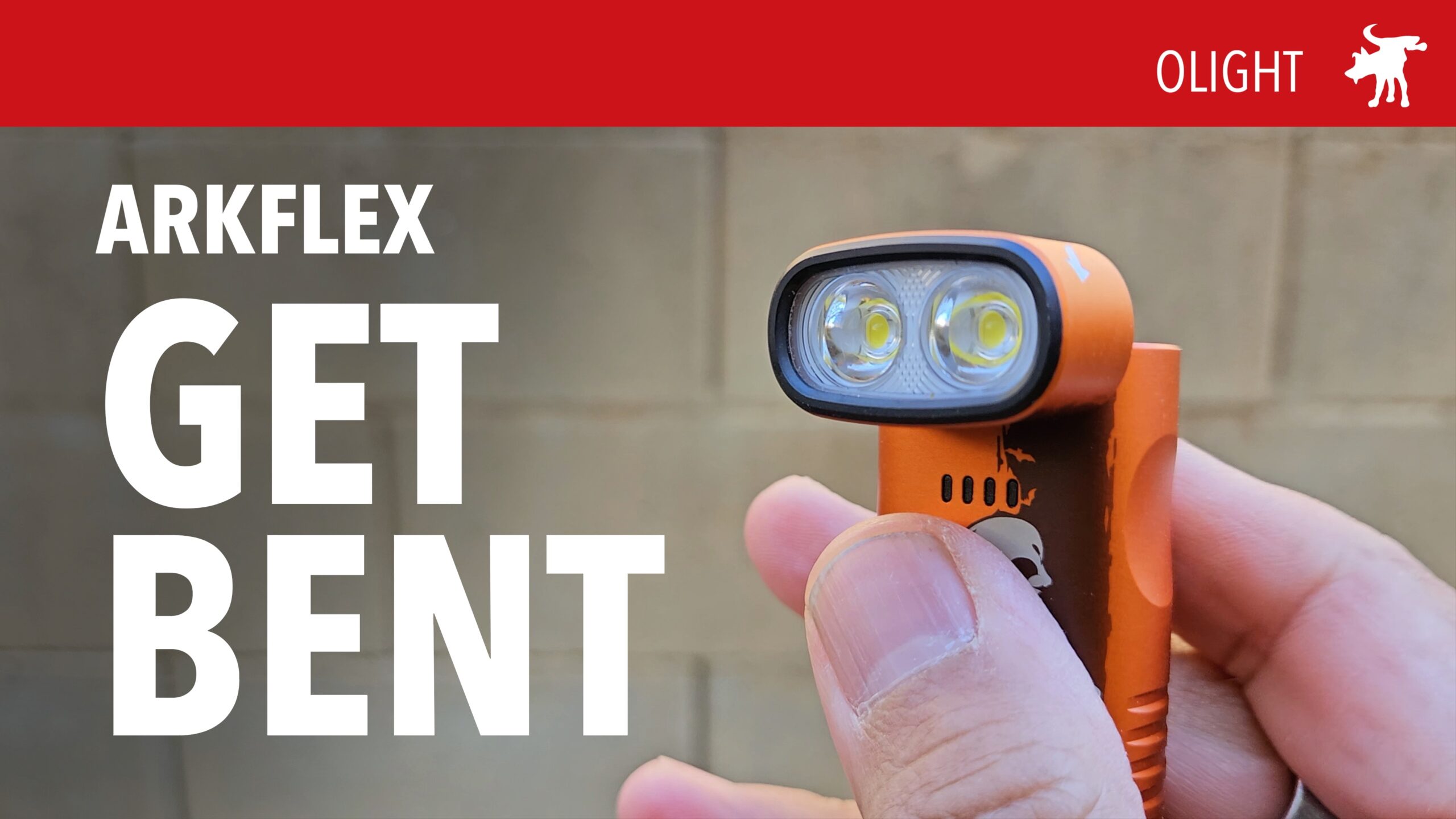
The Arkflex adds a new angle to the innovative wedge style EDC. The Arkflex rounds out the harder squared edges of the Arkfeld design. It is a little smaller and lighter than the Arkfeld and lacks the rotary control, UV light, and laser. Arkflex adds a new feature: a hinged top which can tilt the dual LED emitter to 90º angle. With the tilting emitter, the Arkflex can transform from a standard wand style flashlight, into a clip-on hands free work light.
In testing, the Arflex meets or exceeds all of its printed specs. The Arkflex outputs a little over a maximum of 1000 lumens in Turbo mode. It has a runtime of 120 minutes in Turbo and can be fully immersed in water.
But nothing is perfect. After my testing, my sample unit wouldn’t turn off until the battery died and wouldn’t recharge. It was defective. But rather than this review ending in a negative conclusion, it became a test of the company’s warranty and customer service.
I went to the Warranty and Repairs page of Olight’s website and entered in a return request. After uploading photos of the unit and describing the issue, they emailed me a PDF return label. I received a replacement unit a few days later. Unfortunately Olight was out of the Halloween limited edition lights, so they sent me a plain orange one. Far from disappointed, I was impressed with how easy Olight’s warranty return process was.
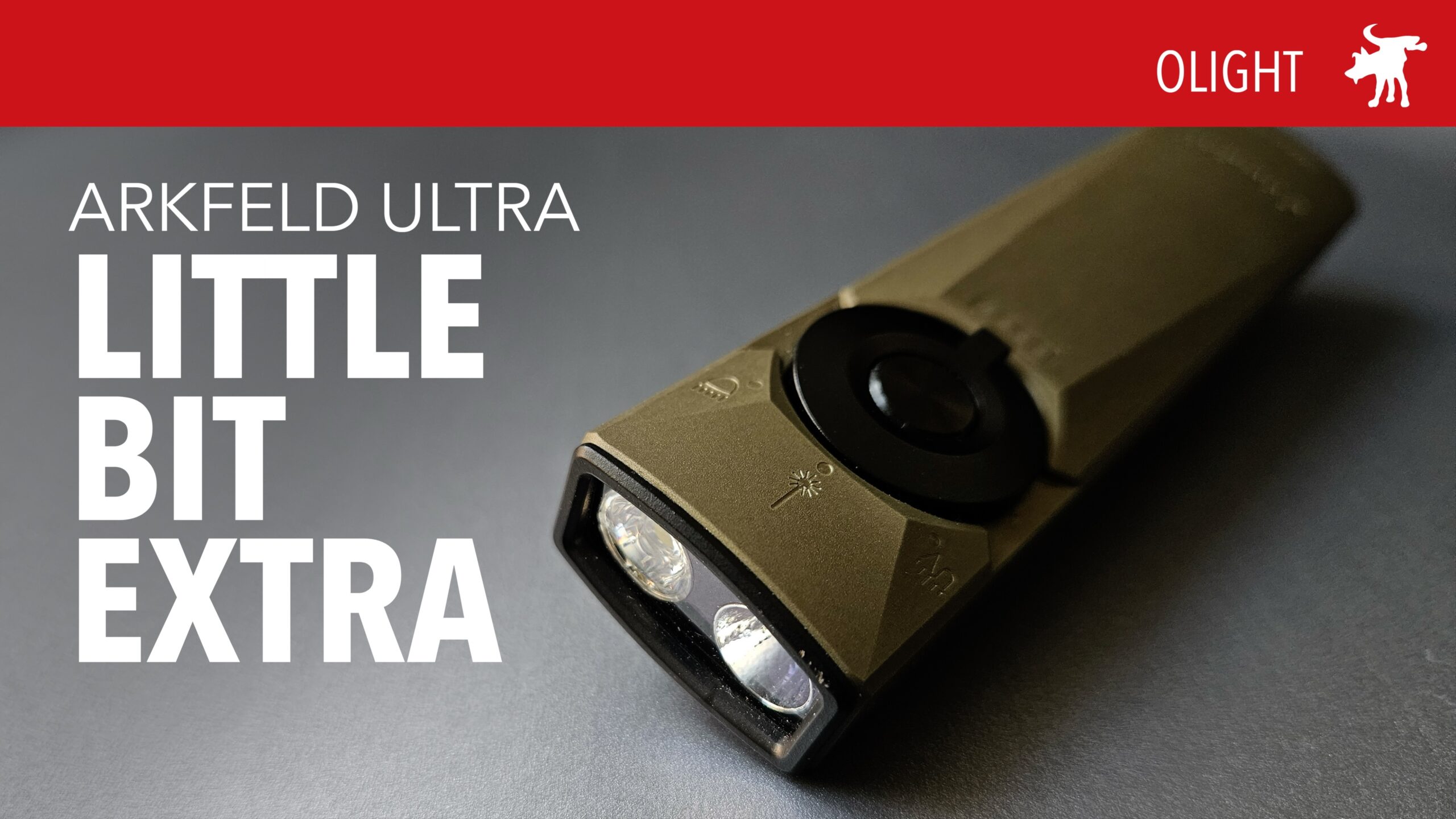
The Arkfeld Ultra is an upgrade on the Arkfeld Pro, which I reviewed just a few month ago. The Ultra increases light output by 100lumens which isn’t a huge leap in output. The more notable changes are in the design of the body and a new aluminum alloy used in it’s construction, that Olight calls O-aluminum.
The Ultra has a slightly raised and beveled face on it’s body design, somewhat reminiscent of the Tesla Cybertruck. This serves a practical purpose, shielding the control ring and button from wear and tear. For extra credit, I tested the Ultra’s claimed extra strong design by running it over with my KIA SUV. It survived, though I did bend the belt clip noticeably and scratched up the lower body (though not as badly as I would have expected).
The Ultra also features a finely checkered pattern on the sides of the box-shaped flashlight, which provides more grip friction than the Arkfeld Pro’s ribbed pattern. In performance, the Arkfeld Ultra is nearly identical to the Pro. My testing did confirm a light output near its claimed 1400 lumens. The Ultra is rechargeable and uses the same magnetic recharging cable as the Pro and other Olight flashlights.
The Ultra costs about $20 more than the Pro but the latter offers a wider array of color selection in its body. At the moment the Ultra only comes in a olive-gold like color thats somewhat infused into the metal. In addition, Olight inlcudes a limited edition Olight challenge coin in the Ultra box.
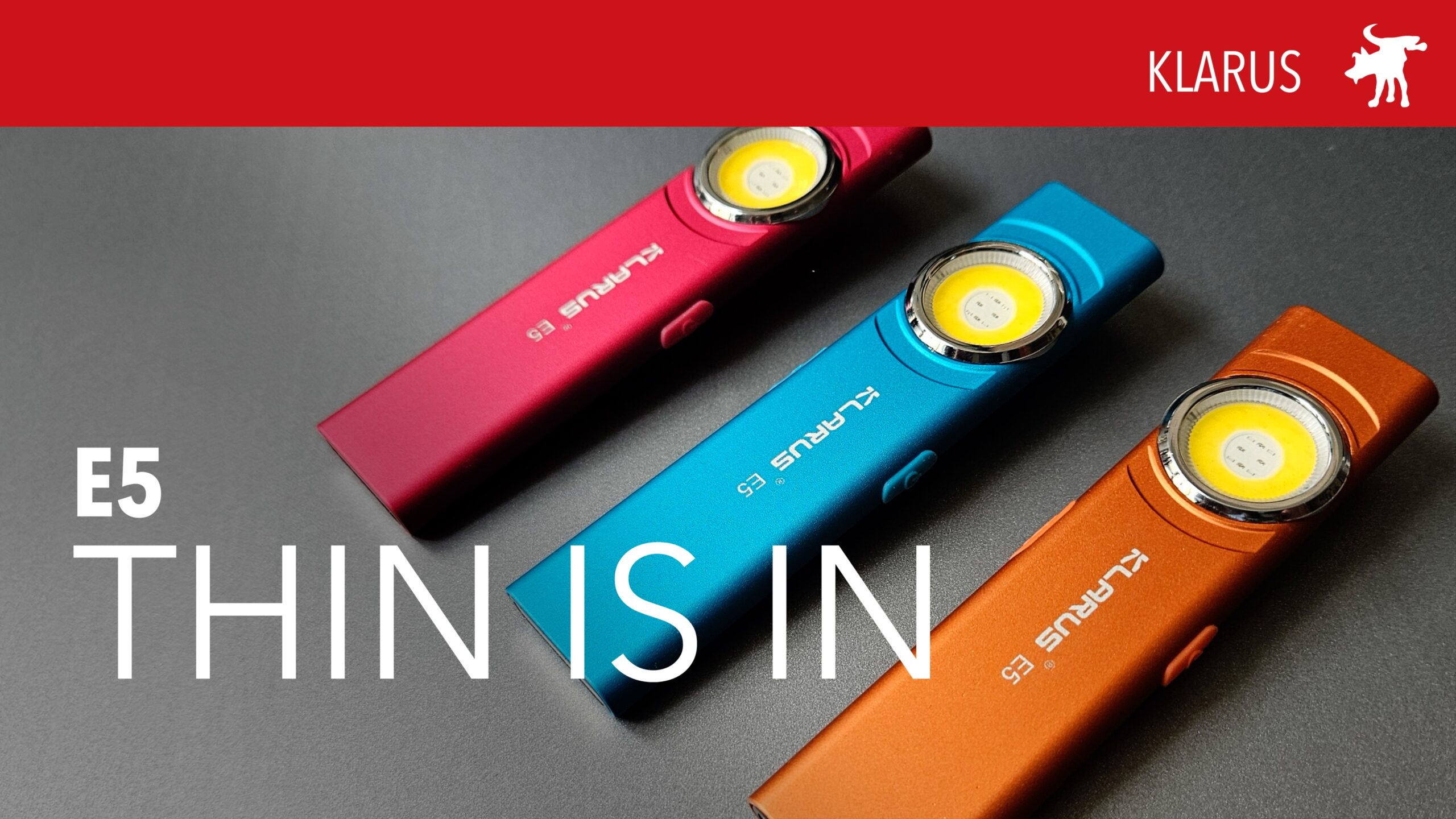
The Klarus E5 looks like a flashlight Apple would design: a cross between a highly functional EDC and an overpriced minimalist fashion accessory. But the E5 is anything but overpriced. Flat EDC lights are a mini-trend in flashlights. The Olight Arkfeld is probably the best-known example. Klarus has staked out its position by offering the lightest, flattest EDC.
The 1.4 oz E5 weighs less than a pair of Apple AirPods (with charging case). It’s about the size of 3″ bladed EDC knife and shares about the same pocket space. It has a magnetic tip that allows the E5 to tail-stand as a work light or be attached to the roof of a car as a warning signal. The EP5 comes in 6 different colors, with matching colored belt clips.
The EP5 has two light emitters. In function, it’s intended to be primarily a clip-on lapel light. Its main LED emitter is its larger round light on its side. Its auxiliary light forms the top end opposite its magnet. Both lights are activated and controlled by a single side button the light. Tapping on the button after the light unit is activated switches the main light from low-medium-high-flash/signal modes. Keeping the button pressed after activation switches between the Main and Aux light emitters. Double tapping the button activates the Aux light in strobe mode. Triple tapping the button activates the Main light in Turbo mode, outputting a maximum of 600 lumens
The EP5 trades off ergonomics in controls and function for minimalist aesthetics. The EP5 is stylish and lightweight, making it appealing, but it lacks features like mode memory, which are required in a real EDC work light. But its low price, lightweight, and packability make it a great every-day-carry light, just not an every-day-use light.
Tactical lights with their multiple lighting modes have always been hamstrung by their control, usually having to resort to multiple clicks or one or two buttons to cycle modes and brightness. With the PD40R, Fenix developed a duty light whose controls are an intuitive selector ring, allowing the user to precisely dial in their desired brightness or set the flashlight into SOS and strobe.
The PD40R v3.0 steps up in run time and throw distance from the v2.0. Physically the PD40 is just a little bit larger than the PD30 at a little over 6″ long. It runs of a 5000mAh 21700 lithium battery. The PD40R has a USB-C charging port allowing the battery to be charged inside the flashlight (which is fortunate because none of my LiPO chargers is large enough to fit a 21700 battery).
The PD40R has a slightly crenelated crown to assist in breaking glass and as a pressure point when used a self-defense tool. Because of its control ring, the unit lacks a tail click button and thus easily tail stands. Fenix included a removable pocket clip though the unit is a bit oversized.
In my testing, I measured 2600 lumens from a freshly recharged battery, which is close enough to its stated 3000 lumen output that I consider my reading well within a margin of error. In addition, the PD40 lasted well past Fenix’s 2hr and 40min runtime in Turbo brightness; I stopped my test at 3hrs and 40min and it was still not exhausted.
The only disappointing aspect of the flashlight is its control ring. I prefer the PD40’s control ring system which is much more intuitive and precise than pressing button combinations. Fenix claims the ring has a hard stop at TURBO to prevent the user from accidentally activating the SOS or strobe function. But in my testing, I too often accidentally turned the unit past TURBO into SOS. I contacted Fenix about this and they were aware of the feedback.
Suggestions about the SOS mode in the ring control aside, the PD40Rs exceeded expectations for “professional” performance.
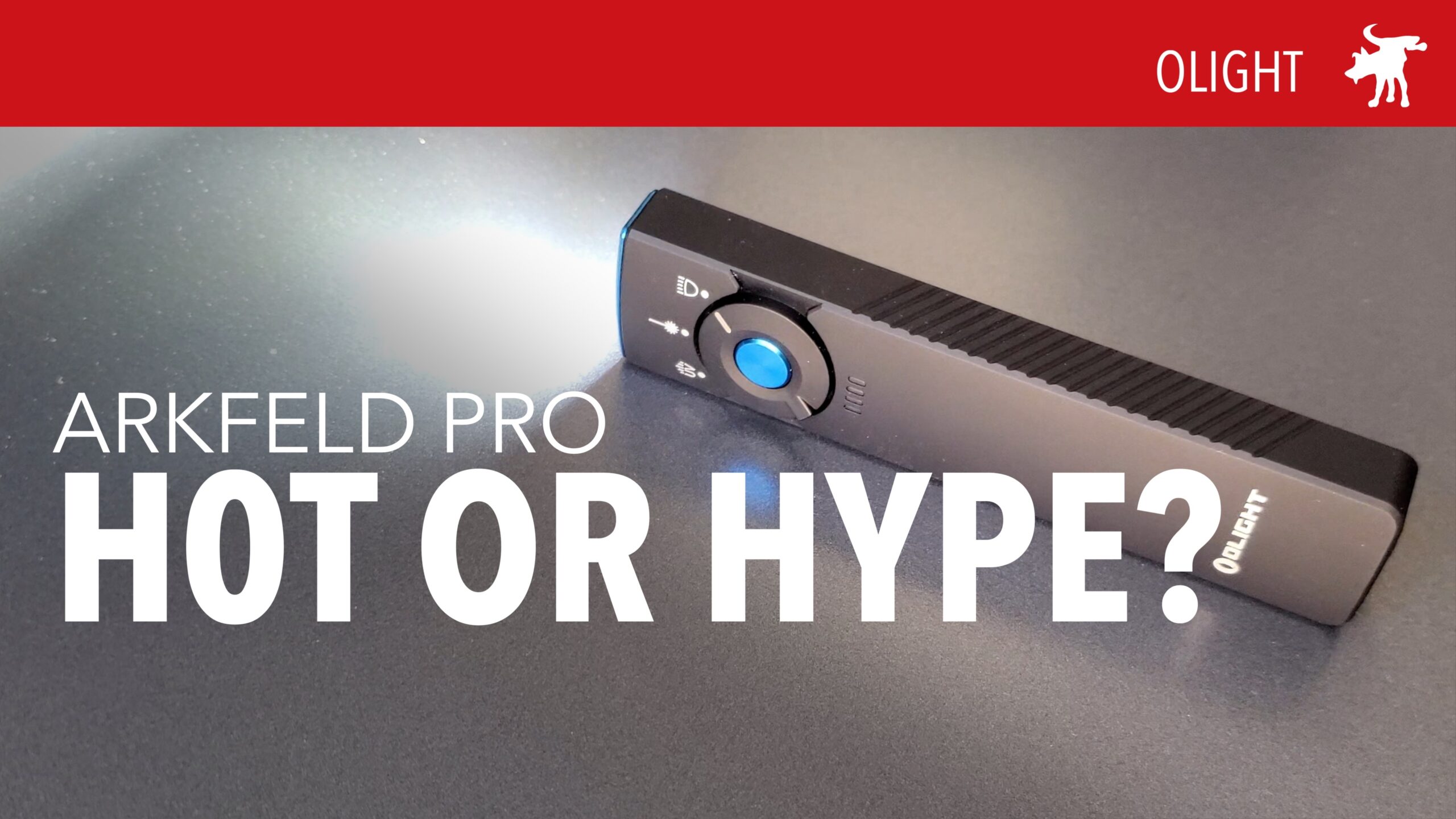
OLight turned heads when they released the Arkfeld EDC light a few years ago. The Arkfeld’s innovative flattened box design was an inspired departure from the barrel tube body of flashlights since the 19th century. This newest version, the Arkfeld PRO, adds both a UV inspection light and a green laser pointer to a high lumen output multi mode white LED.
The primary controls are an ergonomic dial and a single, if not completely intuitive, activation button on the side of the unit. The dial switches between white light, laser, and UV light. Its internal battery has charge indicator lights below the mode dial. It is recharged via OLight proprietary magnetic charging adapter calbe which is USB-A compatible. The magnetic charging port at the tail of the unit has the secondary function of allowing the flashlight to be attached to metal surfaces, like a car hood.
The Arkfeld features a deep cary clip which can be removed. The clip is 2-directional allowing it to be clipped into the brim of a cap to function as a headlamp. The body is a solid feeling box of aluminum that comes in a variety of colors and some special edition graphic paint jobs.
In my testing I was able to get more than it’s 1300 lumen advertised maximum brightness. It met my drop test and water proof testing. Fully recharged I got a runtime of about 140 minutes starting in Turbo mode which aligns with OLight’s specs.
I’ve been used to wearing a smaller and lighter EDC but despite the Arkfeld’s larger size and weight, its flattened design allows it to fit into most pants pockets with minimal printing or encumbrance. My only peevs with this otherwise near perfect EDC is that the simple one-click activation can lead to accidental activation in pocks and that a double-click could lead to accidental strobe activation.
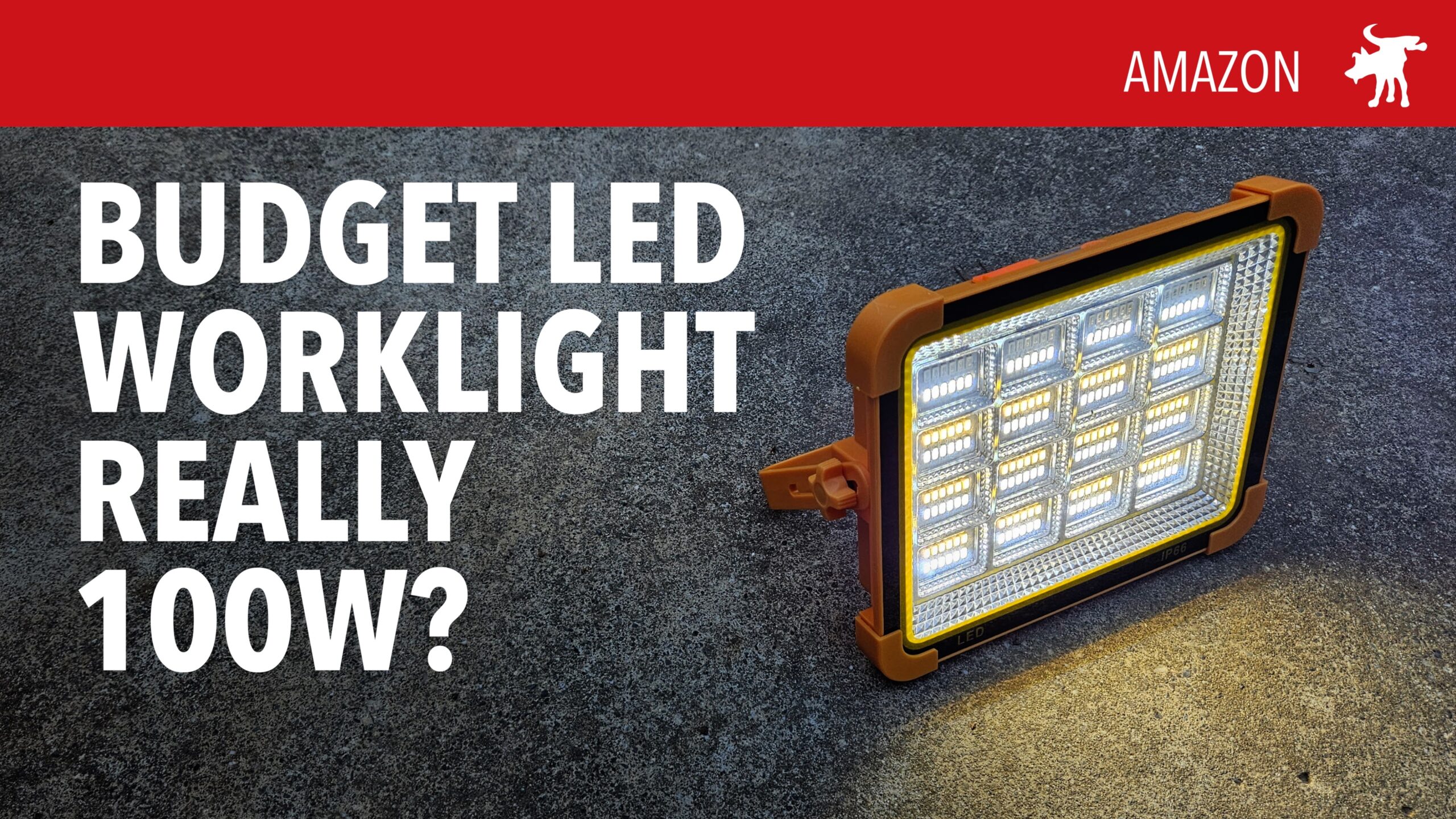
I bought a generic LED worklight off of Amazon. They are sold under various brand names. It is a battery-powered LED outdoor/shop light that claims to output the equivalent of a 100W work light. But unlike old school light, this work light is internally powered, which offers versatility in it’s placement location.
My initial impressions of the unit when taking it out of the box was that it felt light and cheap plastic. I doubt that it would survive a typical commercial construction site for very long. I did not do a drop test from 1m onto a concrete floor but I doubt the housing or or solar panels would likely not survive the fall intact.
My goal was to determine its usefulness in my home repairs and garage projects. I tested the unit and had difficulty confirming it’s brightness in my DIY flashlight lumen testing rig due to it’s large size. I got a reading of 364 lumens which is far less than the 3000 lumen advertised and a fraction of an old school halogen bulb (100,000 lumens). My naked eye estimate was that it output closer to a 40W.
After fully recharging the unit it ran for 270 minutes with both warm and cold LED lights on. The next day, I placed the unit’s panels in direct sunlight for 6hrs and found it was 2/3 recharged. I was initially dubious of the usefulness of the solar panel but in an emergency situation, the unit could provide lighting for a good +4hrs after spending a day in the sun.
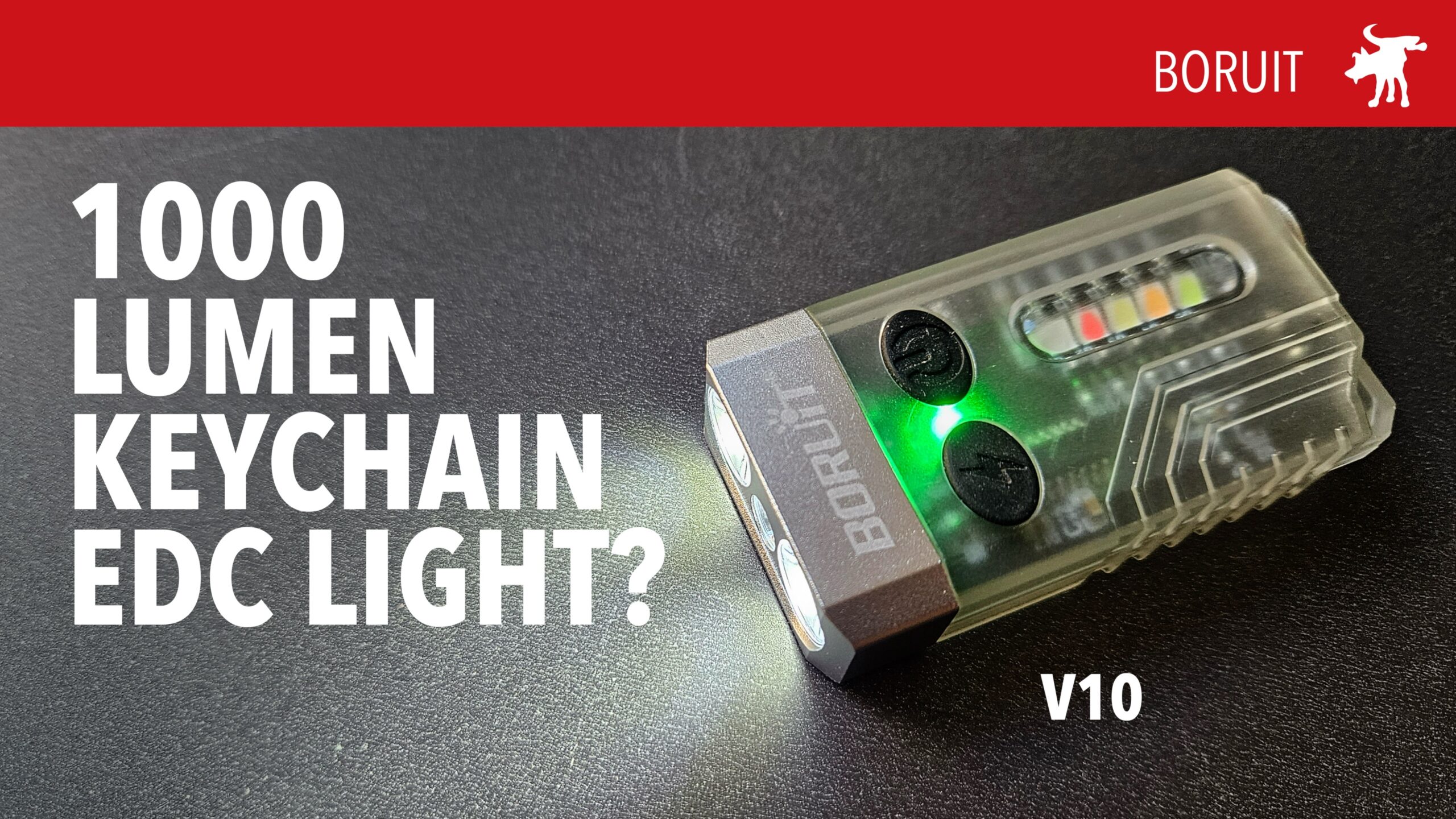
A few months ago, I reviewed the Boruit V3 which disappointed me because its light output fell short of it’s claims. Would it be the same with the new V10? This flashlight follows the same keychain fob format, creating a slightly bulkier and boxier version of the V3. The V10 is the same size as my car key remote fob making it a handy backup EDC or as a primary one.
Like the V3 the V10 comes in a choice of a polymer body in dark smoke or glow-in-the-dark white. The unit is powered by an internal LiPo battery charged by a USB-C cable under a silicone flap. There is a rare-earth magnet on the tail like the V3 which allows the light to attached to a steel car hood or on the side of a door panel where the side LEDs could be used as an emergency signal.
The V10 has a twin set of main LED white emitters and a small UV emitter at one end and a panel of colored LEDs on the side panel next to the buttons. Inexplicably the control buttons on the V10 arranged differently than the V3. When tapped twice, the left button activates the side LEDs and cycles through various color modes. 3 taps the side button activates the UV mini lamp. A continuous press activates an audible panic siren and the flashing red/blue side LED.
Double tapping on the main control button activates the twin LEDs. Tapping cycles through the brightness modes. A continuous press actives maximum output TURBO mode. In my lumen testing rig, I was able to record a HIGH output reading over 600 lumens which drops off quickly after 35-45 seconds to below 400 lumens. This was approximately in line with manuals stated HIGH output of 450 lumens.
Testing the TURBO mode was challenging because it requires holding the lights button down while holding the flashlight inside of my testing box. Some light would inevitably not leak out. Despite this I was able to record about 900 lumens which was close enough to its claimed 1000 lumens. This makes me wonder if I gave the V3 too poor of a review if it has a similar performance curve drop.
Testing the beam, the pattern is very much a flood with a defuse hot spot. Even in TURBO mode, I could barely register any visible illumination past 50-60 yards. The side LEDS are visible from a distance but cast a very short throw.
There is one key feature where the V10 falls short of the V3: IPX4 water resistance. Because of sound holes on the body for the siren speaker, the V10 is not water proof. The unit is only resistant to splashes and light rain. Not knowing this when I tested the unit using a water hose, water entered through the sound holes and pooled up inside the body. Oops.
The V10 is in most ways more capable than the V3. I especially like the panic button mode. But it is a bit larger so adding a second large fob on my key chain would be ungainly. It would still make a very useful backup EDC. If I envisioned a V20, it would be an elongated version of the V10 with longer runtime and a clip.
Help support my channel by using the Amazon affiliate link below
V10 Dimensions: 2.63″D x 1.37″W x 0.59″H Beam Distance: 100m Battery: Internal Lithium Ion Weight: 46 Grams Water Resistance: IPX4 Brightness: 1000 Lumen Battery Description Item Weight: 1.62 oz
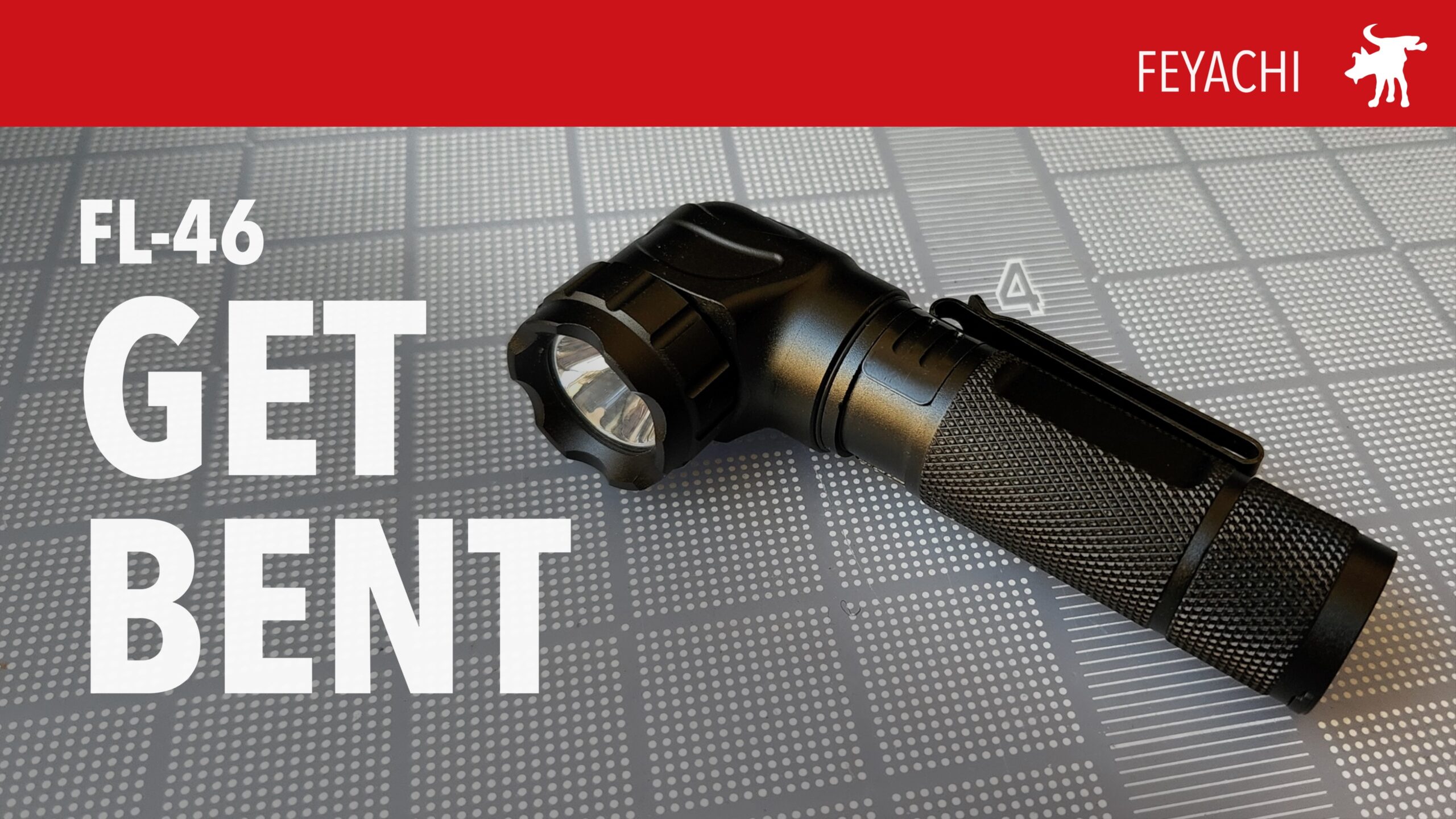
Feyachi sent me their new right angle rechargeable flashlight, the FL-46. Right angle flashlights are not new. The design was boy scout and military standard since before WWII. Right angle flashlights can be attached to the wearer’s chest, backpack straps, or pocket to illuminate while allowing wearer both hands free.
The box that the FL-46 comes in is a little fancier than Feyachi’s normal packaging, with a pull drawer. The flashlight comes with a nylon holster, USB-C charging cable, and user manual. The charging port is located under a plastic sliding panel at the base. The FL-46 can be stood on its tail and attached to your pocket or strap with a metal double-direction clip.
The controls are basic, with a silicone clicky button at the right angle bend. Pressing turns turns it on and each tap cycles through its modes: On>High>Strobe>Off. Pressing it for over 1 sec. will also turn the flashlight off. The FL-46 lacks mode memory or momentary on.
In my testing, the “Regular” on mode output more than its stated 300 lumens by over 50%. It’s “High” mode was just above to its stated 500 lumens. Fully charged, the unit had a run time in excess of 400 minutes. It dimmed considerably after the first hour but stayed in a candlelight dim output well past the 300 minute mark when I had to cut the test due nightfall and the lack of light for the camera to read my timer.
If this light has just too many flaws for me to recommend it. It lacks mode memory and a means to lock out the strobe mode. Furthermore the plastic dust cover for the charging port leaves the light at only IPX4 water resistance; a glaring oversight for a “tactical-style” flashlight for it not to be rain-proof. This light might be better suited for workshops, repairmen, or mechanics.
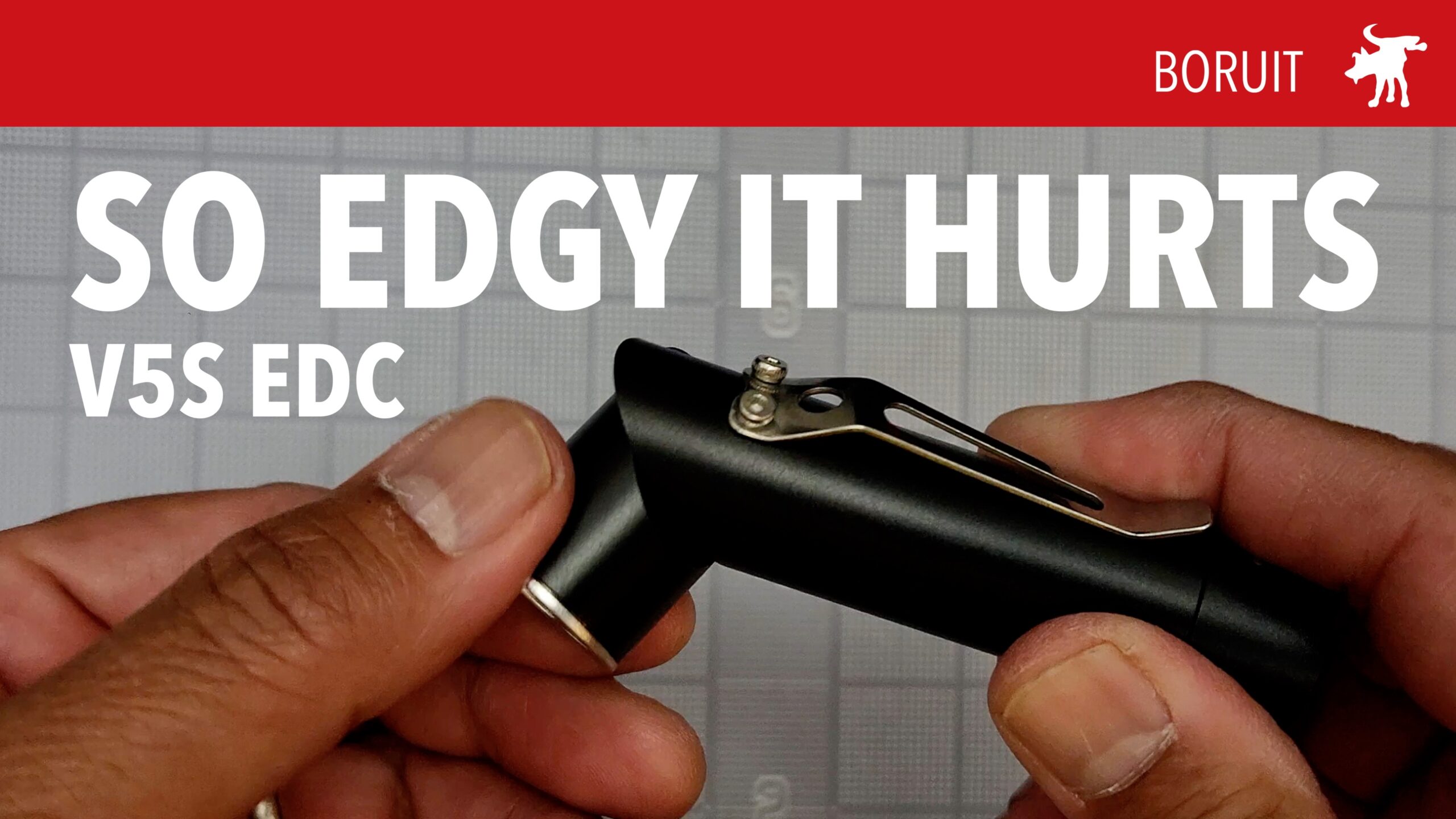
This is the first product I can’t recommend due to dangerous construction. This little flashlight sliced open my thumb while testing it. This EDC is unusual in that the head of the tube has a 45º cut which allows the head to swivel into a 90º position. Unfortunately, the edges of that 45º cut were left razor sharp by the factory.
I really wanted to like this budget EDC flashlight. It has is USB-C rechargeable with set of side LED lights for signaling and use as a table top lamp. In addition, it has a magnetic clickey tail allowing it to be wall or overhang mounted as a work light. In my testing it met the 500 lumen output it claimed and had a runtime just over 100 minutes on high mode.
The factory just didn’t take into consideration that the tube cuts need to be ground down. Perhaps they were kept sharp for aesthetic reasons but they are a safety hazard. I contacted the original Amazon seller NGOKPYD. If you’ve been injured by this product let me know. I don’t plan a class-action lawsuit, I’m just curious. This EDC is stil available elswehere online under the brand name BORUIT.
In the contest to make the smallest, brightest, EDC flashlight, the Fenix E03R isn’t the smallest or the brightest but this keychain sized flashlight offers a bit of both while being perhaps the most durable. This all-metal bodied flashlight looks like it feel straight out of the Star Wars universe. It is about the size of a car alarm remote fob (actually smaller than mine).
The light activates by pressing the activation button for about 1 second and immediately release upon activation. While on, tapping the button changes the brightness mode (4 levels). Pressing the button for longer than 1 second activates the red LED which has a constant and blinking submode. Tapping the button once shows you the battery charge level by the color of the illuminated ring around the button.
Tapping the button twice causes the battery illumination ring to slowly pulse; tapping in this mode switches colors from red, green, and cycling between both. The amount of light cast by the ring is very dim (less than 1 candela). It looks only bright enough to help locate the light in the dark, I’m not convinced this lighting mode has much utility in the real world?
In my lumen test, I recorded an output of 440 lumens on highest brightness which is well within the margin of error of the 500 lumens Fenix lists for the E03R. Fenix claims the light is IPX6 water resistance which I tested and confirmed. Fenix also claims the light has a runtime of 1hr and 20minutes on high; in my test it exceeded that mark by 18 minutes.
The light met all of its specifications and felt so solid in my hand, that I decided to give it a rare durability test out of curiosity. I ran it over with my SUV, twice. The flashlight survived without a dent (well more like a bunch of small scratches) but somehow the pressure activated the flashlights ‘lockout’ mode where the light doesn’t turn on when the button is pressed. The activate or deactivate lockout mode, simply keep the button pressed for 3+ seconds.
The E03R’s main drawbacks are in its controls. I don’t like having to turn on the unit in white light before it switches to red light mode which could spoil your eye’s natural nigh-vision. And the units 1/2 second press activation seems insufficient in preventing accidental activation in your pocket.
But overall I like this light a lot based on performance with those small caveats with the controls (which I have nitpicks with Fenix other lights). This is the Version 2 of this light and perhaps they can address this in a future Version 3.