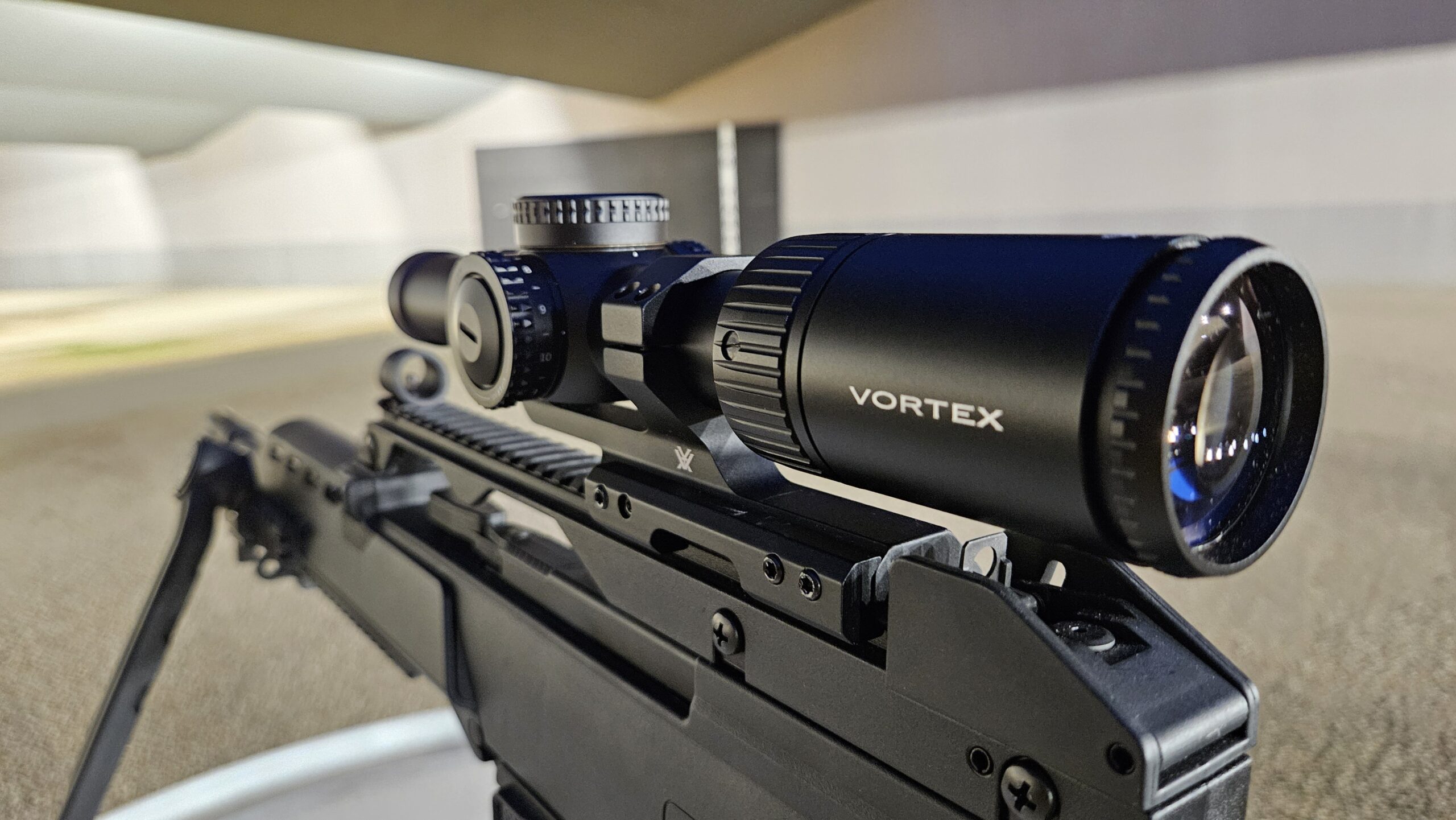
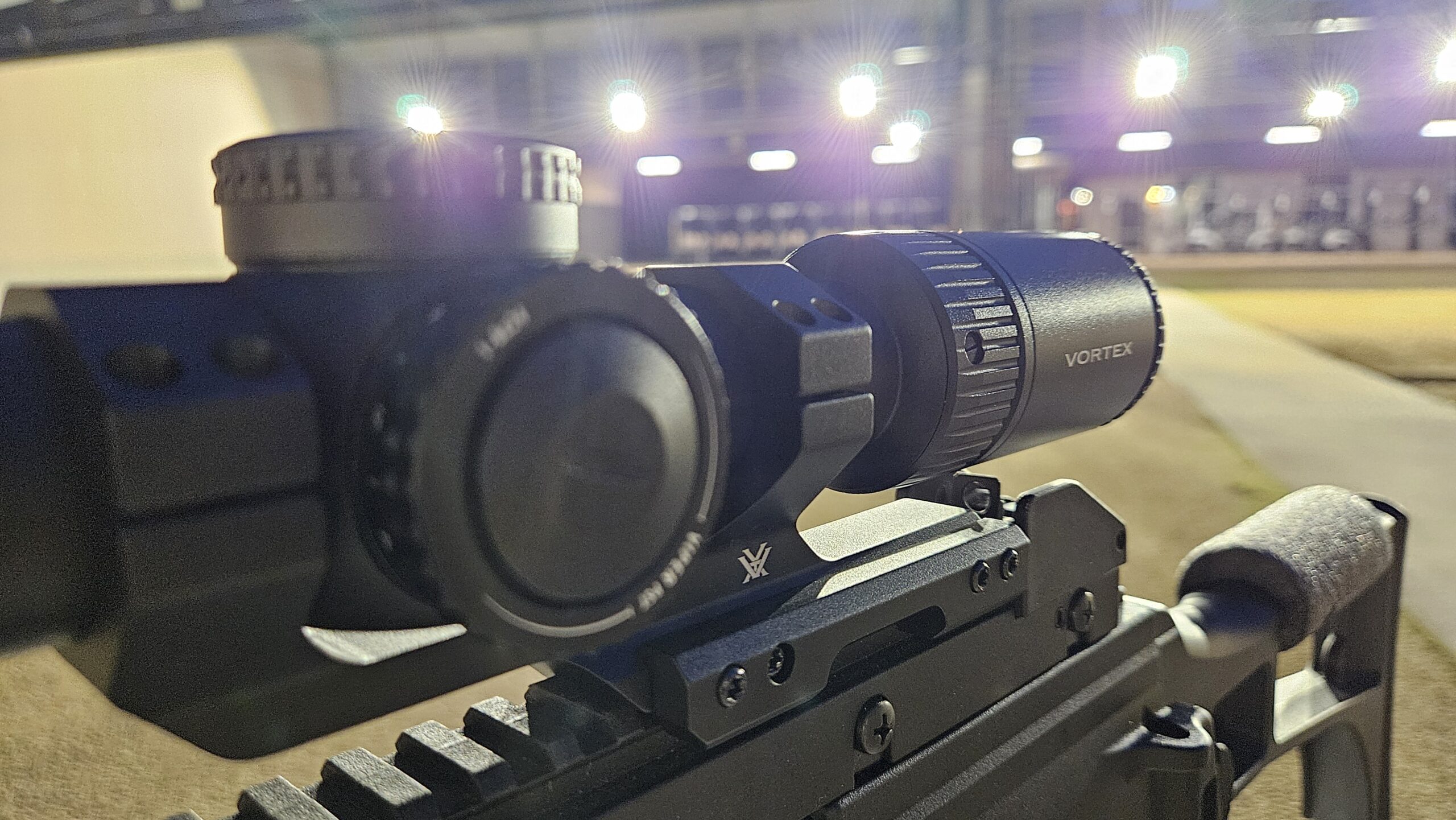
The Viper PST Gen 2 is Vortex’s mid-tier LPVO (priced between the Venom and the Razor) and lowest-priced LPVO that offers true daylight bright illumination. You have a choice of an MOA or MILRAD crosshair reticle with calibrated hash marks for long-distance shots. The fiber optic embedded in the reticle provides a red dot bright dot at the center with 10 levels of intensity, powered by a CR2032 battery.
Design-wise, the Viper appears very similar to Vortex’s premium LPVO the Razor HD. Its illumination knob features 10 steps of brightness with an off in between. The indexing of the illumination knob felt a tad bit loose and sloppy. Optically it is a bright, clear, and relatively flat sight picture with only a little fish-eye effect.
The Viper’s only drawbacks are its illumination turret and weight (22.7oz). The Viper was one of the first LPVOs to utilize fiber optic in its reticle but is a bit more expensive than fiber optic offerings from Monstrum and Primary Arms. The Viper is still a strong performer and matched with the famous Vortex warranty, still a viable LPVO option today.
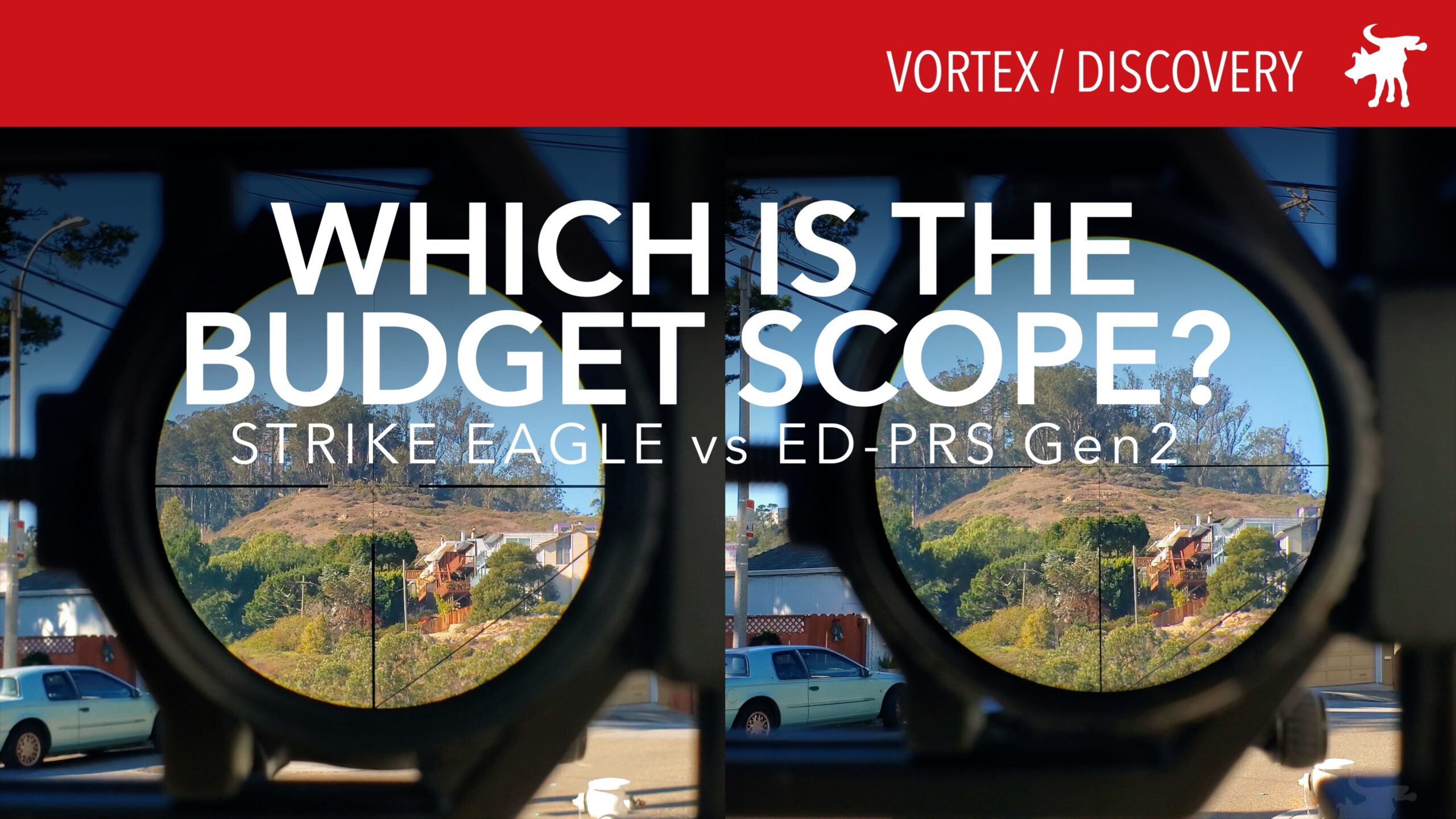
The Strike Eagle 5-25×56 is Vortex’s best long-range scope under $1000 (with a street price of around $700-$800). Optical technology has advanced as fast as prices have dropped. New “budget” scopes now offer higher optical quality and performance. One of the best examples is Discovery Optics’ ED-PRS which sells for half the price of the Strike Eagle.
The ED-PRS ships with more accessories than the Vortex. My model is the first edition Gen2. The newest version of the Gen 2 has updated tool-less turrets and does not ship with scope rings. The ED-PRS has tall oversized turrets which are easier-to-read numbering. The ED-PRS turrets had more precise feeling clicks and a wider range of adjustment. Both scopes appeared to be well constructed but the ED-PRS is almost a full pound heavier and certainly appears more chunky.
Both scopes offer bright and clear imagery that is very similar in quality. The Strike Eagle has a brighter and higher contrast image but with slightly more chromatic aberration at high power. The Strike Eagle also offers a more forgiving eye box.
Both scopes showed good color rendition at the gun range and the ability to see details in low light at 25x. Because of the Vortex higher contrast glass, the Strike Eagle seems a bit sharper but both scopes can resolve the same level of detail in the US Airforce reference chart.
Long-range shooters will be well served with either scope for their similar optical performance. But for conscious shooters, the Discovery Optics ED-PRS is the clear winner.
The Vortex Strike Eagle 5-25×56 is one of the top-rated long-range scopes under $1000 (MSRP over $1250 but with a street price of around $700) when it first came out a few years ago. Vortex took many of the features found in their top-tier Razor HD and created a virtually identical-looking scope for a 1/3 of the price. But is it a “Budget Razor” or a “cheap knockoff”?
The Strike Eagle shares a nearly identical-looking external design to the Razor, save for the Razor’s MilSpec FDE/Burnt Bronze finish. But on closer inspection, there are some differences. The illumination knob does not lock and the elevation and windage turrets don’t feel as crisp or precise as the more expensive Razor. While the controls are lackluster, its glass is not.
Looking through the scope, I was treated to Vortex’s glass. The image was bright, sharp, color accurate and high contrast. At the range, I did notice some chromatic abortion at high magnification, but not as pronounced as seen in the video footage. The Strike Eagle is able to resolve fine details to a degree I usually see in much more expensive scopes.
The Strike Eagle is not cheap. With the arrival to the market of brands such as Arken and Discovery Optics, its performance has been matched or even exceeded to some degree by budget High-Performance scopes. The Strike Eagle is still Vortex’s best glass for long-range under $1000.
The Vortex Strike Eagle 5-25×56 is one of the top-rated long-range scopes under $1000 (MSRP over $1250 but with a street price of around $700). In the five to six years since its release, optical manufacturing technology has advanced as fast as prices have dropped. How does a Vortex scope released in 2020 compare to a modern budget scope like the new $199 Monstrum Challenger?
The Monstrum ships with more accessories than the Vortex, including its own set of high-height rings. But lacks a sun shade included with the Vortex. The Strike Eagle also comes with a throw lever but the Challenger comes with a built-in fin on the magnification ring so it doesn’t need one.
Holding them both in the hand, I noticed the Challenger was a 6-7oz heavier. The turrets of the Strike Eagle looked slightly better milled and its numbers precisely lined up with the scope’s reference marks, whilst the Challenger did not (a blunder common in budget scopes). The Strike Eagle had the better build quality of the two.
Looking through the glass, I immediately noticed more chromatic aberration in the Challenger. This was disappointing after testing Monstrum’s ED-glass LPVOs last year. The Challenger also showed softened focus around the edges of the scope view, even at its lowest magnification. Both scopes had similar eye relief and eye box.
At the gun range, the Strike Eagle was a bit brighter and noticeably sharper, with less chromatic aberration than the Challenger which showed purple fringing even at 5x. Both scopes showed good color rendition and the ability to see details in low light at 25x. The Strike Eagle resolved resolution lines 3-4 steps smaller than the Challenger.
One other key difference for me was in each scope’s reticle design. The Strike Eagle was better suited for precision target shooting with finer stadia lines and a floating dot-point. The Challenger had a bold central cross as its aimpoint which was visible even at lower magnification, making it a much faster to aim tactical or hunting scope. Overall the Strike Eagle was the better scope. Factoring in the price, the Challenger at 1/3 the price was the better value.
Almost four years ago, I posted one of my first rifle scope reviews of my Vortex Diamondback Tactical (DBT). For the longest while it was my go-to scope on my Ruger Precision Rimfire when I wasn’t testing a scope. In those intervening three years I’ve reviewed dozens of scopes and thought it was worth revisiting my assessment of it.
The DBT is one of Vortex most affordable partly due to it’s more paired down features. It does not have illumination, a zero stop elevation turret, nor locking windage. It does have an excellent FFP reticle with a Christmas tree for long-distance shooting and nice thick outer cross hairs to make it easier to see the reticle out at low power. It was a “cross-over” scope before there was even a term for it. I especially like its tiny 0.25 open center, which allows me to more precisely see the center X when competing at 100yrd matches.
What I’ve forgotten or failed to notice was the DBT’s faults. The scope has an unforgiving eyebox at 24x. It has rather sloppy feeling turrets that pass the box test and track. The glass has noticeable chromatic aberration but despite that shows surprisingly sharp resolution.
Despite its flaws it is still a solid performer and one of the best value scopes, giving a solid option in Vortex’s low entry level scopes.
The Razor HD is Vortex Optics top tier LPVO. With its destinctive trademark burnt-bronze color, the Razor certainly stands out. And up close it has the looks of a premium optic.
The HD Gen iii has a very precise low-profile capped turrets, with a fine 1/4 MOA per click adjustment. It has a lockable illuminator knob and offers 11 levels of brightness that at its highest settings is truly daylight bright; almost too bright for indoor use.
The Razor’s 34mm sized tube body allows it 120 MOA of internal adjustment. This is useful for extreme long distance shots made possible with it’s 10x maximum magnification and a fine, detailed, Christmas Tree reticle. In many ways this is an LPVO optimized for 10x rather than 1x. Because that FFP reticle become a small, simple floating ‘T’ at 1x which can be somewhat hard to acquire under rapid fire. Thankfully its crazy bright reticle illumination solves that problem, making this LPVO as quick to aim as a red dot at 1x.
The image through the scope at all magnifications is satisfyingly bright and sharp. Unfortunately it has “Fish Eye” at 1x and quite noticeable chromatic aberration at 10x. These issues shouldn’t be found Vortex’s top scopes, yet here it is. The Razor is a premium LPVO that sells for $2499 on Amazon. The Razor is clearly a higher quality scope. But for a weekend shooter like me, I was able to shoot just as accurately with either scope.
These optics are available on Amazon through these affiliate links which support my channel:
Vortex was one of the first optics companies to roll out true “daylight bright” illumination on their LPVOs; bright enough to be seen outdoors in daylight sun. Monstrum recently released their first LPVO with a reticle that claims to be “daylight bright”.
Monstrum sent me a sample of their newest Banshee with a new BDC-C1 fiber optic reticle. They also sent along a brand new Vortex PST Gen2 and asked me to test and compare them. Both are 1-6x SFP LPVO’s with 30mm tubes so it would make for a fair apples-to-apples comparison.
Both LPVOs looked broadly similar. The Viper has larger diameter turrets and some small details in its construction that cue anybody who has milled metal that it’s a higher value scope. Both have 30mm tubes but the Viper manages to offer more than twice the range of adjustments of the Banshee’s 70MOA.
Both have illuminator rheostat that offer an ‘off’ setting between its numerical intensity levels. The Viper offers 10 levels whilst the Banshee offers 6; and unlike the other Banshee models, only in the color red. The Vipers rheostat dial had an annoying slop that made me turn past and accidentally turn the unit off when changing intensity levels.
Both have capped turrets with 1/2 MOA adjustments per click; which were clear and loud. The Monstrum’s turrets were mildely tactile positive with a fair bit of slop between clicks. The Viper’s turrets were crisp, tactile clicks with very little slop. I didn’t bother with tracking tests as capped LPVOs, the designs intent wasn’t for futzing during use. These turrets were meant for zeroing the reticle and then shot adjustments should be made by the user using the reticle’s sub tensions.
The Viper had a smoothly turning power ring but was stiff enough that I would have wanted a throw lever that the Viper’s retail package lacks. It did come with a 2″ sun shade which none of the Monstrum LPVOs include in their package. The Banshee’s power ring was stiffer and not as smooth but compensates for it with a built in fin-style throw lever.
Looking through each scopes, the Viper had a brighter view. But both appeared crisp and sharp at 1x. The Vortex had very, very, slight fish eye curve at the outer edge of the view. In most other ways, the LPVOs were evenly matched. Only at the covered range did the Vortex show a clearly greater sharpness and brightness offering 3 levels of resolution better than the Banshee and less chromatic aberration.
The reticles were also very similar looking semi t-style; the Viper having MOA sub tensions whilst the Banshee has bullet drop calibrated sub tensions. Both have a bright central point which illuminates creating a red-dot like focus point. Comparing both at their brightest settings, both were similarly daylight bright and visible even when aimed into the sky near the sun.
At this point there really wasn’t much else to test. While the Viper at 11 may be a bit brighter than Monstrum’s new BDC-C1 Banshee at 6, both are truly is daylight bright. How much brighter do you need?
At the range, I could quickly and accurately aim and hit my targets. Like so many of their features, I found the eye boxes to be effectively identical. Because these scopes were short-term loaners, I wasn’t able to test durability or ruggedness but both held their zero during my day at the range on my 5.56 AR.
Both scopes come with lifetime warranties on workmanship but the Viper comes with Vortex’s no-fault policy, covering accidental damage and user error. Recently Monstrum revised their warranty to cover accidents but their fine print requires a receipt and I haven’t had any feedback with ease of returns. Vortex seems to have an easier return policy but recently has a reputation for sloppy QC.
By far the biggest difference between the Banshee and the Viper is their price. The Viper is one of Vortex mid-range models and sells for $599 on Amazon, which is 4 times the price of the Banshee ($149). Moreover, the Banshee includes a quality offset mount. The Viper does not include a mount and the Vortex Sports mount costs an additional $100.
Comparing the Monstrum Panzer vs Vortex Razor HD 1-10x FFP the differences in the quality of the scopes was significant. But comparing the Banshee to the Viper, the differences were harder to find. Certainly the Viper was sharper, brighter, had more range of adjustments and a better warranty. But if I had to the choice to buy either of these scopes, I think I’d choose the Banshee because its a better value.
These optics are available on Amazon through these affiliate links which support my channel:
If you had an opportunity to test out a $200 scope you’d probably say, “sure.” If they offered to lend you another scope that cost 12x as much to compare, you’d say “hell ya!”
Recently I conducted a head-to-head comparison between a Monstrum Banshee 1-10x and a SIG Tango MSR 1-10x. This time Monstrum sent me their new Panzer 1-10x FFP (First Focal Plane) and asked me to compare it to a real high-end LPVO like the Vortex Razor HD Gen iii.
Now optics snobs can argue that a Vortex Razor really isn’t a high end LPVO but lets leave that nitpick aside and agree that the general public, the DOD, Monstrum believes that it is. For this comparison Monstrum wanted to me to compare their flagship LPVO to Vortex flagship LPVO.
I agreed to create this comparison video with the understanding that I would post my real findings; however they turned out. If the Panzer was outclassed the Razor, I would show it. I wasn’t going to bias the testing in favor of their product. As with the SIG video, Monstrum assured me they wouldn’t want it any other way.
Using Amazon, Monstrum sent me brand new samples of both LPVOs. Razor is Vortex Optics top tier line of of scopes. And up close, in my hand, the Razor certainly looked and felt like a premium optic.
Razors are identifiable by their trademark burnt-bronze color. The HD Gen iii has very precise low-profile capped turrets, with a fine 1/4 MOA per click adjustment. It has a lockable illuminator knob and offers 11 levels of brightness that at its highest settings is truly daylight bright; almost too bright for indoor use.
The Panzer is distinguished from other Monstrum scopes by the design of its control surfaces, which is inspired by the look of tank treads; “panzer” is the German word for “tank”. The Panzer offers two illumination colors but the intensity is nowhere close to the Razors, offering typical CQB/low-light brightness.
Side by side, the biggest visible differences (aside from the Razor’s unusual color) is size. Without its optional sun shade, the Razor is an inch shorter than the Panzer. Despite that the Razor is heavier than the Panzer, largely due to its larger 34mm sized tube body allowing it 120 MOA of internal adjustments vs the Panzer’s 30mm tube and 70 MOA of adjustments. The other material difference is that the Panzer retail package includes flip-up lens caps and a 30mm Monstrum PRO series offset mount; which are premium quality mounts.
Looking through each scopes, I was struck by how clear and sharp everything looked through the Razor; it was looking through a freshly cleaned window. At 1x the superior clarity of the Razor to the Panzer was obvious. The Panzer view was clear and sharp but not nearly as bright and clear as the Razor.
Despite this, there were two surprising shortfalls in the Razors exemplary optics. At 1x the Razors view appeared wider than 1x Object appearing smaller than in real life. Moreover this manifested in a slightly pronounced fish-eye lens effect on objects at the outer edge of the field of view. Oddly this wasn’t as noticeable when looking through the scope with boys open (as LPVO’s are meant to be used at 1x). The Panzer’s view wasn’t distorted like the Razor’s. 1x looked truly 1x.
At 10x the Razor offered a brighter, sharper and more detailed image than the Panzer. The Panzer’s outer edge had a soft focus. Comparing both scopes at the range, the Razor was able to resolve much finer details on the USAF-51 chart. Surprisingly, despite its clarity, the Razor had far more chromatic aberration.
The first focal plane reticles of both scopes were somewhat similar. At 10x they appear as a T-style crosshair with MOA subtensions and circle-dot central aim point. The Razor’s reticle also included a holdover Christmas Tree and in addition has finer stadia lines than the Panzer. Overall the Razor’s reticle was better optimized for extreme long range shooting by obscuring distant targets less than the Panzer.
At 1x both scopes reticles shrink down to reveal a simple floating T. The Panzer’s reticle lines are twice the length of the Razor’s making it slightly more visible. To compensate for such small, fine reticles it’s best to run both LPVOs with illumination and again the Razor’s brightness outclasses the Panzer.
In ran both LPVO’s on my AR, running timed shooting drills shooting 5.56. Like most 1-10x LPVOs, they both suffer from tight and unforgiving eyeboxes, though not the worst I’ve tested. The Razor had a slightly longer eye-relief.
I found the performance difference for casual range shooting and plinking to be minimal between Panzer and Razor. But for a LEO, 3-Gun Competition Shooter, or a combat professional, the Razor’s proven battlefield performance can not be overstated. Both scopes come with lifetime warranties on workmanship but the Razor comes with Vortex’s no-fault policy, covering accidental damage and user error.
By far the biggest difference between the Panzer and the Razor is their price. The Razor is a premium LPVO that sells for $2499 on Amazon. That is ten times the price of the Panzer ($199). The Razor is clearly a higher quality scope. But for a weekend shooter like me, I was able to shoot just as accurately with either scope.
Circling back to Monstrom’s original request: how does the Panzer compare to a higher-end LPVO. What I learned is that it is surprisingly good for a budget scope. And while the Panzer is not in the same league as the Vortex for sharpness, clarity, brightness, for the price of a Razor you could buy a Panzer and a firearm or two with the spare change.
These optics are available on Amazon through these affiliate links which support my channel: