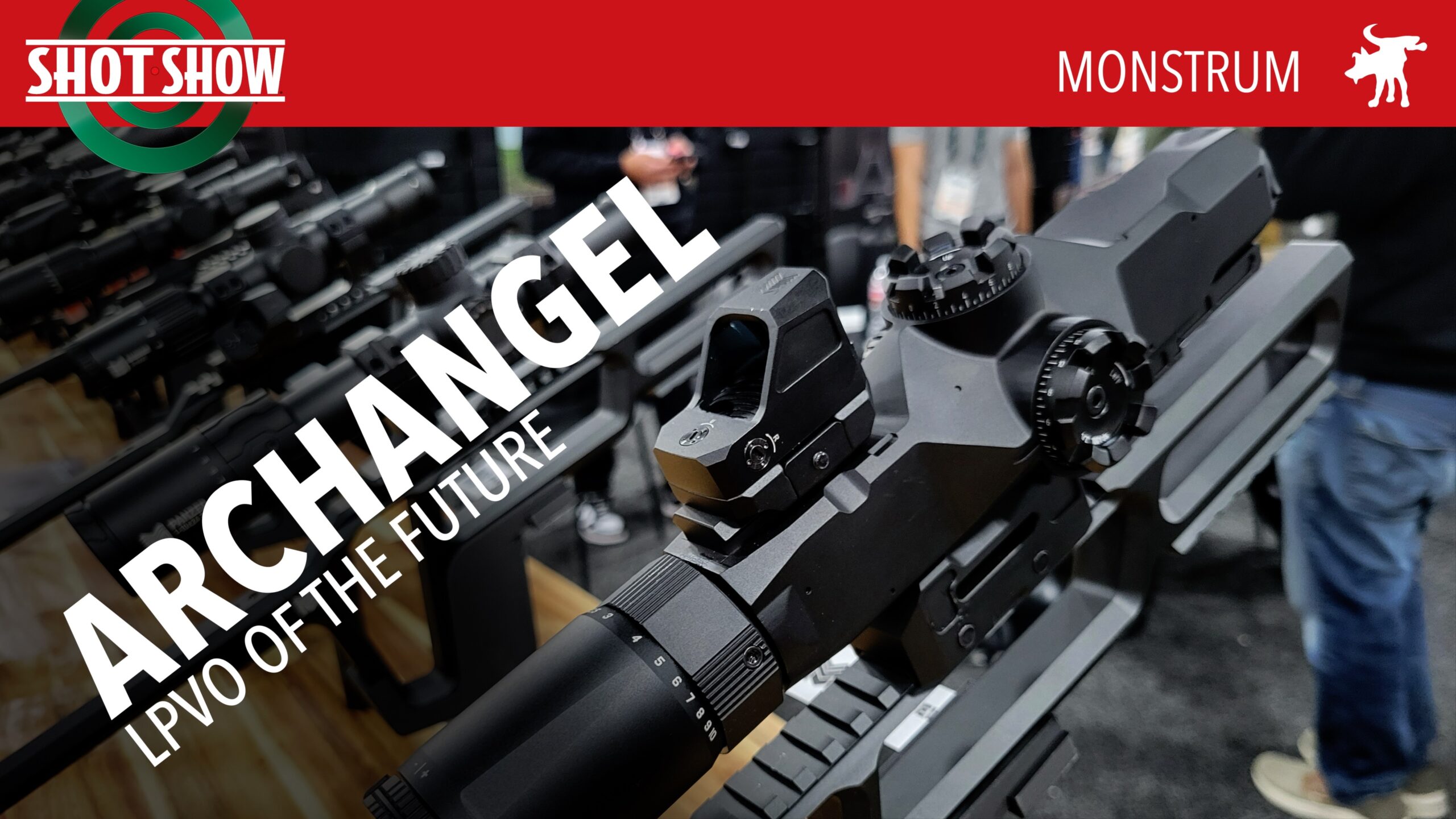
At SHOT Show, Monstrum showed off a concept optic named the Archangel. This LPVO has the internals of their upcoming 1-6x Panzer FFP LPVO but with a radically different body. It has a very angular futuristic body design that reminds me of video games like Halo or Mass Effect. Their Marketing Director told me they took inspiration from Vortex’s Next Generation Squad Weapon system optic being developed for the US Army and Marine Corp.
This is still a concept design. I am puzzled by the utility of a piggy back red dot on an LPVO? This would be more practical on an MPVO. Post a comment in the YouTube video if you would like Monstrum to move forward with producing this eye catching optic.
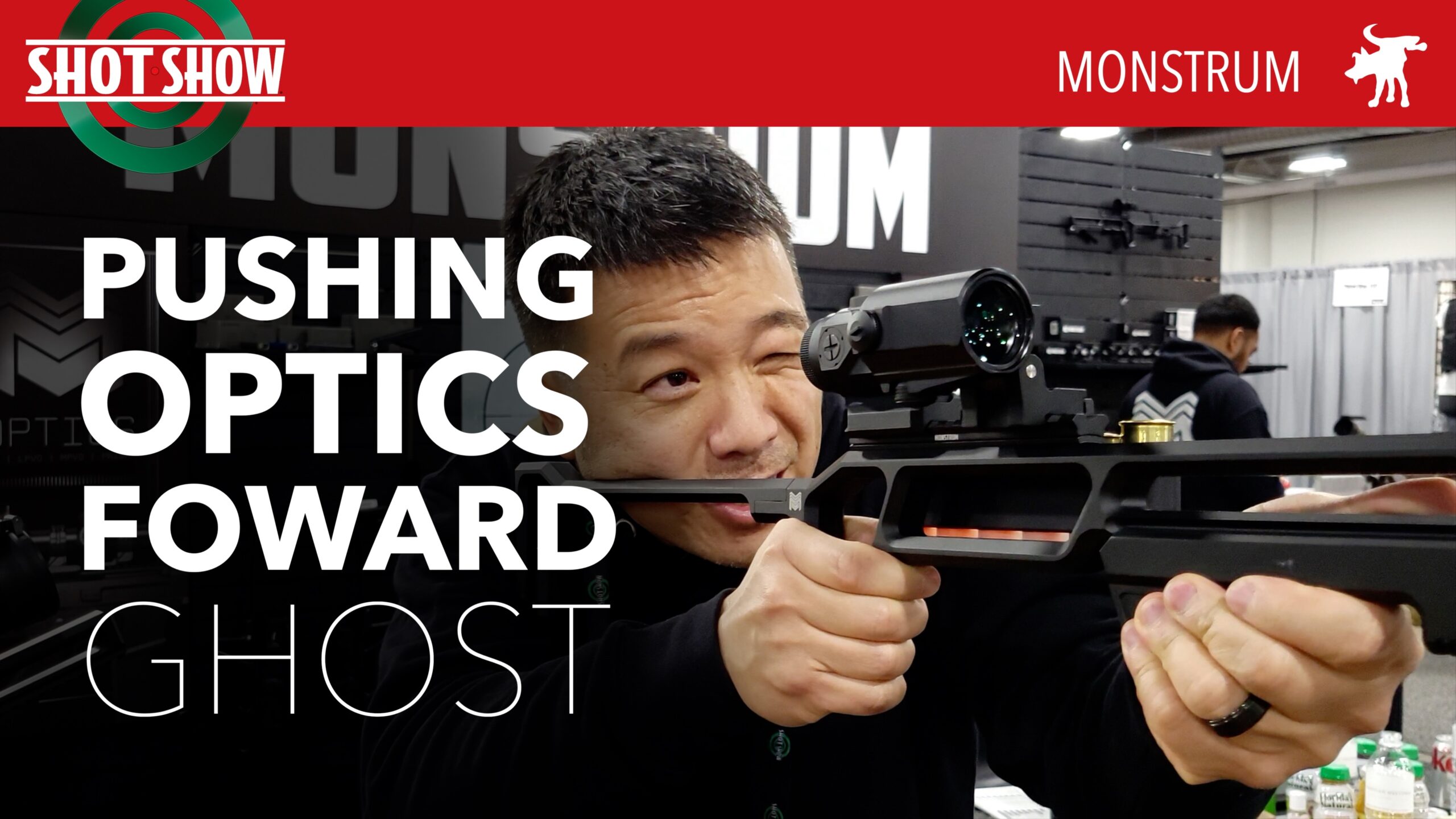
Red dot magnifiers have been around for over almost two decades. These specialized scopes allow users to add magnification to their red dots. But for prism scopes, magnification has been fixed due to their limited eye relief. Monstrum did something innovative.
The Ghost magnifier is the first of its kind that I’m aware of that fits forward of the aiming optic instead of behind it. This allows the GHOST to work with both red dots and prism scopes; converting a 4x prism scope to an 8x. It comes with a side-flip mount.
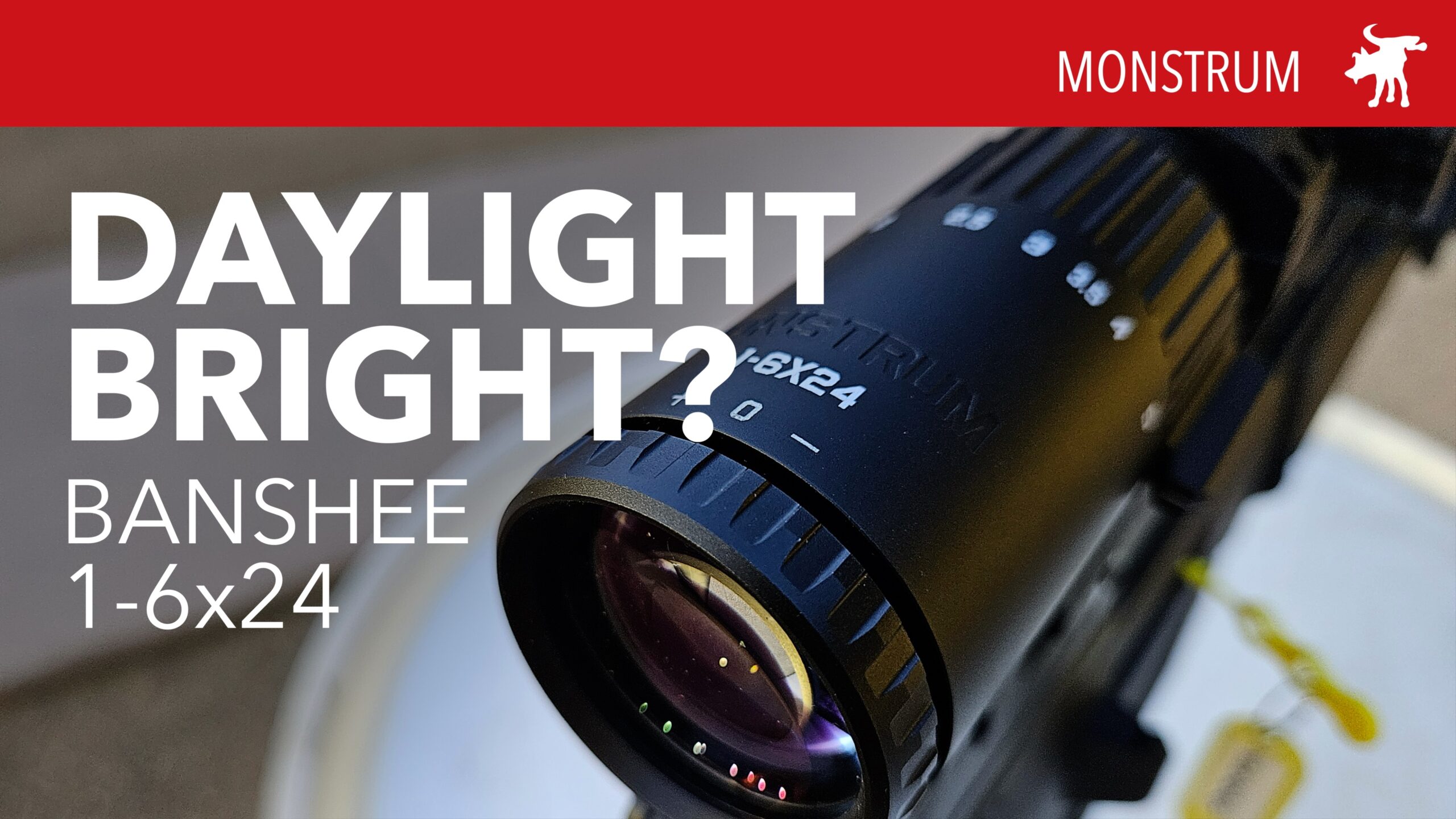
Many LPVO’s claimed to have “daylight bright” illumination, but until recently that was largely a boast. Monstrum sent me a 1-6×24 Banshee. This LPVO appeared physically identical to the 1-6×24 Banshee I previously reviewed but this sample comes with their new BDC-C1 fiber optic reticle.
The package comes with the an offset mount and flip-up caps. The scope has capped turrets that are resettable to zero. This sample’s turrets had audible clicks but were a bit sloppy indexing.
Unlike the standard Banshees, this version’s illuminator rheostat only has red as its color and has an ‘off’ setting between its numerical intensity levels. To make the reticle daylight bright, a hair thin fiber optic strand is embedded inside a BDC duplex reticle to provide a bright illuminated point at the center of the crosshair. In my tests, I found that at at its maximum intensity the reticle was red-dot bright, easily visible in broad daylight even pointed into the sunlight sky.
It checks the boxes. At 1x it’s a flat 1x view with no fish eye. It provides a surprisingly clear and sharp image with little to no chromatic aberration even at maximum magnification. It’s held zero over multiple range visits. This makes the Monstrum the most affordable daylight bright LPVO that’s worth a damn.
This optic is available on Amazon through this affiliate links which support my channel:https://amzn.to/3SndrLQ
Vortex was one of the first optics companies to roll out true “daylight bright” illumination on their LPVOs; bright enough to be seen outdoors in daylight sun. Monstrum recently released their first LPVO with a reticle that claims to be “daylight bright”.
Monstrum sent me a sample of their newest Banshee with a new BDC-C1 fiber optic reticle. They also sent along a brand new Vortex PST Gen2 and asked me to test and compare them. Both are 1-6x SFP LPVO’s with 30mm tubes so it would make for a fair apples-to-apples comparison.
Both LPVOs looked broadly similar. The Viper has larger diameter turrets and some small details in its construction that cue anybody who has milled metal that it’s a higher value scope. Both have 30mm tubes but the Viper manages to offer more than twice the range of adjustments of the Banshee’s 70MOA.
Both have illuminator rheostat that offer an ‘off’ setting between its numerical intensity levels. The Viper offers 10 levels whilst the Banshee offers 6; and unlike the other Banshee models, only in the color red. The Vipers rheostat dial had an annoying slop that made me turn past and accidentally turn the unit off when changing intensity levels.
Both have capped turrets with 1/2 MOA adjustments per click; which were clear and loud. The Monstrum’s turrets were mildely tactile positive with a fair bit of slop between clicks. The Viper’s turrets were crisp, tactile clicks with very little slop. I didn’t bother with tracking tests as capped LPVOs, the designs intent wasn’t for futzing during use. These turrets were meant for zeroing the reticle and then shot adjustments should be made by the user using the reticle’s sub tensions.
The Viper had a smoothly turning power ring but was stiff enough that I would have wanted a throw lever that the Viper’s retail package lacks. It did come with a 2″ sun shade which none of the Monstrum LPVOs include in their package. The Banshee’s power ring was stiffer and not as smooth but compensates for it with a built in fin-style throw lever.
Looking through each scopes, the Viper had a brighter view. But both appeared crisp and sharp at 1x. The Vortex had very, very, slight fish eye curve at the outer edge of the view. In most other ways, the LPVOs were evenly matched. Only at the covered range did the Vortex show a clearly greater sharpness and brightness offering 3 levels of resolution better than the Banshee and less chromatic aberration.
The reticles were also very similar looking semi t-style; the Viper having MOA sub tensions whilst the Banshee has bullet drop calibrated sub tensions. Both have a bright central point which illuminates creating a red-dot like focus point. Comparing both at their brightest settings, both were similarly daylight bright and visible even when aimed into the sky near the sun.
At this point there really wasn’t much else to test. While the Viper at 11 may be a bit brighter than Monstrum’s new BDC-C1 Banshee at 6, both are truly is daylight bright. How much brighter do you need?
At the range, I could quickly and accurately aim and hit my targets. Like so many of their features, I found the eye boxes to be effectively identical. Because these scopes were short-term loaners, I wasn’t able to test durability or ruggedness but both held their zero during my day at the range on my 5.56 AR.
Both scopes come with lifetime warranties on workmanship but the Viper comes with Vortex’s no-fault policy, covering accidental damage and user error. Recently Monstrum revised their warranty to cover accidents but their fine print requires a receipt and I haven’t had any feedback with ease of returns. Vortex seems to have an easier return policy but recently has a reputation for sloppy QC.
By far the biggest difference between the Banshee and the Viper is their price. The Viper is one of Vortex mid-range models and sells for $599 on Amazon, which is 4 times the price of the Banshee ($149). Moreover, the Banshee includes a quality offset mount. The Viper does not include a mount and the Vortex Sports mount costs an additional $100.
Comparing the Monstrum Panzer vs Vortex Razor HD 1-10x FFP the differences in the quality of the scopes was significant. But comparing the Banshee to the Viper, the differences were harder to find. Certainly the Viper was sharper, brighter, had more range of adjustments and a better warranty. But if I had to the choice to buy either of these scopes, I think I’d choose the Banshee because its a better value.
These optics are available on Amazon through these affiliate links which support my channel:
If you had an opportunity to test out a $200 scope you’d probably say, “sure.” If they offered to lend you another scope that cost 12x as much to compare, you’d say “hell ya!”
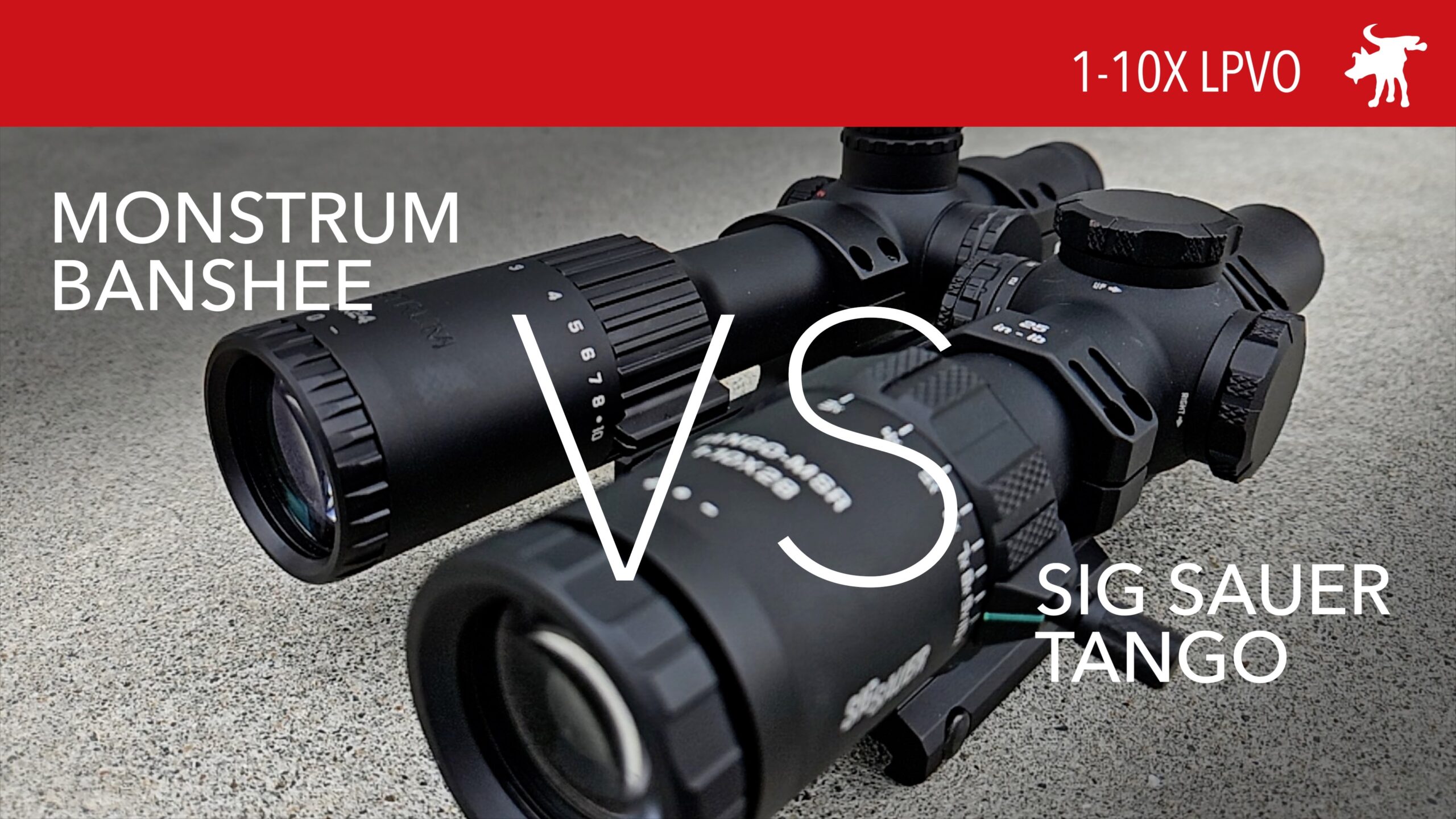
Recently I conducted a head-to-head comparison between a Monstrum Banshee 1-10x and a SIG Tango MSR 1-10x. This time Monstrum sent me their new Panzer 1-10x FFP (First Focal Plane) and asked me to compare it to a real high-end LPVO like the Vortex Razor HD Gen iii.
Now optics snobs can argue that a Vortex Razor really isn’t a high end LPVO but lets leave that nitpick aside and agree that the general public, the DOD, Monstrum believes that it is. For this comparison Monstrum wanted to me to compare their flagship LPVO to Vortex flagship LPVO.
I agreed to create this comparison video with the understanding that I would post my real findings; however they turned out. If the Panzer was outclassed the Razor, I would show it. I wasn’t going to bias the testing in favor of their product. As with the SIG video, Monstrum assured me they wouldn’t want it any other way.
Using Amazon, Monstrum sent me brand new samples of both LPVOs. Razor is Vortex Optics top tier line of of scopes. And up close, in my hand, the Razor certainly looked and felt like a premium optic.
Razors are identifiable by their trademark burnt-bronze color. The HD Gen iii has very precise low-profile capped turrets, with a fine 1/4 MOA per click adjustment. It has a lockable illuminator knob and offers 11 levels of brightness that at its highest settings is truly daylight bright; almost too bright for indoor use.
The Panzer is distinguished from other Monstrum scopes by the design of its control surfaces, which is inspired by the look of tank treads; “panzer” is the German word for “tank”. The Panzer offers two illumination colors but the intensity is nowhere close to the Razors, offering typical CQB/low-light brightness.
Side by side, the biggest visible differences (aside from the Razor’s unusual color) is size. Without its optional sun shade, the Razor is an inch shorter than the Panzer. Despite that the Razor is heavier than the Panzer, largely due to its larger 34mm sized tube body allowing it 120 MOA of internal adjustments vs the Panzer’s 30mm tube and 70 MOA of adjustments. The other material difference is that the Panzer retail package includes flip-up lens caps and a 30mm Monstrum PRO series offset mount; which are premium quality mounts.
Looking through each scopes, I was struck by how clear and sharp everything looked through the Razor; it was looking through a freshly cleaned window. At 1x the superior clarity of the Razor to the Panzer was obvious. The Panzer view was clear and sharp but not nearly as bright and clear as the Razor.
Despite this, there were two surprising shortfalls in the Razors exemplary optics. At 1x the Razors view appeared wider than 1x Object appearing smaller than in real life. Moreover this manifested in a slightly pronounced fish-eye lens effect on objects at the outer edge of the field of view. Oddly this wasn’t as noticeable when looking through the scope with boys open (as LPVO’s are meant to be used at 1x). The Panzer’s view wasn’t distorted like the Razor’s. 1x looked truly 1x.
At 10x the Razor offered a brighter, sharper and more detailed image than the Panzer. The Panzer’s outer edge had a soft focus. Comparing both scopes at the range, the Razor was able to resolve much finer details on the USAF-51 chart. Surprisingly, despite its clarity, the Razor had far more chromatic aberration.
The first focal plane reticles of both scopes were somewhat similar. At 10x they appear as a T-style crosshair with MOA subtensions and circle-dot central aim point. The Razor’s reticle also included a holdover Christmas Tree and in addition has finer stadia lines than the Panzer. Overall the Razor’s reticle was better optimized for extreme long range shooting by obscuring distant targets less than the Panzer.
At 1x both scopes reticles shrink down to reveal a simple floating T. The Panzer’s reticle lines are twice the length of the Razor’s making it slightly more visible. To compensate for such small, fine reticles it’s best to run both LPVOs with illumination and again the Razor’s brightness outclasses the Panzer.
In ran both LPVO’s on my AR, running timed shooting drills shooting 5.56. Like most 1-10x LPVOs, they both suffer from tight and unforgiving eyeboxes, though not the worst I’ve tested. The Razor had a slightly longer eye-relief.
I found the performance difference for casual range shooting and plinking to be minimal between Panzer and Razor. But for a LEO, 3-Gun Competition Shooter, or a combat professional, the Razor’s proven battlefield performance can not be overstated. Both scopes come with lifetime warranties on workmanship but the Razor comes with Vortex’s no-fault policy, covering accidental damage and user error.
By far the biggest difference between the Panzer and the Razor is their price. The Razor is a premium LPVO that sells for $2499 on Amazon. That is ten times the price of the Panzer ($199). The Razor is clearly a higher quality scope. But for a weekend shooter like me, I was able to shoot just as accurately with either scope.
Circling back to Monstrom’s original request: how does the Panzer compare to a higher-end LPVO. What I learned is that it is surprisingly good for a budget scope. And while the Panzer is not in the same league as the Vortex for sharpness, clarity, brightness, for the price of a Razor you could buy a Panzer and a firearm or two with the spare change.
These optics are available on Amazon through these affiliate links which support my channel:
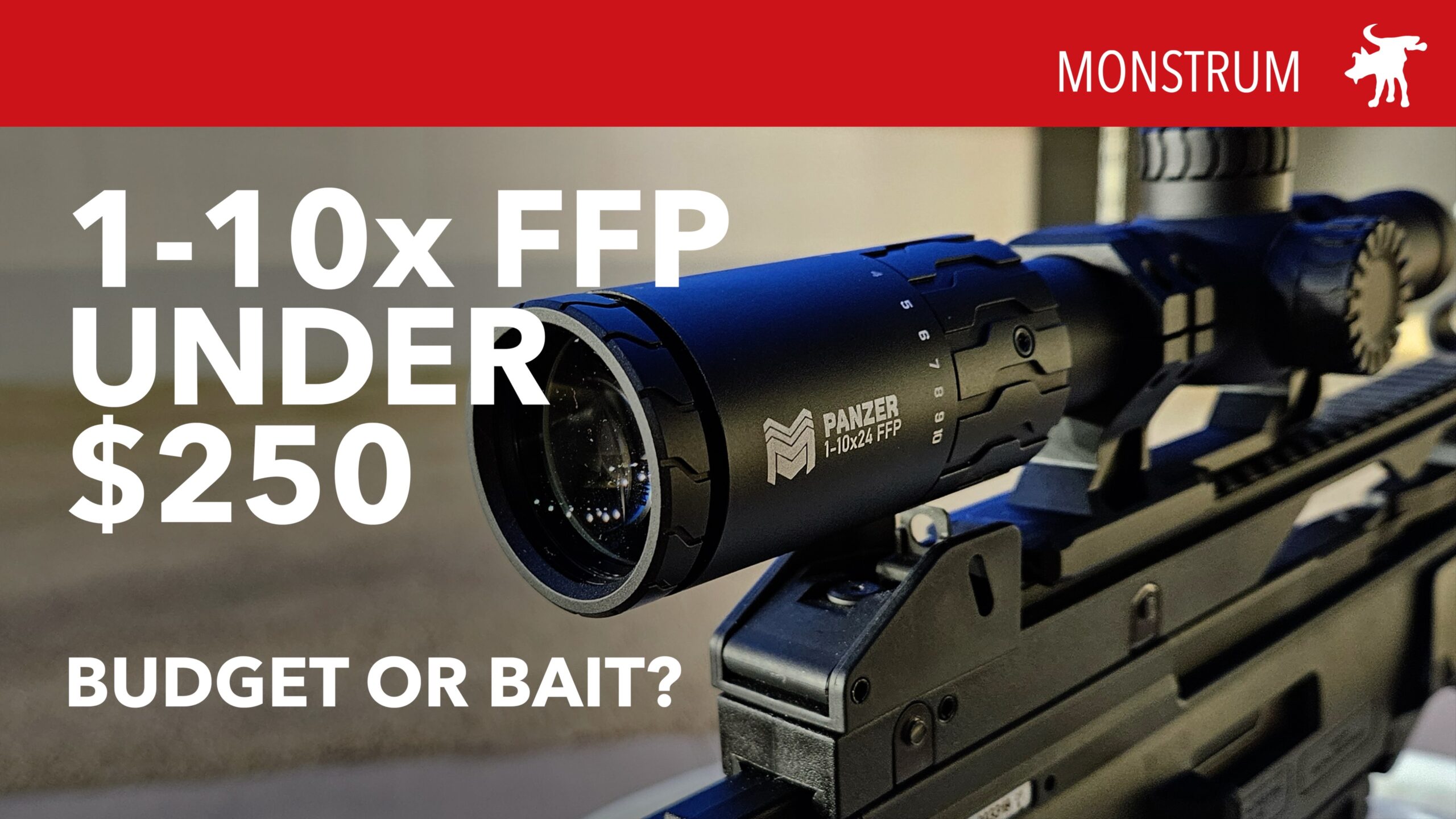
Monstrum asked me to be one of the first YouTubers to review their newest LPVO, the Panzer 1-10×24. This is their first, First Focal Plane (FFP) 1-10x and is distinguished from their other LPVO’s with a new tank-tread texture on its turret caps and control surfaces. In addition, it comes with their PRO Series offset mount.
Another new feature is a removable fin on the magnification ring, which can be swapped for an included throw lever or removed entirely for a clean profile. It is held in place with a single Philips screw and the box includes a mini screw driver and Allen wrench for the turrets (I wonder why they didn’t use a common hex screw instead). The turrets are capped and resettable. The 1/2 MOA turret cliks were clear and audible but not very tactile, moreover there was a bit of slop between each click.
At 17oz, the Panzer is relatively light for 30mm tube LPVO. It has a large ocular lens which gives it a nearly unobstructed field of view. Unfortunately, like many 1-10x LPVO’s it has a tight and unforgiving eyebox, even at 1x. It has a decent eye-relief if about 4″.
At 1x the image through the glass had a mild warm tint but no notable fish-eyeing. At 10x there is a softening at the the edges and loss of light and contrast. But its resolution is surprisingly sharp (as with other Monstrum LPVOs). Continued improvement in Chinese glass manufacturing have greatly improved budget glass.
The scope features their new CM2 reticle which is optimized for long range shooting at 10x. At 1x it appears as a simple “T” reticle but at 10x the central dot enlarges to become a circle-dot and with a finer long range reticle with MOA subtensions, wind holdovers, and a range estimation ladder at the base of the ‘T’. The 10x reticle lilnes isn’t as fine as higher end etches scopes like the Riton Tactix or Vortex Razor. The center dot is 1 MOA but this may still be too large obscure long range targets.
Like many other FFP LPVO reticles, the CM2 isn’t as useful a reticle at both extremes of its magnification range. The 1x configuration of the reticle is a tad too thin unlike more graphic SFP tactical reticles. The CM2 reticle appears very similar to the Vortex Razor but lacks the Razors brighter illumination (and the Razor’s $2500 retail price).
The Panzer offers red and green illumination with an intensity range from 1-5. Oddly, unlike their other LPVO’s, the red appears more visible than the green at 1x. In fairness, the Panzer illumination brightness is typical of most LPVOs; not daylight bright but visible in low-light or CQB.
Its overall clarity and sharpness is pretty good but no in the same league as premium 1-10x offered by Vortex, Athlon, or EoTech. But it is perhaps one of the best scopes in its price tier and punches well above its weight. With a price tag just under $200 the Panzer offers features and optical clarity found in LPVOs that cost 2 to 3 times more (certainly better glass than the SIG Tango I recently reviewed). It comes with Monstrum’s Lifetime warranty on workmanship (but not damage). It remains to be seen if the Panzer lives up to its tank-like name in terms of durability.
This LPVO is available on Amazon through this Affiliate link which helps support my channel: https://amzn.to/3REH6yF
RESOLUTION
@50yrds: Element 3 / Group: -1
SPECS
Reticle: CM2 Lens Coating: Full Multi-Layer Materials: 6061 Aircraft Grade Aluminum Magnification: 1-10x Objective Diameter: 24 mm Rail Mount Torque: 20-25 in/lbs Scope Ring Torque: 18 in/lbs Tube Diameter: 30 mm Max Windage Adjustment: ±70 MOA Max Elevation Adjustment: ±70 MOA Click Adjustment: 1/2 MOA Eye Relief: 4.0-4.5 in Weight: 17 oz Length: 11 in
After reviewing the Banshee 1-10×24, Monstrum offered to sponsor my next video if I would compare it to a higher end LPVO. I was hesitant thinking their scope would probably be optically inferior and I would not hide that fact in my video. Surprisingly they said they would be ok with me showing their LPVO’s shortcomings as long as I was honest and fair about it.
Monstrum agreed to cover my ammo, gas, range fees, and time. Most 1-10x LPVOs we could find were First Focal Plane. Wanting to compare apples-to-apples, we looked for a Second Folcal Plane (SFP) 1-10x. The Sig Sauer Tango MSR was the only higher end brand that fit that profile. And while SIG isn’t really a “high end” brand, Nightforce doesn’t make a 1-10x LPVO and Vortex and EOtech 1-10x are First Focal Plane, so those were not good comparisons. Primary Arms also makes a 1-10x SFP, but most consider Primary Arms to be also a “budget brand” so Monstrum agreed to send me a Sig Tango to compare to the Banshee. Both scopes were shipped directly from Amazon in new sealed boxes.
Both scopes come with offset mounts and similar accessories in the box. On paper they share many similar features.
BANSHEE
TANGO
Objective Lens:
24 mm
28 mm
Magnification:
1 – 10 x
1 – 10 x
Tube Diam:
30 mm
34 mm
Weight:
17 oz
20.4 oz
Eye Relief:
4.0 – 4.5 in
3.22 – 3.54 in
Reticle
SFP
SFP
Adjustments:
0.5″
0.5 MOA
Illumination:
Red & Green
Red
Battery Type:
CR2032
CR2032
Beyond the specs, looking at both LPVO’s side by side, it was easy to see which scope looked better built and expensive. The Tango had more refined design features and construction. The Banshee’s design could best be described as clean and spartan but in comparison looked like a budget scope. This design difference extended even into the scope mount.
Sig Sauer has a great reputation for making solid optics. The Tango costs more than double the price of a Banshee. I was sure before I began the testing that it would be better than the Banshee. The question would be how much better?
At the range I tested both out on the same reference targets and was surprised at the results. Optically, the Banshee was a bit brighter, sharper, and clearer than Tango. It also had an inch further eye relief and a more forgiving eye box than the Tango at 10x.
The Banshee held its own against the Tango save for one key feature, its reticle. The Banshee MX1 reticle is an old school crosshair with MOA sub-tensions, traditionally found on long range target scopes. The Tango has the MSR, a modern tactical reticle that provides the user with windage hold-overs and aim points to lead moving targets.
Despite the Banshee’s better optical qualities, I’d prefer the Tango because its MSR reticle makes it a more useful LPVO for action shooting and combat. On the other hand, at half the price of the Tango, the Monstrum is still a good value. If Monstrum were to upgrade a future version of the Banshee with a more useful reticle, it would be a done deal.
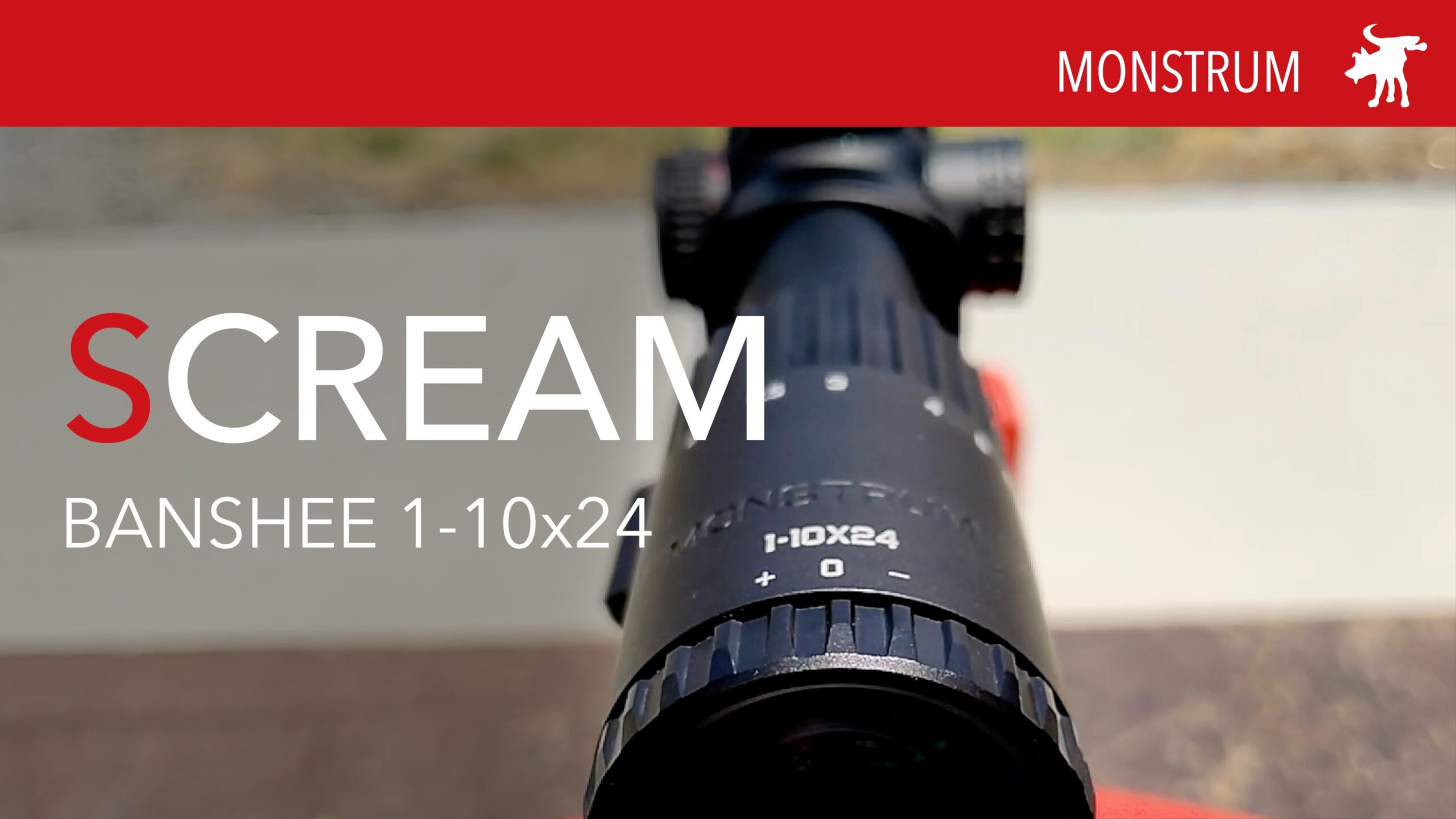
Earlier this year I was shown Monstrum’s newest LPVO scope, the Banshee. This new line would be slightly lower priced than their new Spectre. And more importantly, would feature a 1-10x model but due to manufacturing delays, Monstrum was unable to bring a 1-10x prototype to Shot Show. Months later, I was excited to receive a sample of the new Banshee 1-10×24 LPVO from Monstrum.
The Banshee shares broad physical similarities to the Spectre. Both have 30mm tubes and the same X1 reticle. Unlike the Spectre, the Banshee has capped turrets and the highest magnification of Monstrum’s LPVOs of 10x. As a minor note, on the Banshee the Monstrum logo is engraved into the eyepiece section of the scope, possibly a new standard in Monstrum’s industrial design.
At the range, I was able to quickly able to identify and engage targets at 50 yrds and 100 yrds. However, the illumination of my particular sample scope was a bit weak. Testing in the noon day sun, I could barely see a red tint at its highest level 5 setting. Green was slightly better. But to be fair, in bright daylight the X1 reticle is thick enough to line up my target without the need for illumination and in low light or CQB, the illumination levels would be adequate.
Overall I found the glass to be as good as the Spectre. I couldn’t quite compare apples to apples because of the higher 10x magnification of the Banshee. With both, I was pleasantly surprised at its sharpness and brightness for a price tier of under $250.
I recently reviewed the Monstrum Raider X1 weapon light. I got an early look at a prototype at Shot Show 2023. Back then, they didn’t even have a name for it but I was struck by their claim that it could output 2000 lumens. I was eager to test this claim, and thankfully Monstrum came forward and sent me both an X1 and an X2 to evaluate.
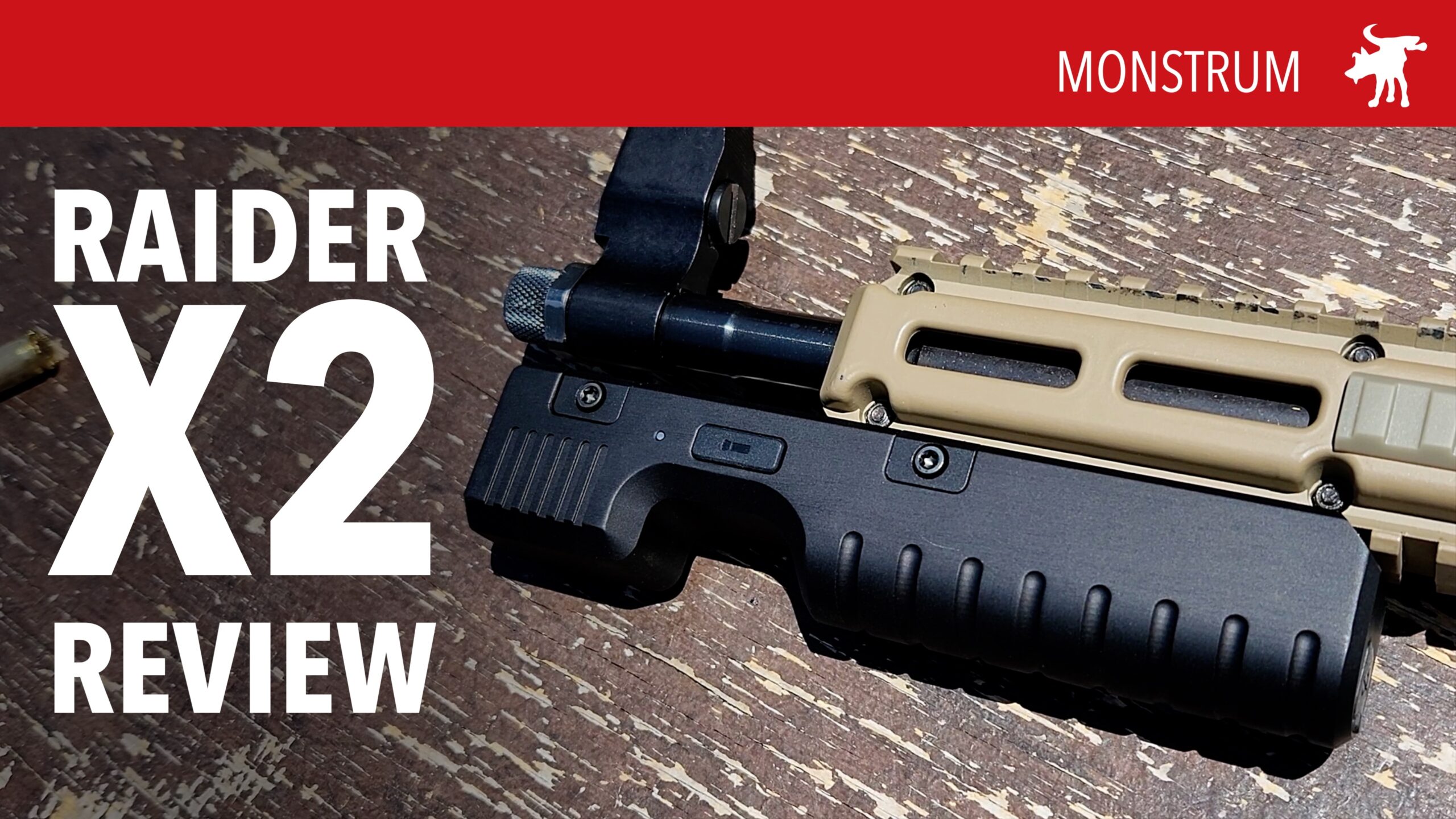
Like the X1, the Raider X2 comes in a compact box containing the light and a M-LOK/Picatinny rail. The weapon light is made of 6061 aircraft grade aluminum which feels quite durable and solid. It recharges via a covered USB-C port at the rear of the wedged shaped body.
Unlike the wedge shaped X1, the X2 has a straight lower profile shape. There is a small cut out in the body that allows the light to function as a hand stop, preventing your hand from moving forward which is useful as a safety feature for bullpup or short barreled rifles and shotguns.
An single activation button is located on the left side of the body. A press turns the unit on in its high output mode. Pressing the button cycles the flashlight from high, to low, to off. Keeping the button pressed for 5-6 seconds activates the strobe mode.
In my testing, I measured approximately 1650 lumens; which not as bright as the 2000 claimed. The shortfall may be because new batteries take a few cycles to reach maximum performance? The X1 I tested had a higher 1850 lumen output despite having the same internal components.
The Raider lacks momentary on or mode memory; two features I consider to be vital for a modern weapon light. This control scheme was standard for weapon lights 15 years ago and for those that are used to this scheme may be a selling point but not for me.
What is a selling point is it’s performance and durability. Monstrum states that it has a 60 minute run time on high mode. Fully recharged, my X2 ran for 70 minutes, with a gradual drop in brightness.
The Raider X1 did fail one of my tests: I found the unit did not meet to IPX6 rating it claims. I hit it with a high pressure water hose at various angles for about 15-20 seconds. A few minutes later, I found that moisture beads appeared behind the lens and lifting the silicone charging port cover, I found water weeping out of the port.
I left the unit outside in the sun for a few days to dry it out. After checking the charging port for moisture, I tried charging it up again and it appears to be working normally. While water getting into the unit is failure, it’s recovery from its wet condition may be a positive.
At the Monstrum booth at Shot Show 2023 they introduced me to a prototype weapon light that they claim could output 2000 lumens. It was so new they didn’t have a name for it. Four months later Monstrum sent me their brand new weapon light called the Raider X1.
The Raider X1 comes in a compact box containing the light and a M-LOK/Picatinny rail. The weapon light is made of 6061 aircraft grade aluminum which feels quite durable and solid. It recharges via a covered USB-C port at the rear of the wedged shaped body.
The rear wedge functions as an angled fore grip. Not quite pistol grip (as that would violate many state’s gun laws), it provides an ergonomic hand position. The lens housing also functions as a hand stop, preventing your hand from moving forward which is useful as a safety feature in bullpups, short barreled rifles or pump shotguns like the KS7/KSG.
An single activation button is located on the left side of the body. A press turns the unit on in its high output mode. In my testing, I measured approximately 1850 lumens; which is still plenty bright. Pressing the button cycles the flashlight from high, to low, to off. Keeping the button pressed for 5-6 seconds activates the strobe mode.
The Raider lacks momentary on or mode memory; two features I consider to be vital for a modern weapon light. This control scheme was standard for weapon lights 15 years ago and for those that are used to this scheme may be a selling point but not for me.
What is a selling point is it’s performance and durability. Monstrum states that it has a 60 minute run time on high mode. Fully recharged, I tested its runtime and found it exceeded it’s claimed run time by over 17 minutes (crapping out at 78 minutes). It’s built so tough, I ran it over with my SUV twice, and despite some small nicks and scratches, it survived un-dented and functional.
The Raider X1 did fail one of my tests: I found the unit did not meet to IPX6 rating it claims. I hit it with a high pressure water hose at various angles for about 15-20 seconds. A few minutes later, I found that moisture beads appeared behind the lens and lifting the silicone charging port cover, I found water weeping out of the port.
After a number of minutes the went into strobe mode and the activation button became unresponsive. I left the unit outside in the sun for a few days to dry it out. After checking the charging port for moisture, I tried charging it up again and it appears to be working normally. While water getting into the unit is failure, it’s recovery from its wet condition may be a positive.