Thanks to my special guest Linq Chen of Discovery Optics for joining my Too Much Information Livestream to talk about the thinking and engineering behind their new ED-AR 1-8×24 LPVO. This is the scope that I reviewed and it’s one of the best budget FFP LPVOs out there. During this episode we watched my drop test video and showed the scope surviving a 2m drop and holding zero.
In this episode we also gave away a new pair of GT Media N4 night vision goggles. I recently tested these budget electronic NVG which is also a night vision camera able to take 1080p video.
During the show we also gave away a Guns.com swag bag and a Colt firearms swag bag to viewers on the live chat. If I get enough interest in doing a livestream, I’ll start doing this regularly.
Finally, I’d like to to especially thank American Hillbilly for letting his assistance on the show tonight.
1000yrd Benchrest
If you’re interested in learning more about Freedom Benchrest matches near Sacramento, CA contact James jamesbacardi@aol.com
Bear Creek Arsenal (BCA) is a firearms manufacturer out of Sanford, North Carolina that is a reminds me of a smaller Palmetto State Armory. BCA makes AR15, AR10, and 10/22 pattern rifles and components that are well built, reliable and affordable. They wanted to send me one of their rifles to test but due to California’s draconian (and sometimes contradictory) regulations they could only send me a 22LR upper receiver.
The BC-22 is a complete .22LR all metal upper receiver with a direct blowback action. The model they sent me had a 16″ long free float barrel with a 1:16 twist. It had a full length aluminum M-lok handguard with a small section of 1913 Picatinny rail on each end for front sights and mounting optic extensions.
The BC-22 complete upper was originally designed to run CMMG magazines but they told me that CMMG recently changed the feeder on their mags, so that they no longer ran reliably in the BCA upper. Instead they sell Black Dog magazines which were patterned after the original CMMG mags. BCA sent me two to test. I compared them to some CMMG 22LR mags I bought 3 years and did notice some differences in thickness of the feed lips and a notch not present in the Black Dog mags. I ran the CMMG mags on the BCA upper and it ran without issue, so maybe I’m lucky?
The BC-22 mounts like any MilSpec AR upper. The biggest differences in manual of arms is the lack of the AR rear charging T-handle. Instead, the BCA 22LR upper has a right side charging handle screwed directly onto the bolt. My AR bolt hold open paddle was partially non-functional; it did not hold the bolt completely open but it did prevent the bolt from falling into battery until it was disengaged. The BC-22 does have last round hold open with a mag inserted.
Disassembly of the upper and bolt for cleaning is different than on a standard AR. First the charging handle has to be unscrewed and removed with an hex key. Then a rear thumb locking bolt, where the T-handle usually sits on an AR upper, needs to be unscrewed. Once the charging handle and locking bolt are removed, the whole bolt assembly including recoil spring can be removed for cleaning.
I tested the BC-22 with bulk .22 ammo: Federal AutoMatch, Aguila Super Extra HV, and CCI standard velocity. Be sure to clean your barrel before testing because my barrel and handguard had a light coat of sticky lubricant to prevent corrosion. My first 20-30 rounds of AutoMatch grouped so horribly that I thought the barrel was damaged during shipping. It wasn’t until the barrel was properly cleaned and then lead fouled by 30-40 rounds of ammo that the groups tightened and normalized. Aguila and CCI grouped much better from the get go than AutoMatch, though this rifle seems to accentuate fliers, throwing them in the most random of directions.
There’s a lot of valid reasons to want an AR that can shoot 22LR: lower cost to train and shoot, greater availability of ammo (except during a pandemic), lower recoil, etc. The BC-22 is inexpensive for a complete AR upper; about as much as a base model 10/22. Unlike buying a 10/22, with the BC-22 you can shoot with the same rifle, optics, accessories, and sling as your War Rifle; but you can train with it for pennies. To put it another way, BC-22 costs about as much as 10 boxes of .223 ammo. So you could pay off the cost of a BC-22 in a good afternoon at the range.
Dawn shone on the golden foothills of the Sierra Nevadas mountains. This morning, I found myself at the Sacramento Valley Shooting Center, about 40 minutes outside of Sacramento, CA and about 3 hours from San Francisco (give or take an hour depending on traffic).
As a father of two school aged kids, my ability to travel to a gun range for an early morning match is somewhat limited by time and distance. This was well outside of my normal range visits but one I had long wished to make. I was invited by my range buddy, James, to film and observe a 1000 yard benchrest match organized by the a Northern California chapter of the Freedom Benchrest club.
Freedom Benchrest organize monthly 600 yard and 1000 yard matches open to all. But unless you want to consistently place at the bottom of the standings, to be competitive requires a bit more than a factory high-power rifle and store bought ammo. Each of the shooters invested a small fortune into their setup. The 13 competitors brought out a panoply of custom built rifles, heavy-duty geared rifle rests, precision scopes (that cost most than most factory rifles), boxes of hand loaded ammo, and an array of cooling fans and sundry gadgets.
The course of fire was 1 round of 5-shots within 10 minutes followed by a second round of 10-shots also within 10-minutes. The shooters were allowed as many “sighter” test rounds as time allowed provided they completed their “scoring” shots within the total time frame. The targets were 6.5″ rounds with a 3″ bullseye, but at 1000yrds I could barely see 10″ target board with my naked eye. To score a perfect round a shooter would have to place all of their shots within 1.5″ of the center X; in gun parlance that’s a rifle capable of less than half-sub MOA accuracy.
The rifle is only a 1/3 of the equation. Each shooter used custom hand-loaded ammunition. Many of them build their own ammo loading setup in their garages and spend hours developing, testing, and crafting each round of ammunition. And then the other 1/3 of the equation is the shooter and the time they spent practicing.
The shooters came from all different backgrounds and skill levels. Some had been shooting “normal’ firearms all of their lives but only recently entered into long-range shooting. Some had just learned to shoot a few years ago and feel into the challenge of long-range. One thing I noticed was there were no shooters under 40 in the crowd; probably because the cost of entry precluded all but retiree’s and well paid tech-employees or in some cases they were one in the same (as I mentioned this is not far from Sacramento and San Francisco).
But even if you don’t have the small fortune, the folks in the group were happy to lend spare gear like an unused backup rifle bag or rifle rest to anybody willing to bring a rifle and some ammo to join them. And they were all willing to share their hard-won knowledge about the sport to anyone who was willing to invest their time. That’s the one other thing I found all of the shooters had in common: camaraderie.
At the end of the 2nd match after most of the shooters had finished there was still 5-6 minutes left. Louie invited me to shoot his custom-built rifle and his 6mm “Louie” ammo at his bench. His rifle had a 2oz trigger (for context a military M16 rifle has a 6-8lb trigger pull) and a geared rifle rest that adjusts the rifles’s position by millimeters by turning dials. I let myself have 4-5 test shots until I found a bullseye hit and then proceeded to shoot 10 scoring shots. Most landed within the bullseye and I got a 93 out of possible 100 points. Not bad for my first try at 1000 yard precision shooting.
Freedom Benchrest hosts regular monthly events at the Sacramento Shooting Center. Contact them ahead of time to sign up to compete or attend a practice day. Tell them Moondog sent you. Contact James jamesbacardi@aol.com
When choosing travel binoculars there’s a trade off between power and portability. With the Maven B.3 it meets a Goldilocks spot between both. The B.3 compact size and optical performance covers a wide variety of users from hunters to sports fans, to birders, naturalists, and travelers. Most of all it appeals to those who strive for efficiency and minimalism.
The B.3 comes in 6x, 8x, and 10x models, all with 30mm objective lenses and the same body. The differences in magnification also provide differences in field of view and depth of field, inverse to its magnification power. I chose the 8x to as the best balance of both. On Maven’s website, you have the ability to custom design and order your optics; selecting the color of components, including adding commercial camouflage patterns.
The B.3 also features ED glass for clarity and color balance. It has a generous depth of field, a wide field of view, and a silky focus mechanism. Like all of Maven’s optics, it is also the most stylish and aesthetically designed sports optics on the market.
The 3Tactix PRD3 is advertised as Riton’s every day cary micro red dot but has features that are far from ordinary. It offers 3 user selectable reticles: a 2MOA dot, a 50MOA circle-cross, and a combined circle-cross and dot. It has motion activation with a 50,000hr battery life. And a pull-out side battery tray. The PRD3 somehow manages to offer all of these features with a low-profile design which has a lower base than most side-tray battery red dots by its competitors.
I tested PRD3 on an RMR cut slide but found that the PRD3 still wasn’t low profile enough for me to use Glock factory iron sights. For testing, I mounted to my Glock via an MOS/RMR adapter plate. The PRD3 is the RMR footprint model of the 3Tactix red dot line and comes with a RMR to Picatinny 1913 adapter.
For those new to shooting pistol with red dots, I recommend multi-reticle red dots because new shooters often find it easier to find a bright circle reticle. That way, as the shooter becomes more proficient with presenting, they can simply press the + button and transition to shooting with the more precise 2MOA dot. Moreover, the circle-cross reticle can be used for action shooting or mounting the PDR3 to a shotgun to quickly bracket your target. The PRD3 offer a wide range of brightness, visible even in broad daylight.
The PRD3 has a street price comparable to single reticle red dots from Athlon and Vortex. So it’s a no-brainer for me to recommend getting a red dot with a choice in reticles.
The Ruger Precision Rimfire (RPR) is an popular entry-level chassis rifle for PRS training or NRL22. At its heart it’s a Ruger American action, which many companies make upgrade parts to customize and upgrade. One of the easiest upgrades is the knob at the end of the bolt lever.
The factory knob is a simple plastic teardrop which is functional but forgettable. The knob simply unscrews off the lever. Anarchy Outdoors sent me their Little Birtha knob which is an all aluminum dumbell shaped knob available in a variety of colors. Anarchy Outdoors makes the Little and larger Big Birtha knob for other popular rifle makes like Remington and CZ.
Tactical lights with their multiple lighting modes have always been hamstrung by their control, usually having to resort to multiple clicks or one or two buttons to cycle modes and brightness. With the PD40R, Fenix developed a duty light whose controls are an intuitive selector ring, allowing the user to precisely dial in their desired brightness or set the flashlight into SOS and strobe.
The PD40R v3.0 steps up in run time and throw distance from the v2.0. Physically the PD40 is just a little bit larger than the PD30 at a little over 6″ long. It runs of a 5000mAh 21700 lithium battery. The PD40R has a USB-C charging port allowing the battery to be charged inside the flashlight (which is fortunate because none of my LiPO chargers is large enough to fit a 21700 battery).
The PD40R has a slightly crenelated crown to assist in breaking glass and as a pressure point when used a self-defense tool. Because of its control ring, the unit lacks a tail click button and thus easily tail stands. Fenix included a removable pocket clip though the unit is a bit oversized.
In my testing, I measured 2600 lumens from a freshly recharged battery, which is close enough to its stated 3000 lumen output that I consider my reading well within a margin of error. In addition, the PD40 lasted well past Fenix’s 2hr and 40min runtime in Turbo brightness; I stopped my test at 3hrs and 40min and it was still not exhausted.
The only disappointing aspect of the flashlight is its control ring. I prefer the PD40’s control ring system which is much more intuitive and precise than pressing button combinations. Fenix claims the ring has a hard stop at TURBO to prevent the user from accidentally activating the SOS or strobe function. But in my testing, I too often accidentally turned the unit past TURBO into SOS. I contacted Fenix about this and they were aware of the feedback.
Suggestions about the SOS mode in the ring control aside, the PD40Rs exceeded expectations for “professional” performance.
Not only is this one of the cheapest semi-auto 22LR available nationally, but it may be the most accurate budget rimfire. Rock Island Armory (RIA) is best known for producing Philippine made budget priced, reliably built, pistols and revolvers. I’ve heard they produce the most 1911 pistols in the world. Recently they’ve been expanding into shotguns and now the rifles. RIA lent me their TM22 to test out.
The TM22 is 22LR, semi-automatic, blowback rifle is a proprietary design produced by Derya of Turkey. It follows the general shape of an AR pattern rifle. It is compatible with AR-type grips and stocks. The receiver is made of 7075 aircraft grade aluminum. It has an MLok compatible AR handguard and is topped with a receiver length Picatinny rail.
At the rear of the receiver is a castle nut which accepts MilSpec AR buffer tubes. The model I was sent uses a non-standard fixed metal stock affixed to a fluted tube. The TM22’s action is direct blowback with a recoil spring entirely contained in the receiver. It comes in either a 20″ or 18″ barrel that is free floated in an M-Lok handguard which looks similar to an AR but which has a locking bolt on top, which connects it to the upper receiver. Some models are available with more M16A2 style furniture like an A2-esque carry handle, 2-piece round handguard, and A-frame front sight.
The TM22 comes with a pair of 10-round polymer magazines which look similar to CZ-455/457 magazines but are unfortunately proprietary.
The TM22 has a last round hold open which is also its functional bolt hold open. The bolt only stays open with an empty magazine inserted. The rifle has a left side charging handle but no bolt catch other than keeping an empty mag in the magwell. Once the mag is removed, the bolt slides closed. The rifle includes a uniquely designed chamber flag that allows the bolt to be dropped on it after pulling the bolt, to permit function checks and dry firing the trigger.
The trigger is flat faced with a light trigger pull of about 2.5lbs. In live fire testing, we found the rifle easy to shoot and surprisingly accurate. Our testing as conducted at 25yrds and 50yrds proved it shoots 1.5-2inch sized groups at 50yrds with inexpensive Armscor 22LR ammo. We had about a dozen stove pipes and FTF malfunctions were due to the ammo.
It was fun to shoot but I did find some quirks and nitpicks with this rifle. RIA/Derya should have designed it to use more widely available compatible magazines like Ruger, GSG, S&W, or cheap 3rd party magazines were available. There appears to be a new variant of the TM22 at Sportsman’s Warehouse which has have more A2-styling, with an AR buffer tube and a fixed polymer buttstock.
It is also also a bit more complicated and laborious to field strip than it should be. The TM22 requires the removal of its handguard first which would not be necessary if it utilized standard a standard AR style receiver and pins. Moreover, to clean the bolt requires the removal of the Picatinny rail. This would require the removal of any optic, so forget about maintaining zero. Is it too much to ask that a .22LR AR that is as easy to take down as a real AR?
Those nitpicks aside, the biggest selling feature of the TM22 is its low price. Even in notoriously expensive California, a RIA TM22 sells for under $200 at a local Sportsmans Warehouse. With this budget friendly and easy to shoot 22LR, RIA continues to deliver on its reputation for value.
The Athlon Helos BTR with a street price just under $400, is the most affordable LPVO that offers a side-focus parallax focus. Most LPVO’s (even Service Grade LPVOs over $2K) only offer 100-150yrds fixed focus optics. This Helos BTR was designed with the input of NRA High Power XTC “service rifle” class competition shooters.
The first sample that Athlon sent me had a very minor 1x image shift issue that most shooters would never notice unless you ran it with both eyes open. I’ve discovered image shift at 1x to be a common issue with LPVOs; I’ve even experienced this in much vaunted combat grade LPVOs from Trijicon and Vortex. I contacted Athlon, who’s excellent customer service got me a replacement quickly.
My first impression of the Helos is that of an optic in a higher price tier in terms of build and construction. It has exposed turrets are similar to high-precision turrest found on Athlon’s long range optics. The elevation turret has a one revolution zero-stop for competition. For an AR moving from the 200yrd to 600yrd target during a XTC competition, the adjustment for drop would be within it’s 23MOA rotation. Its beefier turrets also help make it a tad heavy at around 23oz.
The reticle ATSR3 SFP reticle is unique to this Athlon model offering a crosshair-with-floating dot within its circle of death. The center circle and holdover T are illuminated for day-to-dusk competitions but is not red-dot bright. Against black competition bullseyes, a brighter illumination would be welcome.
When I first got the Helos BTR, I was puzzled as to its relatively low 1-4.5x power range, which I assume comes from the heritage of NRA High Power ‘service rifle’ competitions. The current marketing trend in LPVOs to offer more-is-better with 8x, 10x, and higher magnification. I wonder why Athlon doesn’t offer a parallax focus in their 1-10 Ares ETR? Regardless, the Helos BTR is an LPVO that offers competition grade features and high quality optics at a “budget” price for an Athlon.
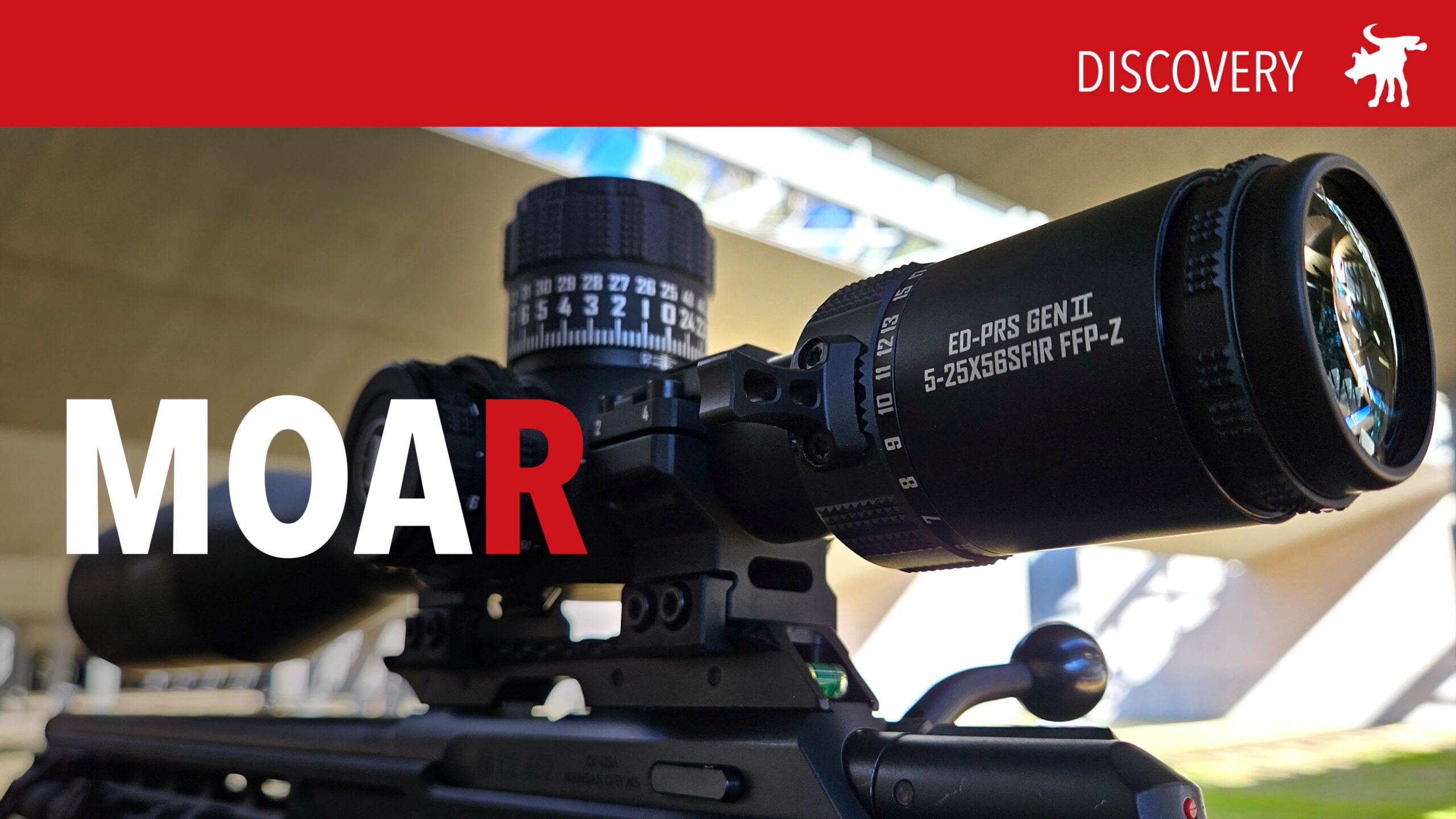
Discovery Optics has quietly been making high featured optics in the price tier usually considered “budget”. Discovery sent me a pre-release sample of their new ED-AR 1-8x24SFIR FFP LPVO. This is part of their top tier ED line of optics which utilize Japanese ED glass.
This is an evolution on the ED-AR 1-6×24 not just in illumination but also in the addition of a side-focus parallax adjustment knob. This feature is nearly unheard of in LPVOs. Moreover, this scope is able to focus from infinity to an unprecedented 5 yards; making this optic an option for hunting, NRL22 or precision airgun.
The overall glass quality was bright, clear and sharp. While not quite the same league as the Vortex Razor HD it come much closer than most LPVOs under $500. At launch this scope is selling for a street price of $200 on Amazon and the Discovery Optics website which makes this optic cheaper than Swampfox, Primary Arms and many other budget optics! The retail version does not include rings or a mount; I recommend mounting this on an offset mount for your AR like Discovery Optics and Monstrum QD mounts.
Like other FFP’s, the ED-AR suffers from a thin reticle at 1x. Unfortunately the ED-AR’s illuminator is typical of most LPVO’s, not quite daylight bright and only useful in low light or CQB. I would suggest Discovery offer this optic with a much thicker 1x reticle configuration similar to the Arken EP8 or the Sig TANGO MSR.
Over multiple range visits, the scope held zero. It has a lifetime warranty. With their new service office in California customer service shouldn’t be a problem. If they can keep this unit at this price point the ED-AR has the potential to change the LPVO landscape.