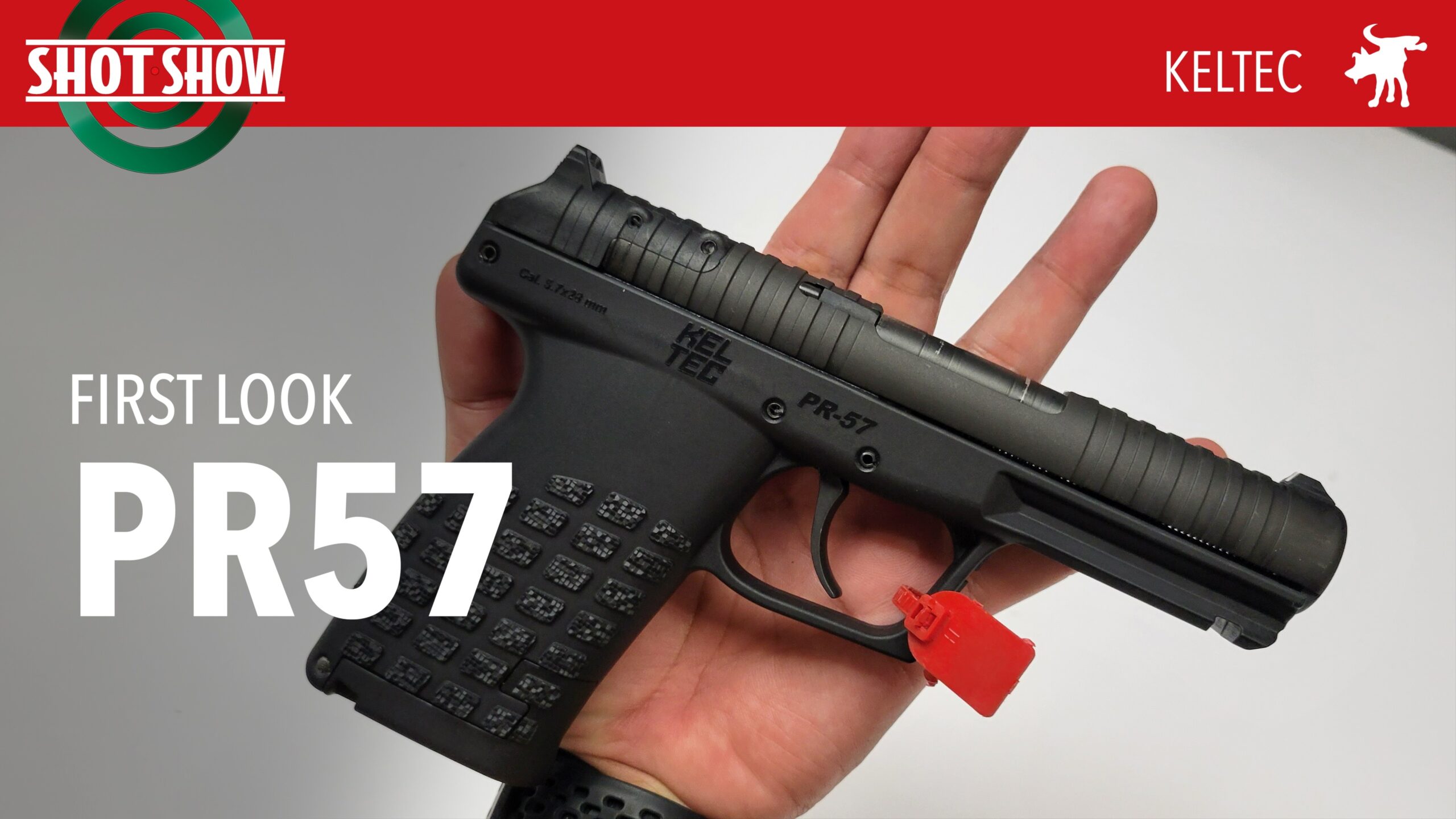
Just before SHOTShow 2025 KelTec announced the release of a pistol that was strange and unusual; even for KelTec and that’s saying something. The PR57 is a compact double-action-only pistol, chambered in 5.7, with an internal 20-round magazine, which means this is a clip-loaded pistol.
Stripper clip pistols haven’t been common since the early 20th century. And nobody I know of has made a new one in decades. It is probably no coincidence that the most recent clip-loaded pistol was the Zytec Grendel which the founder of KelTec invented.
I had a chance to try out this pistol at the SHOT2025 Range Day. Jokes about KelTec reliability aside, it appeared solid and equal to KelTec’s pistols in build quality and construction. Notable was its double-action trigger (which is also becoming exceedingly uncommon) which also functioned as the slide disassembly lever when pushed forward.
It was remarkably light at 14oz unloaded and loading and unloading it was simple enough using their adapter/loader which functions like a stripper-clip in function. Shooting, it had had a lot less recoil and snap than a 9mm or .38 of similar size. It shot flat and accurately (I was able to hit an IPSC plate a few times at 100yrds though any misses were shooter error).
It is a much better pistol than I gave it credit. But I think it’s a solution looking for a problem as its utility seems to elude me. And 5.7 is not a caliber I want to get into due to its cost per round. THE PR57 will probably attract the gun buyers who want something very different at the range, that can cause other folks to ask to try it.
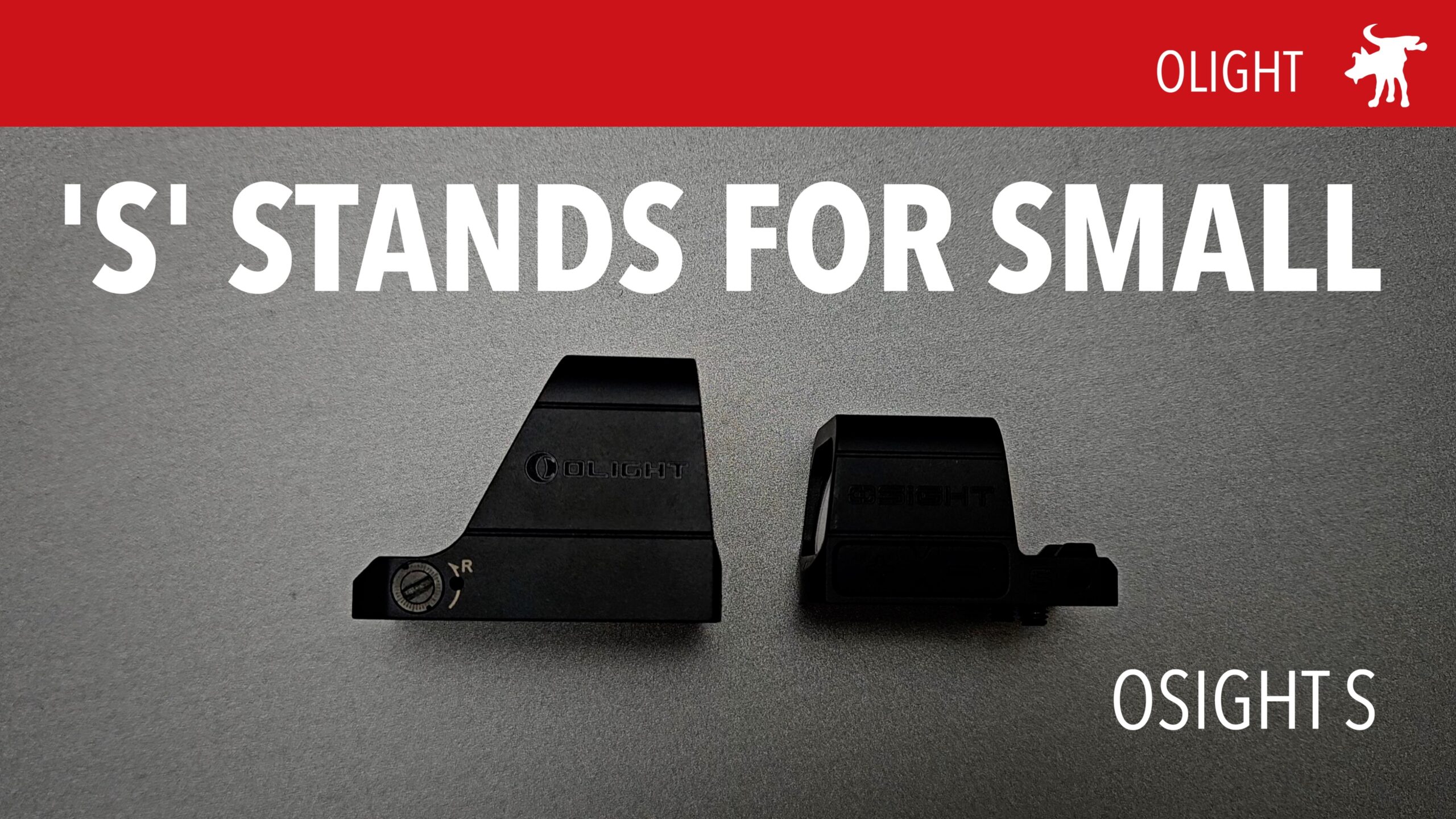
Last year, Olight released the OSight, a revolutionary micro reflex sight (MRD) with a unique wireless charging cover. The OSight features an oversized window, which is great for fast target acquisition and re-engaging the target during rapid fire. However, a large window is a negative for those who want to mount an MRD onto a compact concealed carry pistol. OLight created the OSight S to address this issue.
The OSIght S (presumably this stands for “small) uses an RMSc footprint and is one of the smallest enclosed emitter red dots available. It is roughly half the physical size of the OSight but its smaller size means it also has a smaller battery. Fully charged an OSight can run for up to 21,000 hours, which is over 2 years. For those concerned with a non-replaceable internal battery, the OSight comes with a cover that displays the OSights battery charge level. Moreover, this cover functions as a mini-powerbank, capable of recharging the OSight up to 4 times.
Despite its small size the OSight S has the full-sized OSight X’s changeable reticle system. The user can press the “-” button to switch between a 2 MOA dot, 32 MOA circle, and a circle-dot reticle. This feature makes the OSight S one of the smallest MRDs on the market and also the most versatile.
BUY
Osight S Up to 25%OFF +Login Gift (a Free i3E keychain light)+a Free Challenge Coin
Bear Creek Arsenal is a value-priced ARs, firearms, and components maker. But it isn’t as well known as some other value-priced brands like Palmetto State Armory. What’s surprising to many more is Bear Creek Arsenal also sells branded rifle scopes and red dots. But more surprising to me is that they make a low-priced 30x scope.
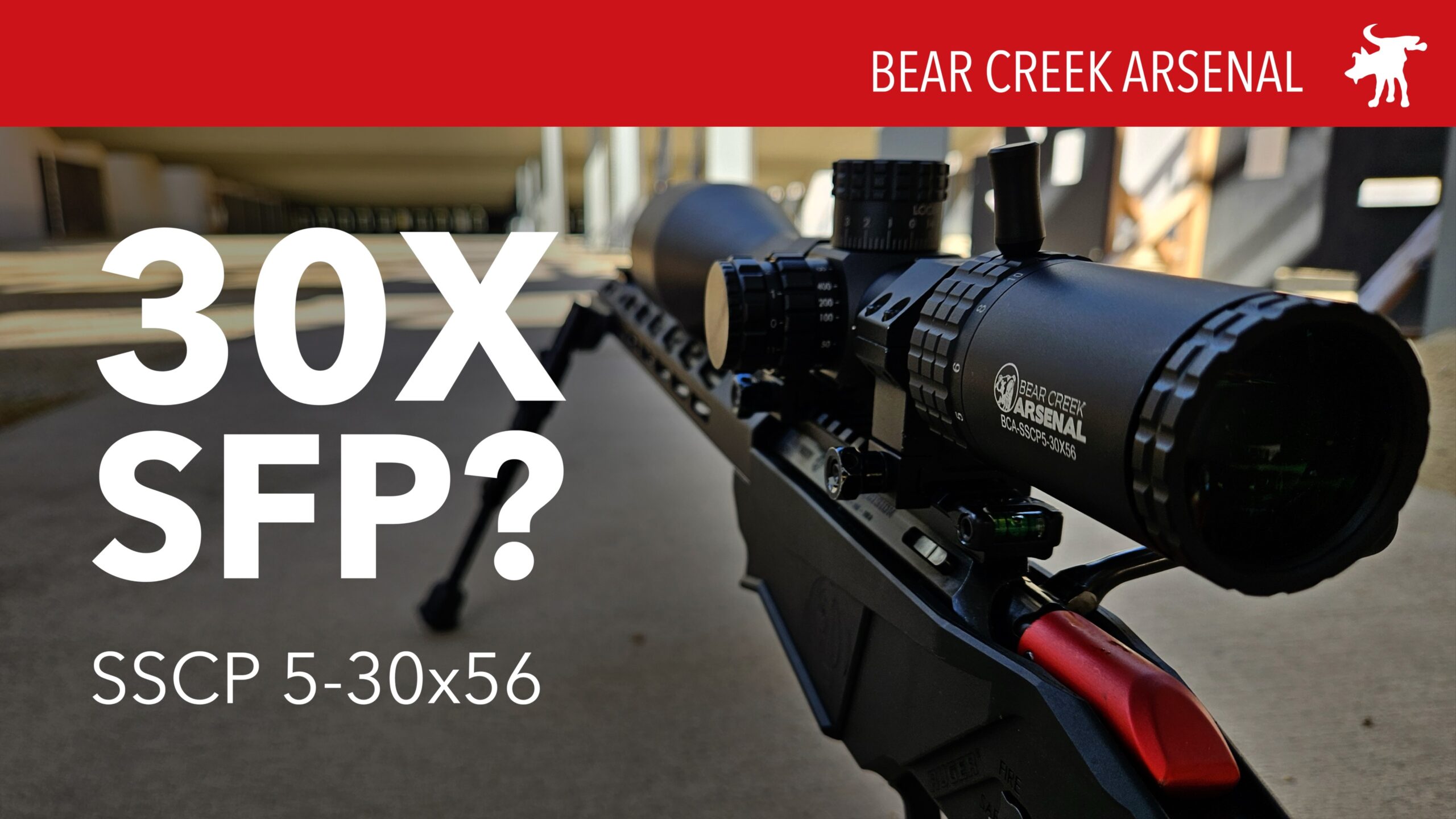
The BCA SSCP is a 5-30x scope with a Christmas Tree reticle but in SFP which means the reticle doesn’t change size or thickness when changing the magnification. This means the ranging marks are only shown accurately when using it at 30x (without using mental math) but it also means the reticle is visually prominent and usable at 5x. For many hunters, this is a desirable trade-off.
Given its low price, there will be compromises. The turret numbers do not line up to the witness mark. Optically, it has a tight eye box and noticeable chromatic aberration. The image gets milky and dark at 24-30x.
For hunters looking for more magnification than a typical 4-16x scope but with a very tight budget the SSCP is a scope to consider. For someone interested in getting into long-range shooting on a shoestring, the optical limitations may be frustrating.
The Vortex Strike Eagle 5-25×56 is one of the top-rated long-range scopes under $1000 (MSRP over $1250 but with a street price of around $700). In the five to six years since its release, optical manufacturing technology has advanced as fast as prices have dropped. How does a Vortex scope released in 2020 compare to a modern budget scope like the new $199 Monstrum Challenger?
The Monstrum ships with more accessories than the Vortex, including its own set of high-height rings. But lacks a sun shade included with the Vortex. The Strike Eagle also comes with a throw lever but the Challenger comes with a built-in fin on the magnification ring so it doesn’t need one.
Holding them both in the hand, I noticed the Challenger was a 6-7oz heavier. The turrets of the Strike Eagle looked slightly better milled and its numbers precisely lined up with the scope’s reference marks, whilst the Challenger did not (a blunder common in budget scopes). The Strike Eagle had the better build quality of the two.
Looking through the glass, I immediately noticed more chromatic aberration in the Challenger. This was disappointing after testing Monstrum’s ED-glass LPVOs last year. The Challenger also showed softened focus around the edges of the scope view, even at its lowest magnification. Both scopes had similar eye relief and eye box.
At the gun range, the Strike Eagle was a bit brighter and noticeably sharper, with less chromatic aberration than the Challenger which showed purple fringing even at 5x. Both scopes showed good color rendition and the ability to see details in low light at 25x. The Strike Eagle resolved resolution lines 3-4 steps smaller than the Challenger.
One other key difference for me was in each scope’s reticle design. The Strike Eagle was better suited for precision target shooting with finer stadia lines and a floating dot-point. The Challenger had a bold central cross as its aimpoint which was visible even at lower magnification, making it a much faster to aim tactical or hunting scope. Overall the Strike Eagle was the better scope. Factoring in the price, the Challenger at 1/3 the price was the better value.
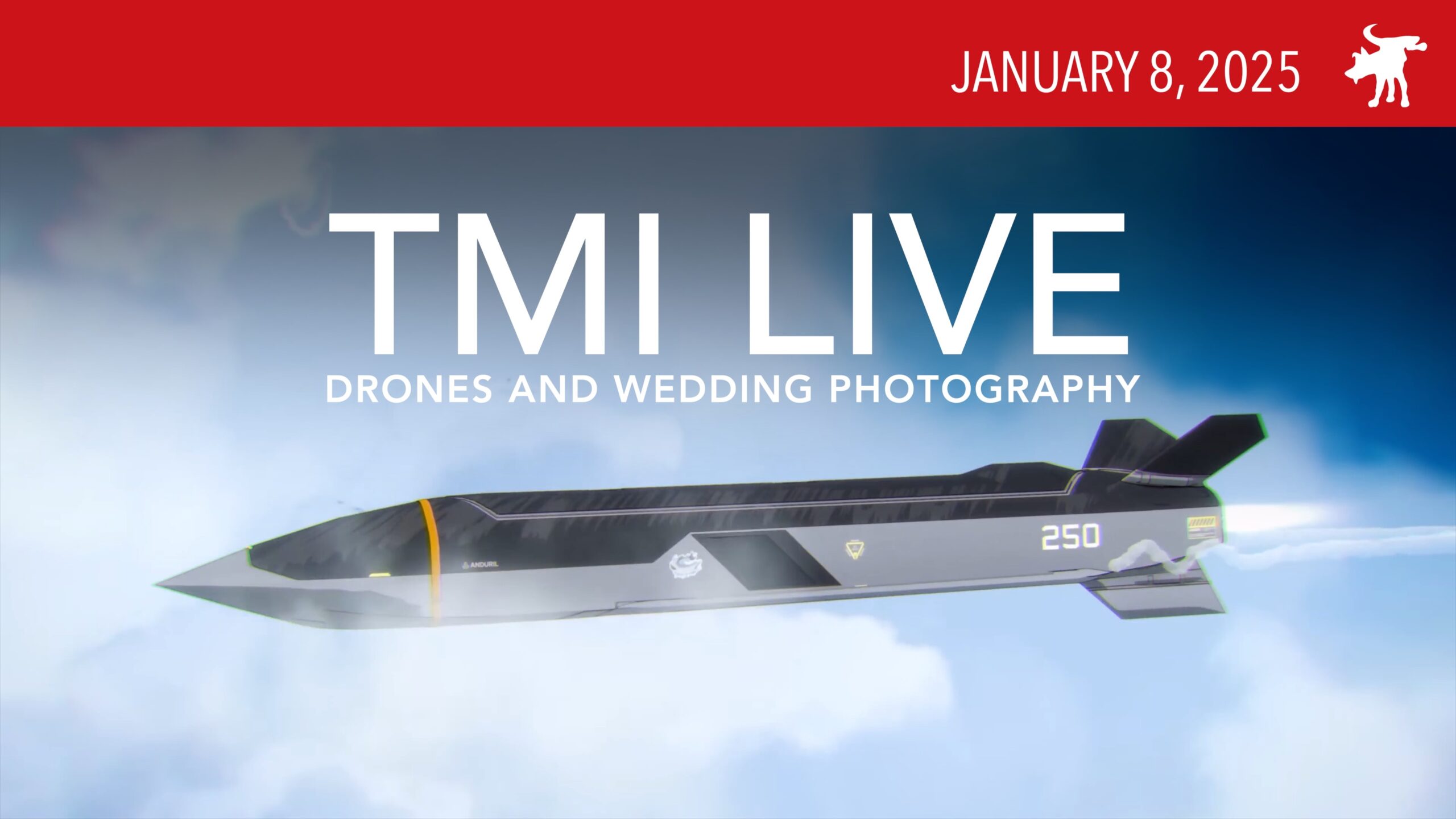
Anduril originally named Narsil is a sword in The Lord of the Rings and The Silmarillion. Narsil was forged in the First Age by the first Dwarves, was broken by Sauron and reforged by the Elves during the Lord of the Rings, and renamed Anduril (which means Flame of the West) by Aragorn.
DOWN THE RABBIT HOLE
Andruil Technologies
Anduril Industries, Inc. is an American defense technology company that specializes in autonomous systems. It was cofounded in 2017 by Oculus Rift inventor and entrepreneur Palmer Luckey
Next Livestream Wed January 15 for our SHOT Show episode
EARLBIRD CLUE: This gun brand’s M9 pistol replaced the Colt 1911 as the issued sidearm of the US military in 1985, until it was in turn replaced by the SIG P320.
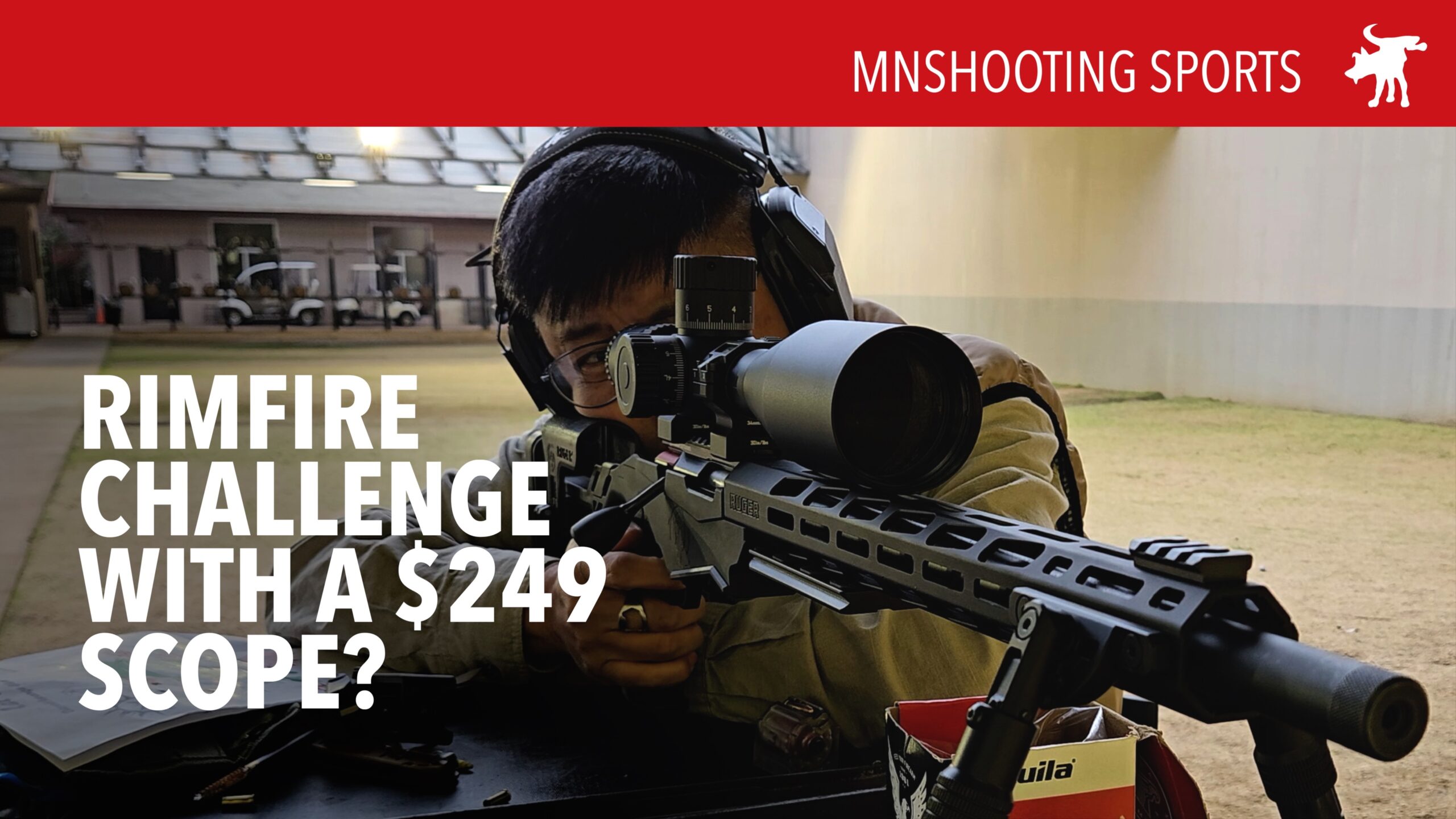
BoomStick @FukuYTmark6 and LongRilfe @MnShootingSports have set up a 50-yard rimfire challenge that is right up my alley: Budget. This challenge target has six 3/4″ target rounds which is pretty standard but the real challenge is the limitations on the price of the gear and ammo you can shoot it with.
This challenge is limited to factory rifles (no upgraded trigger or barrel) and optic must have a retail price of less than $700 combined. Moreover, the rimfire ammo used must be bulk box 22LR and excludes more premium ammo types such as CCI Standard and Norma Tac22 (CCI standard is premium? love it!).
I’m a dumpster diver at heart so I accept this challenge with a smile. My rifle is a factory Ruger Precision Rimfire which I bought on a Black Friday sale at Sportsmans Warehouse for less than $300, but for the sake of this challenge, I’m going to count the average sale price today which is about $400. That means the scope I choose has to cost less than $300. Fortunately for me, I recently reviewed the Discovery Optic LHD 8-32×56. A very high magnification scope for a very budget price of about $249 https://youtu.be/Jn7LcnJBsbg
For the challenge, my Ruger RPRF was installed with UTG Reconflex bipods (retails for about $49) and I shot it with Aguila Super Extra High Velocity 40grn CPRN.
During the challenge run, I initially aimed at the center of the dots but experienced a climbing point of impact. While attempting to compensate by aiming toward the bottom, the point of impact sometimes shifted downward. By the 3rd target circle, I gave up compensating and simply aimed at the center. About 50% of my shots were flyers. All in all, I only scored 11 out of a possible 18.
Arken has dominated the affordable PRS scope market with tactical scopes under $600. Their founders are long-range shooting enthusiasts and this passion drove them to create Outlier, a rifle component company. At SHOT 2025 they won the award for most innovative rifle with their new Backdraft suppressor barrel.
The Backdraft design isn’t limited to bolt-action rifles. At their booth in the Casesar’s Forum, they allowed visitors to at go to a portable indoor shooting range and test out the Backdraft on an Outlier Atlas AR9 PCC rifle. The Backdraft suppressor is a carbon fiber barrel sleeve and a short screw-on barrel can. The design has the side benefit of reducing heat build-up on the screw-on can.
I confirmed this with some trepidation by touching the can after running a mag of 9mm through the Atlas. To my genuine surprise, it felt only about as warm as a human hand. I’ve held hotter coffee cups. You can buy the entire rifle or just the Backdraft barrel from Outlier.
Companies spend thousands of dollars creating their brand that is supposed to be memorable and stand out. Their brand is exemplified in their logo but how unique is their logo design? I asked attendees of SHOT Show to identify these popular brands stripped of any identifying text of their name.
Some companies seemed easier to identify than others. Very few got all of them correct. Take part in my 2A industry quiz. Post your answers to the logo quiz in the comments of the Quiz Video and you’ll be entered into a contest to win a bag of SHOT Show swag.
Entries must be received no later than 12pm EST on 2/25/2025.
CONTEST INSTRUCTIONS
1. Subscribe to my travel channel on YouTube: Moondog Go to prove you’re not a bot. or Post a reply comment in my video giving your best guess to each of logo band identities.
2. Take a screen shot of your COMMENTS or the SUBSCRIBED button for Moondog Go .
NO PURCHASE OR DONATION IS NECESSARY TO ENTER. YOUR CHANCES OF WINNING DO NOT INCREASE WITH A PURCHASE. VOID WHERE PROHIBITED.
1. Eligibility
Void where prohibited by law. Must be legal resident in the USA. Moondog Industries employees, subsidiaries, affiliates, suppliers, advertising and promotion agencies, employees’ immediate family members, are ineligible to participate in the contest/giveaway.
Entrants must be willing and able to appear on YouTube to discuss the contest and post images of the prize on their social feed should they win the contest.
2. Sponsors and Platforms
Moondog Industries (known as the CO-SPONSOR) is a video Edutainment producer and game promotor based in San Francisco, CA. YouTube, TikTok, Rumble, X and online video platforms (known as PLATFORMS) are not SPONSORS or in any way affiliated with the contest or content.
3. Agreement to Rules
By entering your contest, participants agree to abide by the SPONSOR’s Official Rules and decisions. The SPONSOR retains the right to refuse, withdraw, or disqualify entries at their sole discretion. By submitting an entry, the participant agrees to accept the decision of the SPONSOR as final and binding.
4. Entry Period
Contest email entries must be received between: 12:00pm EST 1 January 2025 and 12:00pm EST 25 February 2025
5. How to Enter
This contest requires your skill in navigating your phone or computer controls to screen capture an image of the following YouTube channels/Social Media accounts. Subscribe or Follow and make a screen capture of those pages showing a greyed out Subscribe button or indicator that your account is Following that page. Send a screen capture image file of any of those sites to contest@moondogindustries.com . One entry per person or per Social Media account. Fraudulent methods of entry, photo retouched, or other methods of circumvention of the rules may result in the SPONSOR invalidating a participant’s entries.
6. Prizes
Winner must be able to receive the prize by e-mail or by physical mail. Prize may be substituted at the sole discretion of the SPONSOR. Acceptance of the prize grants SPONSOR permission to use the Winners entry, name, and likeness for advertising, promotion, and trade without further compensation or remuneration unless prohibited by law.
7. Odds
The odds of winning is dependent upon the number of eligible entries received.
8. Selection and Notification of the Winner
The winner will be chosen at random by the SPONSOR from among the entrants that demonstrated the skill to navigate the electronic entry and have met the minimum requirements. Winners will be contacted via the email used to enter the contest no later than February 25, 2025. Winner must have a legal address within the US to ship the prize.
SPONSOR is not liable for the winner’s failure to receive notification of winning if he or she provided the wrong email address or if their email security settings caused your prize notification to go into the spam or junk folder. If a winner does not respond within 24hrs of sending a notification, the SPONSOR will select an alternate winner. Receipt of the prize is upon the condition of compliance with federal, state, and local laws.
9. Rights Granted by the Entrant
The SPONSOR, upon submission of an entry into the giveaway or contest, has the right to use the participant’s submission, voice, likeness, image, statements about the contest, etc., for publicity, news, advertising, promotional purposes, trade, and so forth, without any further notice, review, consent, compensation or remuneration.
Participants shall defend or settle against such claims at their sole expense, and shall indemnify, defend and hold harmless the SPONSOR from any suit due to damage of or by the prize.
10. Terms & Conditions
The SPONSOR reserves the right to modify, suspend, cancel or terminate in the event that non-authorized human intervention, a bug or virus, fraud, or other causes beyond your control impact or corrupt the security, fairness, proper conduct, or administration of the contest/giveaway.
11. Limitation of Liability
Entry into this contest constitutes the participant’s agreement to release and hold harmless the SPONSOR and PLATFORMS, subsidiaries, affiliates, employees, etc., against all claims liability, illness, injury, death, loss, etc., that occurs directly or indirectly from participation in the contest or use/misuse of the awarded prize.
12. Disputes
As a condition of participating in the promotion, the participant agrees to resolve all disputes with an arbitrator designated by the SPONSOR in the state of California, without resorting to any form of class action. Entrants waive all rights to punitive, incidental, or consequential damages, and waive all rights to have damages multiplied or increased.
13. Privacy Policy
Participants agree to abide by all privacy and NDA laws in the State of California and any federal laws of the United State of America.
14. Winners List
Participants may request a list of winners by submitting a request in writing to Moondog Industries for up to 30 days after the contest ends.
15. Social Media Platform Rules
Winners will agree to post a photo of the prize on their social media channels in such a way as does not violate any rules of that platform. The winners also agree to appear for an interview where they will discuss the prize and its performance. If there are functional problems with the prize, the winner agrees to make a good-faith effort to resolve all issues with the SPONSOR prior to posting reviews or opinions about the prize.
16. Affirmation of Acceptance of and Agreement to All of the Official Rules
By entering the contest, the entrant has affirmatively reviewed, accepted, and agreed to all of them.
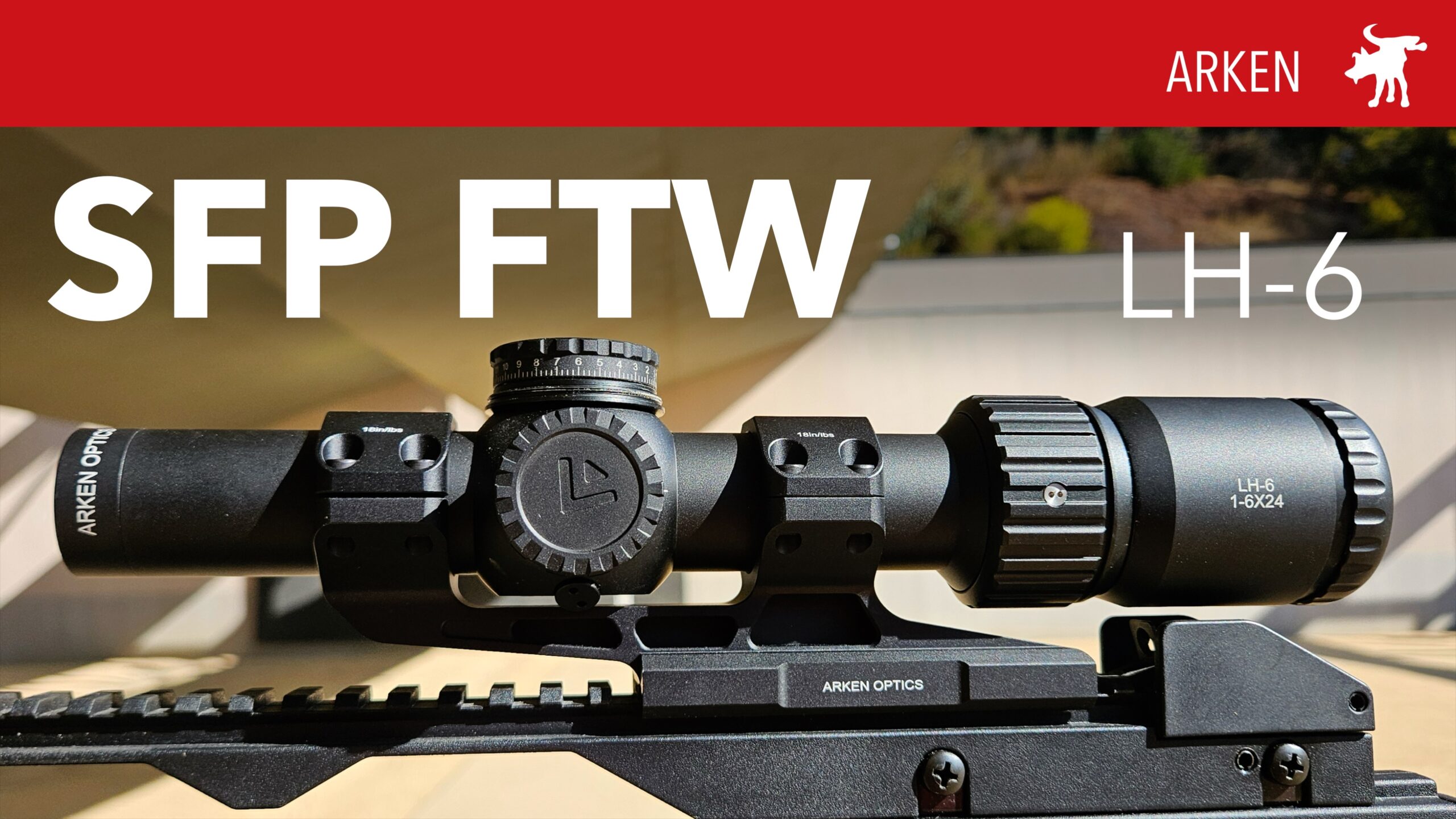
The Arken EP8 is one of the best FFP LPVOs I’ve tested. So, I was very eager to get my hands on the LH6 when I first heard that Arken was releasing a 1-6×24 LPVO in second focal plane (SFP). I prefer SFP LPVOs because their reticle doesn’t change shape with magnification, and I find 1-6x LPVOs to have more forgiving eye boxes than higher power models.
In physical appearance and build quality, the LH6 is nearly identical to the EP8. The LH6 even shares the same KL-Box reticle that incorporates a ranging ladder into the BDC hold-over markings, making it one of the fastest optics to shoot. Unfortunately, while this design works for the FFP EP8, I find the design to be a bit too busy and cluttered for a 1x LVPO.
I still like the KL-Box reticle, but I suggest Arken simplify it for the LH6. They could remove all of the numbers from one side because they are duplicated on the other. And then remove every other number because people know that between 4 and 6 is the number 5. They could remove half of the L-shaped sizing stadia, and it would still be a usable ranging ladder because you can determine if the target is closer or farther if they are smaller or larger than the remaining L.
Here’s the original (left) and my suggested KL-Box Mod M (for Moondog).
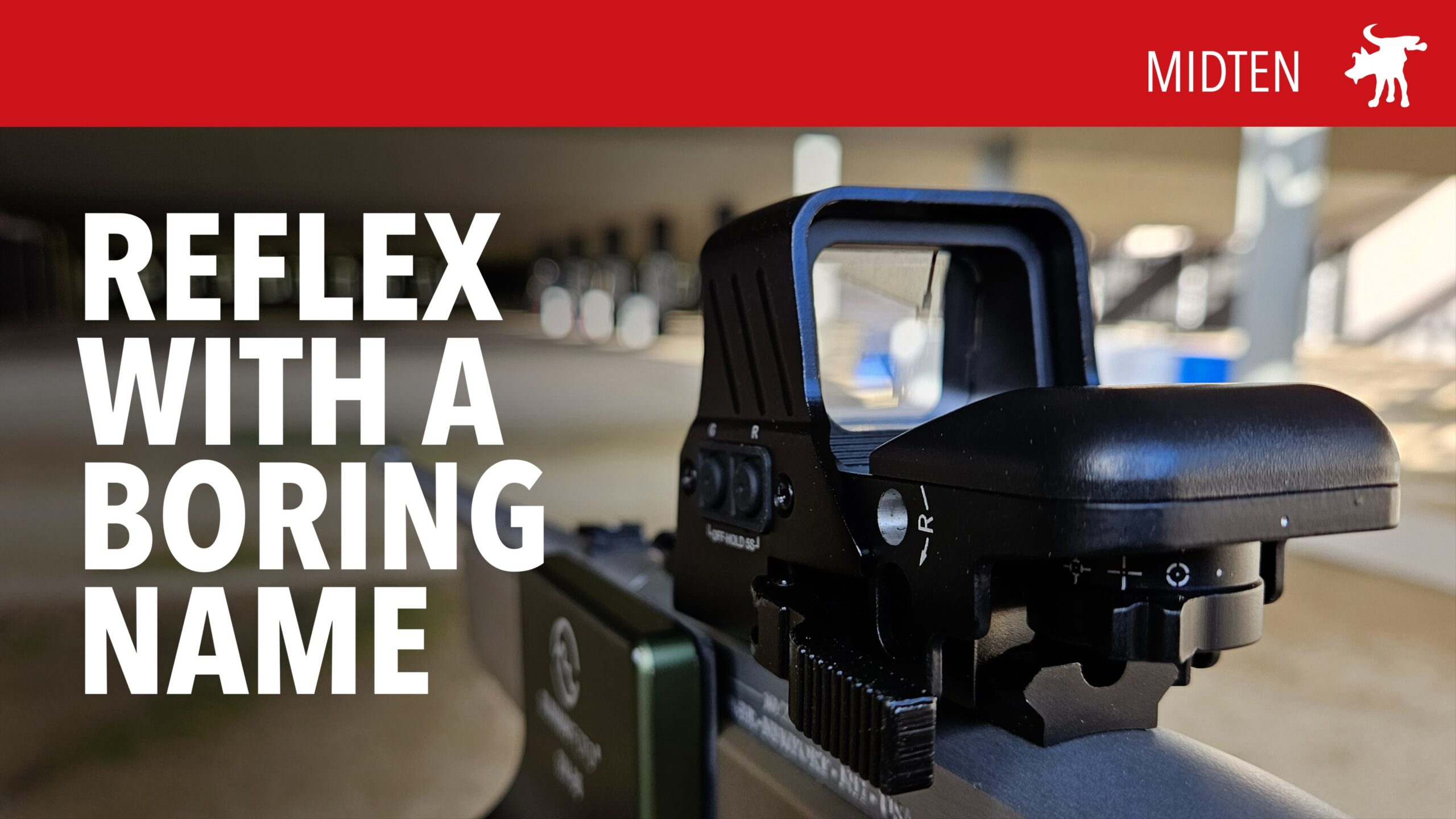
MidTen is a budget firearms accessory brand that many consider to be Airsoft grade. Their products typically come in unmarked boxes, and their products don’t have logos. They released an update rifle reflex sight simply named the “Red Green Dot”. A generic name that perfectly matches their generic packaging.
This reflex sight appears to be a beefed up replica of the Ultradot style reflex; made of metal and polymer. Like Ultradot copies, it a rotary selector at the rear that changes an etched mask which changes the shape of the reticle projected. The unit offers a choice of 4 patterns: dot, circle-dot, crosshair-dot, and sunburst. The unit has a metal cage around a large sized mirrored lens but all reflex sights are not as rugged as a holographic EOTech. From personal experience, an airsoft BB hit from CQB distance can chip a lens so extra protection is required for actual airsoft use.
The Ultradot design is simple and reliable but quite a bit out dated by a couple of decades. Two other disappointing aspects of the design is its QD lever and battery. It has a quick detatch lever with a Picatinny base which does not offer a secondary lock, which means it could work itself loose after repeated recoil. Most red dots are powered by a CR2032 coin battery, but oddly this reflex is powered by a 3 x stacked, tiny LR41 button batteries.
I tested the unit on my Ruger 10/22 at 50yrds. I ran over 100 rounds of 22LR and the unit held zero. While 22LR doesn’t have much recoil, in my experience airsoft optics don’t hold zero on firearm even after a mag or two. This reflex may be a cheap as an airsoft optic but it appears to be a suitable to take to the range on a real firearm.