All posts by moondog

Tom "Moondog" DelMundo is a former NYC Creative Director.

5.11 V.XI Tactical Pants

5.11 is one of the most respected brands in tactical apparel. They got their start in climbing and outdoor wear and became sought after by Special Forces teams for their pants ruggedness, durability, and flexibility. Working with SWAT teams, they developed their line of V.XI pants. This year, the V.X1 will be available to the civilian market.

These pants feature well thought out reinforcements, elements and details to enhance ergonomics and protection. EDC pockets are reinforced for wear and cinch points for add-on pads and soft armor are reinforced and adjustable.
They will come in a new line of colors for both civilian and professions.

https://www.511tactical.com/vxi-collection

Monstrum Banshee BDC-C1

Many LPVO’s claimed to have “daylight bright” illumination, but until recently that was largely a boast. Monstrum sent me a 1-6×24 Banshee. This LPVO appeared physically identical to the 1-6×24 Banshee I previously reviewed but this sample comes with their new BDC-C1 fiber optic reticle.

The package comes with the an offset mount and flip-up caps. The scope has capped turrets that are resettable to zero. This sample’s turrets had audible clicks but were a bit sloppy indexing.

Unlike the standard Banshees, this version’s illuminator rheostat only has red as its color and has an ‘off’ setting between its numerical intensity levels. To make the reticle daylight bright, a hair thin fiber optic strand is embedded inside a BDC duplex reticle to provide a bright illuminated point at the center of the crosshair. In my tests, I found that at at its maximum intensity the reticle was red-dot bright, easily visible in broad daylight even pointed into the sunlight sky.

It checks the boxes. At 1x it’s a flat 1x view with no fish eye. It provides a surprisingly clear and sharp image with little to no chromatic aberration even at maximum magnification. It’s held zero over multiple range visits. This makes the Monstrum the most affordable daylight bright LPVO that’s worth a damn.

This optic is available on Amazon through this affiliate links which support my channel: https://amzn.to/3SndrLQ

RESOLUTION (at 50yrds)

Group -2
Element 3

SPECS

BANSHEE BDC-C1 

Magnification: 1-6x SFP

Objective Diameter: 24 mm

Tube Diameter: 30 mm

Coating: Full Multi-Layer

Max Windage Adj: ±70 MOA

Max Elevation Adj: ±110 MOA

Click Increments: 1/2 MOA

Eye Relief: 3.5-3.08 in

Weight: 17 oz

Length: 11 in

Monstrum Banshee vs Vortex Viper PST

Vortex was one of the first optics companies to roll out true “daylight bright” illumination on their LPVOs; bright enough to be seen outdoors in daylight sun. Monstrum recently released their first LPVO with a reticle that claims to be “daylight bright”.

Monstrum sent me a sample of their newest Banshee with a new BDC-C1 fiber optic reticle. They also sent along a brand new Vortex PST Gen2 and asked me to test and compare them. Both are 1-6x SFP LPVO’s with 30mm tubes so it would make for a fair apples-to-apples comparison.

Monstrum sponsored two of my previous head-to-head comparison in videos: Monstrum Banshee vs SIG Tango 1-10x and Monstrum Panzer vs Vortex Razor HD 1-10x FFP. As with those videos, I agreed to conduct the tests with the understanding that I would post my real findings; however they turned out.

Both LPVOs looked broadly similar. The Viper has larger diameter turrets and some small details in its construction that cue anybody who has milled metal that it’s a higher value scope. Both have 30mm tubes but the Viper manages to offer more than twice the range of adjustments of the Banshee’s 70MOA.

Both have illuminator rheostat that offer an ‘off’ setting between its numerical intensity levels. The Viper offers 10 levels whilst the Banshee offers 6; and unlike the other Banshee models, only in the color red. The Vipers rheostat dial had an annoying slop that made me turn past and accidentally turn the unit off when changing intensity levels.

Both have capped turrets with 1/2 MOA adjustments per click; which were clear and loud. The Monstrum’s turrets were mildely tactile positive with a fair bit of slop between clicks. The Viper’s turrets were crisp, tactile clicks with very little slop. I didn’t bother with tracking tests as capped LPVOs, the designs intent wasn’t for futzing during use. These turrets were meant for zeroing the reticle and then shot adjustments should be made by the user using the reticle’s sub tensions.

The Viper had a smoothly turning power ring but was stiff enough that I would have wanted a throw lever that the Viper’s retail package lacks. It did come with a 2″ sun shade which none of the Monstrum LPVOs include in their package. The Banshee’s power ring was stiffer and not as smooth but compensates for it with a built in fin-style throw lever.

Looking through each scopes, the Viper had a brighter view. But both appeared crisp and sharp at 1x. The Vortex had very, very, slight fish eye curve at the outer edge of the view. In most other ways, the LPVOs were evenly matched. Only at the covered range did the Vortex show a clearly greater sharpness and brightness offering 3 levels of resolution better than the Banshee and less chromatic aberration.

The reticles were also very similar looking semi t-style; the Viper having MOA sub tensions whilst the Banshee has bullet drop calibrated sub tensions. Both have a bright central point which illuminates creating a red-dot like focus point. Comparing both at their brightest settings, both were similarly daylight bright and visible even when aimed into the sky near the sun.

At this point there really wasn’t much else to test. While the Viper at 11 may be a bit brighter than Monstrum’s new BDC-C1 Banshee at 6, both are truly is daylight bright. How much brighter do you need?

At the range, I could quickly and accurately aim and hit my targets. Like so many of their features, I found the eye boxes to be effectively identical. Because these scopes were short-term loaners, I wasn’t able to test durability or ruggedness but both held their zero during my day at the range on my 5.56 AR.

Both scopes come with lifetime warranties on workmanship but the Viper comes with Vortex’s no-fault policy, covering accidental damage and user error. Recently Monstrum revised their warranty to cover accidents but their fine print requires a receipt and I haven’t had any feedback with ease of returns. Vortex seems to have an easier return policy but recently has a reputation for sloppy QC.

By far the biggest difference between the Banshee and the Viper is their price. The Viper is one of Vortex mid-range models and sells for $599 on Amazon, which is 4 times the price of the Banshee ($149). Moreover, the Banshee includes a quality offset mount. The Viper does not include a mount and the Vortex Sports mount costs an additional $100.

Comparing the Monstrum Panzer vs Vortex Razor HD 1-10x FFP the differences in the quality of the scopes was significant. But comparing the Banshee to the Viper, the differences were harder to find. Certainly the Viper was sharper, brighter, had more range of adjustments and a better warranty. But if I had to the choice to buy either of these scopes, I think I’d choose the Banshee because its a better value.

These optics are available on Amazon through these affiliate links which support my channel:

Banshee https://amzn.to/424Kfwz

Viper PST Gen2: https://amzn.to/48DwR4X

RESOLUTION (at 50yrds)

Banshee: Element 3 / Group -2

Viper: Element 6 / Group -2

SPECS

BANSHEE BDC-C1 

Magnification: 1-6x SFP

Objective Diameter: 24 mm

Tube Diameter: 30 mm

Coating: Full Multi-Layer

Max Windage Adj: ±70 MOA

Max Elevation Adj: ±110 MOA

Click Increments: 1/2 MOA

Eye Relief: 3.5-3.08 in

Weight: 17 oz

Length: 11 in

VIPER PST Gen 2

Magnification: 1-6x SFP

Objective Diameter: 24 mm

Tube Diameter: 30 mm

Coating: Full Multi-Coated

Max Windage Adj: ±160 MOA

Max Elevation Adj: ±160 MOA

Click Increments: 1/2 MOA

Eye Relief: 3.8 in

Weight: 22.7 oz

Length: 10.83 in

Monstrum Panzer vs Vortex Razor

If you had an opportunity to test out a $200 scope you’d probably say, “sure.” If they offered to lend you another scope that cost 12x as much to compare, you’d say “hell ya!”

Recently I conducted a head-to-head comparison between a Monstrum Banshee 1-10x and a SIG Tango MSR 1-10x. This time Monstrum sent me their new Panzer 1-10x FFP (First Focal Plane) and asked me to compare it to a real high-end LPVO like the Vortex Razor HD Gen iii.

Now optics snobs can argue that a Vortex Razor really isn’t a high end LPVO but lets leave that nitpick aside and agree that the general public, the DOD, Monstrum believes that it is. For this comparison Monstrum wanted to me to compare their flagship LPVO to Vortex flagship LPVO.

I agreed to create this comparison video with the understanding that I would post my real findings; however they turned out. If the Panzer was outclassed the Razor, I would show it. I wasn’t going to bias the testing in favor of their product. As with the SIG video, Monstrum assured me they wouldn’t want it any other way.

Using Amazon, Monstrum sent me brand new samples of both LPVOs. Razor is Vortex Optics top tier line of of scopes. And up close, in my hand, the Razor certainly looked and felt like a premium optic.

Razors are identifiable by their trademark burnt-bronze color. The HD Gen iii has very precise low-profile capped turrets, with a fine 1/4 MOA per click adjustment. It has a lockable illuminator knob and offers 11 levels of brightness that at its highest settings is truly daylight bright; almost too bright for indoor use.

The Panzer is distinguished from other Monstrum scopes by the design of its control surfaces, which is inspired by the look of tank treads; “panzer” is the German word for “tank”. The Panzer offers two illumination colors but the intensity is nowhere close to the Razors, offering typical CQB/low-light brightness.

Side by side, the biggest visible differences (aside from the Razor’s unusual color) is size. Without its optional sun shade, the Razor is an inch shorter than the Panzer. Despite that the Razor is heavier than the Panzer, largely due to its larger 34mm sized tube body allowing it 120 MOA of internal adjustments vs the Panzer’s 30mm tube and 70 MOA of adjustments. The other material difference is that the Panzer retail package includes flip-up lens caps and a 30mm Monstrum PRO series offset mount; which are premium quality mounts.

Looking through each scopes, I was struck by how clear and sharp everything looked through the Razor; it was looking through a freshly cleaned window. At 1x the superior clarity of the Razor to the Panzer was obvious. The Panzer view was clear and sharp but not nearly as bright and clear as the Razor.

Despite this, there were two surprising shortfalls in the Razors exemplary optics. At 1x the Razors view appeared wider than 1x Object appearing smaller than in real life. Moreover this manifested in a slightly pronounced fish-eye lens effect on objects at the outer edge of the field of view. Oddly this wasn’t as noticeable when looking through the scope with boys open (as LPVO’s are meant to be used at 1x). The Panzer’s view wasn’t distorted like the Razor’s. 1x looked truly 1x.

At 10x the Razor offered a brighter, sharper and more detailed image than the Panzer. The Panzer’s outer edge had a soft focus. Comparing both scopes at the range, the Razor was able to resolve much finer details on the USAF-51 chart. Surprisingly, despite its clarity, the Razor had far more chromatic aberration.

The first focal plane reticles of both scopes were somewhat similar. At 10x they appear as a T-style crosshair with MOA subtensions and circle-dot central aim point. The Razor’s reticle also included a holdover Christmas Tree and in addition has finer stadia lines than the Panzer. Overall the Razor’s reticle was better optimized for extreme long range shooting by obscuring distant targets less than the Panzer.

At 1x both scopes reticles shrink down to reveal a simple floating T. The Panzer’s reticle lines are twice the length of the Razor’s making it slightly more visible. To compensate for such small, fine reticles it’s best to run both LPVOs with illumination and again the Razor’s brightness outclasses the Panzer.

In ran both LPVO’s on my AR, running timed shooting drills shooting 5.56. Like most 1-10x LPVOs, they both suffer from tight and unforgiving eyeboxes, though not the worst I’ve tested. The Razor had a slightly longer eye-relief.

I found the performance difference for casual range shooting and plinking to be minimal between Panzer and Razor. But for a LEO, 3-Gun Competition Shooter, or a combat professional, the Razor’s proven battlefield performance can not be overstated. Both scopes come with lifetime warranties on workmanship but the Razor comes with Vortex’s no-fault policy, covering accidental damage and user error.

By far the biggest difference between the Panzer and the Razor is their price. The Razor is a premium LPVO that sells for $2499 on Amazon. That is ten times the price of the Panzer ($199). The Razor is clearly a higher quality scope. But for a weekend shooter like me, I was able to shoot just as accurately with either scope.

Circling back to Monstrom’s original request: how does the Panzer compare to a higher-end LPVO. What I learned is that it is surprisingly good for a budget scope. And while the Panzer is not in the same league as the Vortex for sharpness, clarity, brightness, for the price of a Razor you could buy a Panzer and a firearm or two with the spare change.

These optics are available on Amazon through these affiliate links which support my channel:

Panzer https://amzn.to/3NZUk8e

Razor HD Gen iii: https://amzn.to/3tZSP2K

RESOLUTION (at 50yrds)

Panzer: Group -1 / Element 3

Razor: Group -1 / Element 5

SPECS

PANZER 

Magnification: 1-10x

Objective Diameter: 24 mm

Tube Diameter: 30 mm

Coating: Full Multi-Layer

Max Windage Adj: ±70 MOA

Max Elevation Adj: ±70 MOA

Click Increments: 1/2 MOA

Eye Relief: 4.0-4.5 in

Weight: 17 oz

Length: 11 in

RAZOR HD Gen III

Magnification: 1-10x

Objective Diameter: 24 mm

Tube Diameter: 34 mm

Coating: Full Multi-Coated

Max Windage Adj: ±120 MOA

Max Elevation Adj: ±120 MOA

Click Increments: 1/4 MOA

Eye Relief: 3.6 in

Weight: 21.5 oz

Length: 10.1 in

The Best SHOT Show Badge Holder

SHOT Show is an Industry-Only trade show, not open to the general public. The only way to get access to the expo floors is with a SHOT Show badge. Companies like Geissele triggers give out free badge holders as swag. But at the Leapers/UTG I came across a super deluxe badge holder and opens into an Admin pouch with plentiful pockets for business cards, pens, and velcro flap for moral patches.

The smart SHOT attendee will head to the Caesar’s Forum Expo on the first day so that they can score a UTG badge holder before they all get snapped up.

Monstrum Panzer 1-10×24

Monstrum asked me to be one of the first YouTubers to review their newest LPVO, the Panzer 1-10×24. This is their first, First Focal Plane (FFP) 1-10x and is distinguished from their other LPVO’s with a new tank-tread texture on its turret caps and control surfaces. In addition, it comes with their PRO Series offset mount.

Another new feature is a removable fin on the magnification ring, which can be swapped for an included throw lever or removed entirely for a clean profile. It is held in place with a single Philips screw and the box includes a mini screw driver and Allen wrench for the turrets (I wonder why they didn’t use a common hex screw instead). The turrets are capped and resettable. The 1/2 MOA turret cliks were clear and audible but not very tactile, moreover there was a bit of slop between each click.
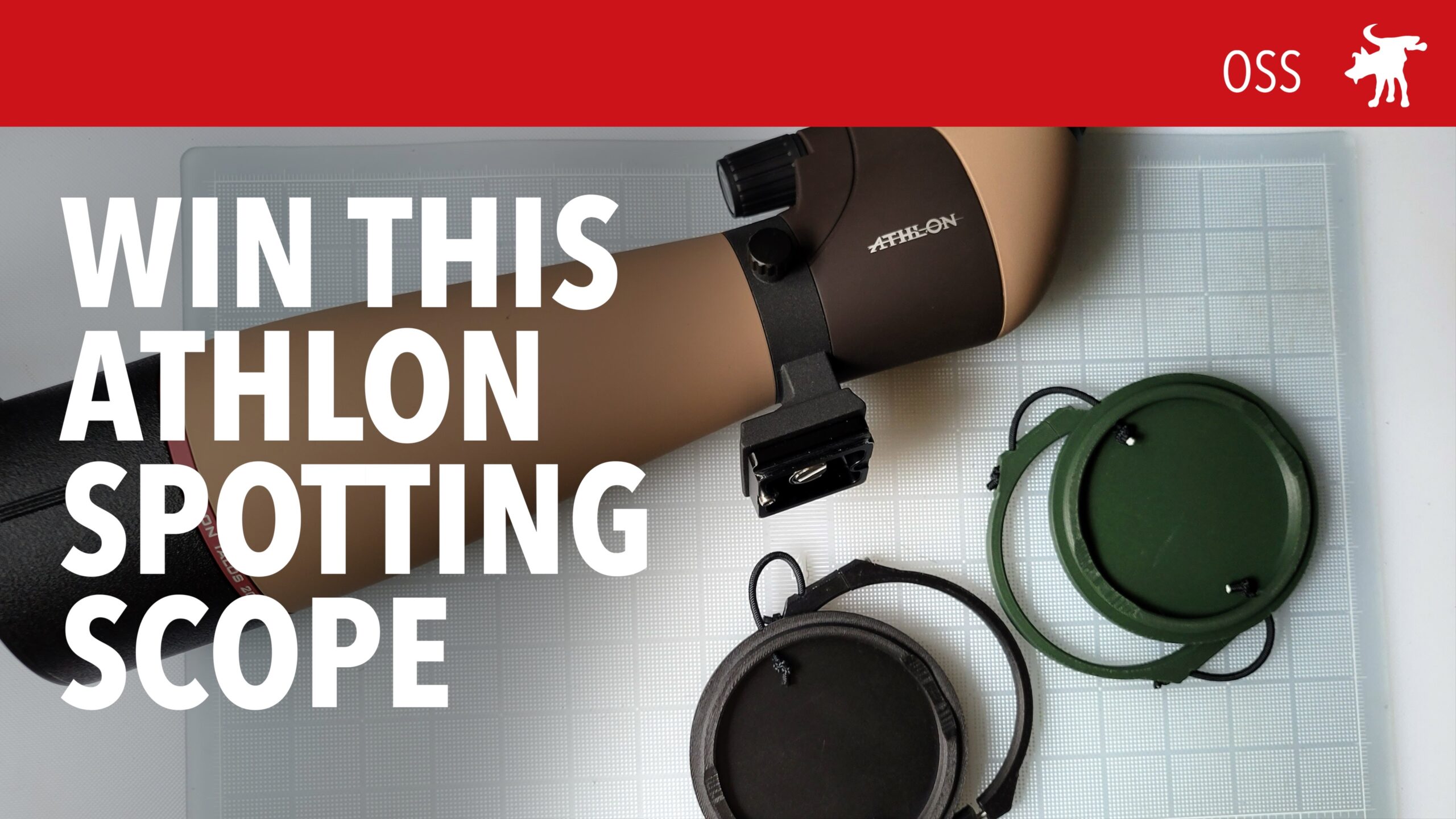
At 17oz, the Panzer is relatively light for 30mm tube LPVO. It has a large ocular lens which gives it a nearly unobstructed field of view. Unfortunately, like many 1-10x LPVO’s it has a tight and unforgiving eyebox, even at 1x. It has a decent eye-relief if about 4″.

At 1x the image through the glass had a mild warm tint but no notable fish-eyeing. At 10x there is a softening at the the edges and loss of light and contrast. But its resolution is surprisingly sharp (as with other Monstrum LPVOs). Continued improvement in Chinese glass manufacturing have greatly improved budget glass.

The scope features their new CM2 reticle which is optimized for long range shooting at 10x. At 1x it appears as a simple “T” reticle but at 10x the central dot enlarges to become a circle-dot and with a finer long range reticle with MOA subtensions, wind holdovers, and a range estimation ladder at the base of the ‘T’. The 10x reticle lilnes isn’t as fine as higher end etches scopes like the Riton Tactix or Vortex Razor. The center dot is 1 MOA but this may still be too large obscure long range targets.

Like many other FFP LPVO reticles, the CM2 isn’t as useful a reticle at both extremes of its magnification range. The 1x configuration of the reticle is a tad too thin unlike more graphic SFP tactical reticles. The CM2 reticle appears very similar to the Vortex Razor but lacks the Razors brighter illumination (and the Razor’s $2500 retail price).

The Panzer offers red and green illumination with an intensity range from 1-5. Oddly, unlike their other LPVO’s, the red appears more visible than the green at 1x. In fairness, the Panzer illumination brightness is typical of most LPVOs; not daylight bright but visible in low-light or CQB.

Its overall clarity and sharpness is pretty good but no in the same league as premium 1-10x offered by Vortex, Athlon, or EoTech. But it is perhaps one of the best scopes in its price tier and punches well above its weight. With a price tag just under $200 the Panzer offers features and optical clarity found in LPVOs that cost 2 to 3 times more (certainly better glass than the SIG Tango I recently reviewed). It comes with Monstrum’s Lifetime warranty on workmanship (but not damage). It remains to be seen if the Panzer lives up to its tank-like name in terms of durability.

This LPVO is available on Amazon through this Affiliate link which helps support my channel: https://amzn.to/3REH6yF

RESOLUTION

@50yrds: Element 3 / Group: -1

SPECS

Reticle: CM2
Lens Coating: Full Multi-Layer
Materials: 6061 Aircraft Grade Aluminum
Magnification: 1-10x
Objective Diameter: 24 mm
Rail Mount Torque: 20-25 in/lbs
Scope Ring Torque: 18 in/lbs
Tube Diameter: 30 mm
Max Windage Adjustment: ±70 MOA
Max Elevation Adjustment: ±70 MOA
Click Adjustment: 1/2 MOA
Eye Relief: 4.0-4.5 in
Weight: 17 oz
Length: 11 in

DIY Polarizer Filter for Security Cam

I have USB powered WiFi security cams around the house, including one on my second floor overlooking the street. It’s an 80 year old home so it doesn’t have outdoor power outlets and I didn’t want to drill a hole in the walls to snake a USB cable through to power an external outdoor cam. Instead, I mounted my Wyze cam indoors in my window.

Unfortunately my window mounted cam gets a lot of glare and unwanted reflections. Taking an idea from the world of photography, I wondered if I could somehow attach a polarizing filter to the cam. Polarizer filters restrict the angle of light that enters a lens. This reduces the overall amount of light entering a camera but it also significantly reduces glare and reflections in a photo or footage.

Polarizing filter sheets are available from most photo and camera stores (though there are fewer and fewer of those). I purchased a pack of polarizing filter sheets from the Photography section on Amazon. These are thin square sheets of plastic film that appear tinted.

By placing this film at 90º or 45º to the axis of your camera, you can reduce perceived glare and reflections. Some experimenting is required to get the best results. I cut off a piece of filter just large enough to cover my cam lens then taped it down.

One re-mounted, I found that the film did not entirely remove all of the reflections but it reduced it noticeably. Furthermore shadow areas in the scene were enhanced and the overall scene had greater contrast and detail. The only downside is that it reduces night/low-light performance slightly with more blurs and digitizing of night footage. I think the trade-off is worth it. This 5-minute DIY hack works on any home security cam and also works on car dash cams.

10-PACK POLARISING SHEETS vailable on Amazon through this affiliate link: https://amzn.to/46eRe6i

Warriorland Crossbow MA1 Weaponlight

Warriorland makes affordable Kydex holsters from a wide variety of pistols. Now, they’ve also come out with their own line of compact weaponlights and pistol lasers. Recently they released the Crosswbow MA1, a weaponlight laser that incorporates an LED display. As part of the launch, they are releasing the MA1 in a special bundle package that includes a Glock 17/19 IWB holster. Warriorland sent me a sample and I am among the first to test and review it.

Lets start with the Crossbow MA1 which is well constructe. It comes pre-installed with a Glock rail adapter and 5 additional “rail key” adapters for common pistols made by Springfield, S&W, CZ, Walther, Beretta and SIG; along with a universal 1913-Picatinny rail adapter. The MA1 is sized to perfectly fit the space in front of a Glock 19 handguard and be nearly flush with the front of the receiver and slide.

The MA1 has an internal battery and comes with a magnetic 2-pin USB charging cable. The built-in LED disply shows a diagram of the current battery charge and the lumen output when turned on. Below the unit, is an analog switch allowing the unit to function in laser only, light only, and combined modes.

The MA1 is activated using either of the two tabs on rear of the unit. These tabs extend slightly over the front of the Glock’s trigger guard to be easily reachable by either hand. A single tap turns the unit on. A constant press activates momentary on. Pressing both tabs simultaneously puts the unit on “candle light” low output mode.

A double tap activates the Strobe mode. This control scheme is problematic because under stress, a user my easily accidentally double tap their switch causing unwanted Strobe activation. Unfortunately,. Warriorland did not build a means to lock-out the strobe function. For some this is a hard-pass. Personally I’m not a fan of the MA1’s control scheme. They should have copied OLight’s control scheme and only activated the strobe by pressing both tabs simultaneously.

On a positive note, when activated the MA1 ouputs more than the manufacturer stated 800 lumens. In my tests, I got over 1000 lumens on high output mode. Moreover, in my run time tests, the unit stayed on in high mode for 62 minutes.

For anyone who’s bought a new weaponlight for their pistol, finding an affordable holster that fits can be challenging and frustrating. The appeal of this bundle is that it includes a nicely designed holster. The Kydex plastic holster fit my Glock 19 with the MA1 mounted perfectly.

The main downside is that the Combo bundle (as of now) only comes holster for the Glock 17/19. Furthermore, the holster is an Inside-the-waistband (IWB) style for right handers. It is not designed to relocate the clip for left handers or mounting on a belt for open-carry.

Given that the Glock 17 and 19 are probably the most common pistol found in North America, this MA1 weaponlight and holster bundle will probably be ideal for many.

Just in time for Christmas, Warriorland is offering the MA1 weaponlight and holster bundled together for the price of the weaponlight alone. They supplied me with this coupon code on Amazon so that my viewers can get 10% off. Moondog10. I don’t know how long this bundle will last at this price so get it while you can. Use my Amazon Affiliate link, which supports my channel. https://amzn.to/48vBA8d

SPECS

OUTPUT:1,000 lumens (high)

RUNTIME: 1 hour (high)

PEAK INTENSITY: 47,000 candela

BEAM DISTANCE: 137m

MODES: High, Candlelight, Strobe

LASER COLOR: Green

CONSTRUCTION: Aluminum

WEIGHT: 3.13oz / 89g

WATER PROTECTION: IPX4

Sig Tango MSR 1-10×28

The Sig Sauer Tango MSR is one of the new breed 1-10x LPVOs. These scopes blur the lines between an LPVO and what many used to consider “high power” scopes of previous decades. At 10x the Tango actually has a higher magnification than standard issue US military Sniper Rifle optics (granted those scopes have clearer and brighter glass).

The Tango is nicely designed with great care evident in the build and construction. The contact surfaces on its controls are well textured for a firm grip. It features capped turrets that are resettable, though I found the numbers and scale on the dial a bit hard to read precisely from a shooting position. The turrets were loud but not particularly tactile positive.

The magnification ring has a removable throw lever but the design of the grooves and knurling seem to be sufficient to turn the ring without it. The kit comes with an very well designed 34mm offset mount. Sig thoughtfully printed a reference line on the front tube to help the user align the scope to the mount rings.

At low power the scope is truly 1x with no fish-eye distortion. At high power the scope does suffer from drop in brightness and noticeable chromatic aberrations. It typical LPVO distances under 300yrds on man-sized targets will be clear and recognizable despite this.

The MSR reticle looks like a hybrid between an ACSS style horse shoe and a traditional German style T-reticle. It features dots and arrows design to help the shooter lead a moving target. The TANGE features 11 levels of brightness on the horse shoe reticle but it is not noon day sunlight bright.

This scope has a Second Focal Plane (SFP) reticle; the majority of 1-10x LPVOs are First Focal Plane (FFP). A FFP is preferable in long range shooting but on an LPVO with a scale change of 1000% can often make for thin, hard to see center dots at 1x. Because of that, I tend to prefer the simplicity SFP reticles in an LPVO. Testing the scope running multiple target engagement drills at 25yrds, I found it easy to aim and center on my target.

While the TANGO is not the sharpest or brightest glass I’ve seen in a ≥$500 scope, its features, design, and construction certainly makes it feel worth the price.

ONLINE RETAILERS

Commission affiliate links

Amazon https://amzn.to/3ZZhRe8

Optics Planet https://shrsl.com/49qvf

RESOLUTION (50yrds)

GROUP: -1
ELEMENT: 1

SPECS

Manufacturer:SIG SAUER
Objective Lens Diameter:28 mm
Magnification:1 – 10 x
Tube Diameter:34 mm
Reticle Focal Plane:Second Focal Plane (SFP)
Exit Pupil:2.8 – 9 mm
Illumination Color:Red
Finish:Hardcoat Anodized
Field of View, Linear:10 – 110 ft at 100 yds
Eye Relief:3.22 – 3.54 in
Diopter Adjustment Range:-2.5 – 2.5 dpt
Weight:20.4 oz
Adjustment Click Value:0.5 MOA
Adjustment Type:MOA
Parallax:100 yds
Illumination Type:LED
Battery Type:Lithium Metal, CR2032
Lens Material:Glass
Optical Coating:Spectracoat
Brightness Settings:11
Weather Resistance:Yes
Water Resistance Level:IPX-7
Shockproof:Yes
Fogproof:Yes
Battery Quantity:1
Magnification Type:Variable
W/E Travel at 100 Yds:100 MOA

Riton 5 Conquer 5-25×56

Conquer is Riton’s flagship long range rifle scope line with the 5 denoting this models magnification factor. This is the first Conquer scope Riton has sent me to test. I was eager to try one out since first seeing the newly redesigned line at SHOT Show 2023. All of their scopes now feature a unique twisted grove patter inspired by the rifle twist in the barrel of a firearm. This is not only stylish but the pattern provides an aggressive contact texture on their rings, knobs and turrets.   

Looking through the scope, the image was clear and sharp with a warm tone bias. My camera saw chromatic aberration looking through the glass at 25x at 100yrds. Despite this, I was clearly able to make out .22LR bullet holes on paper; even the wrinkles on the paper target. Using the USAF-51 chart, its resolution was as good as any 25x scope I’ve tested.

This scope has a fairly unforgiving eye box. At 25x it has a fairly small exit pupal of 1.6mm. Tight eye boxes is a common experience I’ve had with Riton scopes. This is also a common complaint of most high power scopes under $1000 (the Arken EP5 is an example of that). The 5 Conquer has an MSRP of $959, which for the average rifle owner isn’t cheap. But comparing it to the Leupold Mk5 which has a similar resolution performance, this scope is a value.

I can’t speak to the long term durability of this scope, since I’ve only put it through  a couple of mags of .22LR and 5.56. It has so far held zero. Riton’s customer service is responsive and their optics have a transferable Lifetime warranty. The same can’t be said of more expensive European brands.

This scope is available on Amazon. This affiliate link helps support my channel https://amzn.to/46R6rLq

RESOLUTION

Group: -1
Element: 6

MANUFACTURER SPECS

Magnification:5-25
Parallax Adjustment:20-infinity
Tube Diameter:34mm
Objective Lens Diameter:56mm
Focal Lens Position:First Focal Plane
Lens Coating:Fully Multi-Coated, Full Wide Band, Waterproof Coated, Low Light Enhancement
Reticle:PSR (MRAD), MOR (MOA), Illuminated
Field of View at 100 yds:27ft-3.4ft
Material:6061-T6
Eye Relief:3.5in/90mm
Exit Pupil:Low 7mm – High 1.6mm
Click Value at 100 yds/m:1/10TH MRAD, 1/4 MOA
Adjustment Range:31 MRAD, 107 MOA
Mounting Length:7.37in/187mm
Length:15in/381mm
Weight:2.3lbs/37oz
Included Items:Flip Up Lens Covers, Lens Cloth, Allen Wrench